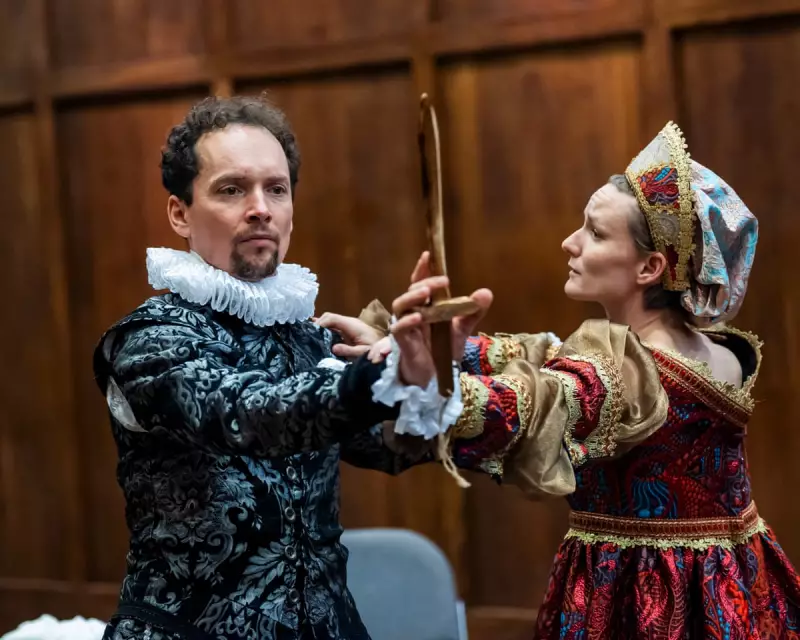
A new stage production opening in London next week confronts one of classical music's most enduring and disturbing paradoxes: the sublime art of a murderer. Death of Gesualdo, a piece of music theatre, will premiere at St Martin-in-the-Fields as part of the iconic church's 300th-anniversary celebrations.
The Atrocity and the Art
The work focuses on the life of Carlo Gesualdo, Prince of Venosa, a late Renaissance composer renowned for his darkly expressive and harmonically adventurous madrigals and sacred music. Yet, his artistic legacy is forever shadowed by a single, horrific act. In 1590, upon discovering his wife, Maria d'Avalos, in bed with her lover, the Duke of Andria, Gesualdo savagely murdered them both.
The premeditated killing was a grisly spectacle, with the mutilated bodies publicly displayed on the steps of his palazzo for days. While this act of 'honour' killing was legally permissible for a prince of his stature, it cast a permanent pall over his name. His subsequent life was one of increasing isolation and torment, marked by reports of ritualistic beatings and a descent into a gothic psychosis, haunted by fears of revenge from the victims' families.

Confronting a Dark Legacy on Stage
The production's writer and director, Bill Barclay, admits to initial surprise at being commissioned by St Martin-in-the-Fields to create a work about such a repugnant figure. The piece features the acclaimed vocal ensemble The Gesualdo Six, who took their name from the composer. Barclay's approach involves mapping the composer's tortured, dissonant harmonies onto the painful episodes of his life, creating a direct link between his musical innovations and his psychological unraveling.
This forces a central, modern question: in an age where an artist's biography is instantly accessible and often overshadows their work, how do we engage with art created by morally flawed individuals? Gesualdo's music—pieces like Moro, lasso, al mio duolo (I die, alas, in my suffering)—seems to audibly document his inner turmoil, making the separation of art and artist particularly challenging.
A Modern Dilemma in a Historical Case
Barclay argues that Gesualdo presents a valuable case study for contemporary audiences. Living centuries before modern celebrity culture and the internet, the composer nonetheless existed in a relentless glare of gossip due to his nobility, wealth, and artistic prominence. His crime was a public scandal, yet he evaded punishment and even formed a strategic second marriage with Eleonora d'Este of the prestigious Court of Ferrara.
The director draws parallels with modern debates, questioning whether it is right to 'cancel' the work of Wagner, Picasso, or J.K. Rowling due to the creators' personal failings or views. "Erasing art is the wrong lesson from the 2020s," Barclay states. He suggests the responsibility is dual: artists must realise their work can become contaminated by their reputation, while audiences must avoid the voyeuristic temptation to excessively 'double-click' on an artist's personal suffering.
Ultimately, Barclay posits that great art serves as a mirror rather than a window. A staging of Hamlet reveals more about the audience than about Shakespeare. Similarly, Death of Gesualdo may reveal little about the composer himself. Its success, Barclay hopes, will lie in what it reveals about those who witness it. The production runs at St Martin-in-the-Fields in London on 16-17 January, before travelling to York and New York.