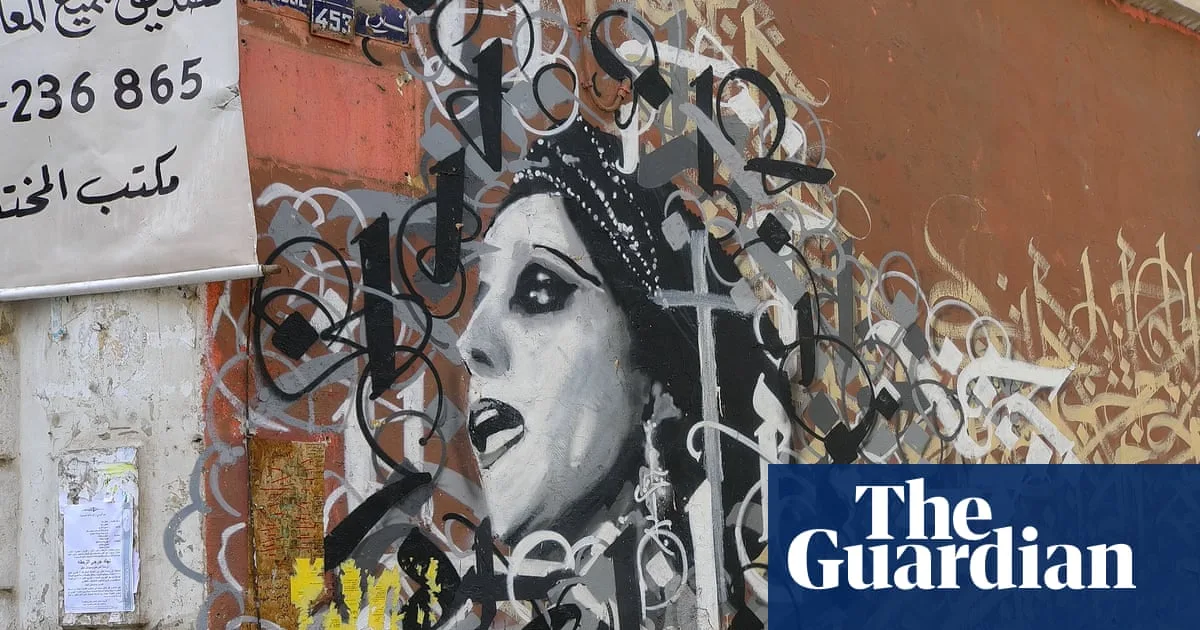
When Leila Milki first heard Fairuz's 'Bahebak Ya Lebnan', she experienced it as the song of Lebanese unity and resilience. Milki, a Lebanese-American singer-songwriter based in Los Angeles, has built part of her career on covering the catalogue of Fairuz, the 91-year-old singer who has become a rare generation-uniting public figure in Lebanon. 'I knew that, in terms of my parents' generation and even my grandparents' generation, the song was sort of this really cathartic, hopeful message of unity,' she says.
The old adage is that Lebanon and its people remain resilient in the face of tragedy, able to rebuild and be born again into a stronger, more stable nation. That was the message Fairuz conveyed with 'Bahebak Ya Lebnan', a song released 50 years ago that has since become the country's de facto national anthem. 'I love you Lebanon, my homeland, I love you / Your north, your south, your plains / I absolutely adore,' Fairuz sings in Arabic. When she released the song in 1976, it came against the backdrop of the early stages of a 15-year civil war that resulted in the deaths of roughly 150,000 people, the mass exodus of nearly 1 million people and foreign occupation by Syria and Israel.
In the decades since its release, 'Bahebak Ya Lebnan' has repeatedly resurged to inspire hope and national pride: during multiple conflicts with Israel, the Covid-19 pandemic, internal sectarian strife, the financial collapse since 2019 and the 2020 explosion in the Port of Beirut. The song has become synonymous with tragedy, meaning many Lebanese now turn to it with mixed feelings, especially as the current US-Israeli war against Iran and the forced displacement of more than a million people in Lebanon by Israel mean that Fairuz's anthem is once again serving as the soundtrack to the country's despair and hope.

'It's evolved into more of a lament,' says Milki. 'It feels like this moment of deep grief that truly captures the essence of what it feels like to be so exhausted, and to time and time again have to surrender to the rebirth narrative, knowing full well that nobody wants to be experiencing this.' For many younger Lebanese, the song offers a fantasy of a 'golden age' in the 1950s and 1960s, but for others that fantasy now feels hollow. 'I love the Lebanon I grew up in but it isn't always the Lebanon that Fairuz talks about in this song,' says Sleiman Damien, a Lebanese music producer based in Dubai.
Lara Atallah, a Brooklyn-based artist and writer whose parents live in Lebanon, cannot bring herself to listen to the song. 'I wish I could listen to it without feeling rattled,' she says. 'I do not actively listen to it or much of Fairuz's music as it's come to connote war, devastation and endless mourning, all caught in the net of her heartbreakingly beautiful voice.' Dr Nour El Rayes, an ethnomusicologist at Johns Hopkins University who grew up in Lebanon, notes that for older generations, the song captures the feeling of the 'golden age', but younger people may view it differently. 'I also think the kids are angry,' she adds. 'They inherited this world that's on fire. Many of them just don't believe there's a way out.'