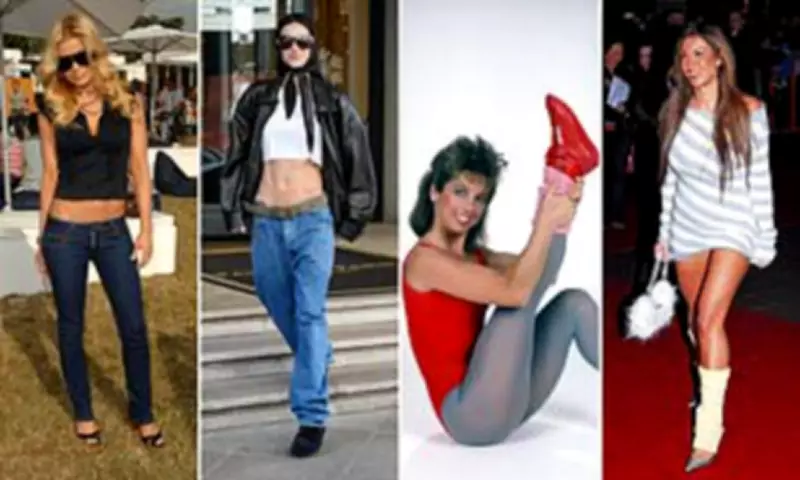
If you ask female millennials about the three words they dread, you will likely hear many of them say 'low-rise jeans'. However, these early-2000s staples are making a significant comeback, alongside classic items like baby tees, oversized belts, and even bandage dresses. Now, a groundbreaking study has revealed the scientific reason behind this phenomenon.
The 20-Year Fashion Cycle Explained
According to mathematicians from Northwestern University, fashion trends repeat themselves on a consistent 20-year cycle. For this study, the team meticulously analysed approximately 37,000 images of women's clothing spanning from 1869 to the present day. Their results clearly demonstrate how styles rise in popularity, fall out of favour, and then experience a revival roughly every two decades.
'Over time, this constant push to be different from the recent past causes styles to swing back and forth,' explained Professor Daniela Abras, co-author of the study. 'The system intrinsically wants to oscillate, and we see those cycles in the data.' This '20-year rule' has long been cited by fashion insiders, but now it has empirical support.

Historical Examples of the Cycle
The research highlights specific examples that illustrate this pattern. In both 1985 and 2005, denim jackets, high-waisted jeans, and leg warmers were at the height of women's fashion. Similarly, band T-shirts, choker necklaces, and Doc Martens were must-have items in 1990 and 2010. More recently, low-rise jeans, baby tees, oversized belts, and bandage dresses have seen a resurgence, having originally been popular back in 2006.
'To our knowledge, this is the first time that someone developed such an extensive and precise database of fashion measures across more than a century,' said co-author Emma Zajdela. The team used custom tools to measure key features like hemline, neckline, and waistline positions in the 37,000 images, revealing a 'striking pattern' of cyclical trends.
Evolution and Fragmentation in Modern Fashion
While fashion trends evolve gradually over time, the popularity of styles follows a two-decade cycle. One of the clearest patterns involves the length of dress hemlines. For instance, in the 1920s, flapper dresses with short hemlines rose to prominence. By the 1950s, more conservative styles took over, before miniskirts returned in the late 1960s.
However, the researchers note that this pattern has lost some clarity in recent decades. From the 1980s onward, the data showed a wider range of skirt lengths appearing simultaneously, suggesting trends are becoming more fragmented. 'In the past, there were two options – short dresses and long dresses,' Ms Zajdela explained. 'In more recent years, there are more options: really short dresses, floor-length dresses, and midi dresses. There is an increase in variance over time and less conformity.'
Predicting Future Fashion Trends
So, what does this mean for women's trends in the future? By applying the 20-year cycle, we can predict the retro fashions that might soon make a comeback. For example, in the year 2030, we could see a return to jeggings, leather jackets, and peplum tops. Looking further ahead, the year 2040 might be defined by puff sleeves and tracksuits, continuing the cyclical nature of style evolution.
This study not only validates long-held beliefs in the fashion industry but also provides a mathematical framework for understanding how cultural preferences shift over time. As low-rise jeans and other Y2K trends regain popularity, it is clear that fashion's past is always poised to become its future.