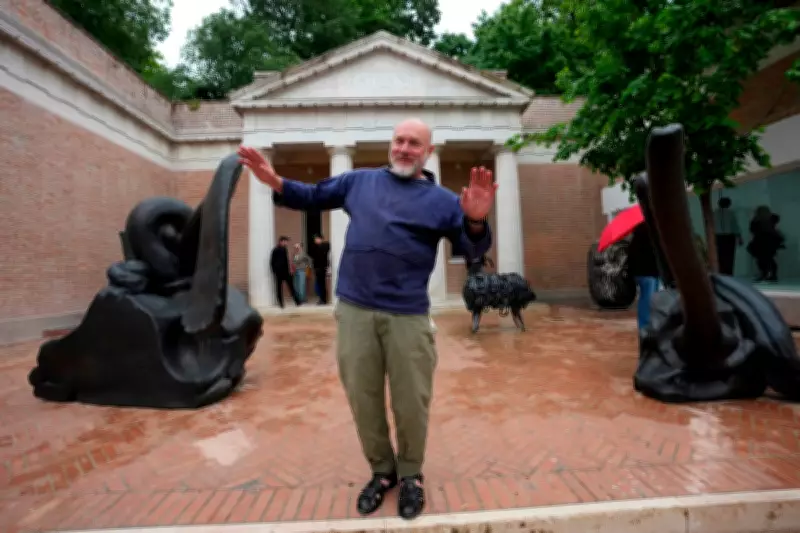
An outsider artist is taking the world's biggest stage with the US Pavilion at the Venice Biennale. U.S. artist Alma Allen had just months to prepare his exhibition after a fraught selection process came down to the wire. The self-taught sculptor from Utah, who works in Mexico, is keenly aware of his place as an outsider within the cliquey art world and is bracing for critical scrutiny as he steps onto one of contemporary art's most prestigious platforms.
Selection Process Controversy
A selection process described as "opaque" has cast a shadow over the opening. Institutions that typically vie for the coveted Biennale commission shied away, apparently concerned about administration politics after the open call removed language focusing on diversity, equity, and inclusion, replacing it with requirements to promote "American values." In a seemingly ironic move, Allen created a bronze evil eye to hang on the exterior of the brick, Jeffersonian-style US Pavilion to ward off bad vibes, he joked. It is one of a dozen new pieces he made for an exhibition that will likely be a defining moment in his 30-year career. Just days before the Biennale's opening on Saturday, the evil eye had still not arrived.
Allen's Perspective
"This is really the first circumstance in my life as an artist where I felt the need to defend myself, or my work," Allen told The Associated Press during a walk-through of the pavilion this week. He acknowledged that living outside the critical eye for the last three decades "has been actually a pleasure." The outsider artist makes biomorphic sculptures in wood, stone, and bronze, and is reluctant to name them, giving viewers "a moment of creation when they can decide what it is."

The Biennale exhibition, titled "Call Me the Breeze," includes works he made over the last 20 years, interspersed with new work. Allen said he chose the title to reflect his ability to get around obstacles. "And that's been my necessity and it's also because of being self-taught and not having any institutional support very often in life," he said. The pavilion's commissioner, Jeffrey Uslip, said Allen's institutional independence was part of the appeal. "I am deeply interested and invested in artists who are not, I guess, academicized … or lobotomized," he said.
Lost and Found Commission
A prior proposal for artist Robert Lazzarini to stage the show, curated by art historian John Ravenal, fell apart in September despite having secured US State Department approval, after the project's required institutional sponsor backed out, Ravenal told AP. A US State Department attempt to link the Lazzarini project to the newly formed American Arts Conservancy failed, and a short time later the new project with the AAC as sponsor, Uslip as curator, and Allen as artist was announced. Uslip declined to discuss the selection process. Ravenal called the process highly unusual, with no apparent committee vetting or application process, noting that the application deadline had expired in July. "It's really a loss of a 40-year history of open call and peer review," Ravenal told AP by telephone, describing Allen as "a pawn in this whole thing."
Allen is aware his willingness to mount the show has been a source of some backlash. But he insists that the Trump administration has not interfered with the show in any way. "My art is not propaganda," he said.
Wrong Sheep, Right Moment
In the pavilion's courtyard, a headless, and thus directionless, sheep stands as a self-portrait of Allen as an outsider. He described it as "a bit shunned because it's the wrong sheep." His most recent work includes bronze wall sculptures that he treats with chemicals in a form of painting, treating the hard metal "as an instantaneous material, like watercolor," he said. Allen's journey to the Biennale included a period of homelessness in New York City when he sold his creations from atop an ironing board, a move of admitted desperation that soft-launched his artistic career, establishing his first collectors.

The Los Angeles County Museum of Art and the Palm Springs Art Museum own pieces of Allen's work, and he participated in the 2014 Whitney Biennial. He made his European debut in Brussels in 2022. After getting the Biennale commission, he made his first trip ever to Venice in November to view the US Pavilion, a neoclassic brick building built around a courtyard and rotunda. A painting by Hieronymus Bosch titled "The Visions of Hereafter" at Venice's Accademia depicting heaven, hell, and purgatory inspired the show's organizing principle. "I wanted there to be a bit of the chaos that we go through," he said. Beyond his body of work, Allen attributes his selection to the fact that "I'm just ready to do things at the last minute" and accept challenges as they come. "When they do, I'm prepared to try it, and fail at it. That's fine," he said.