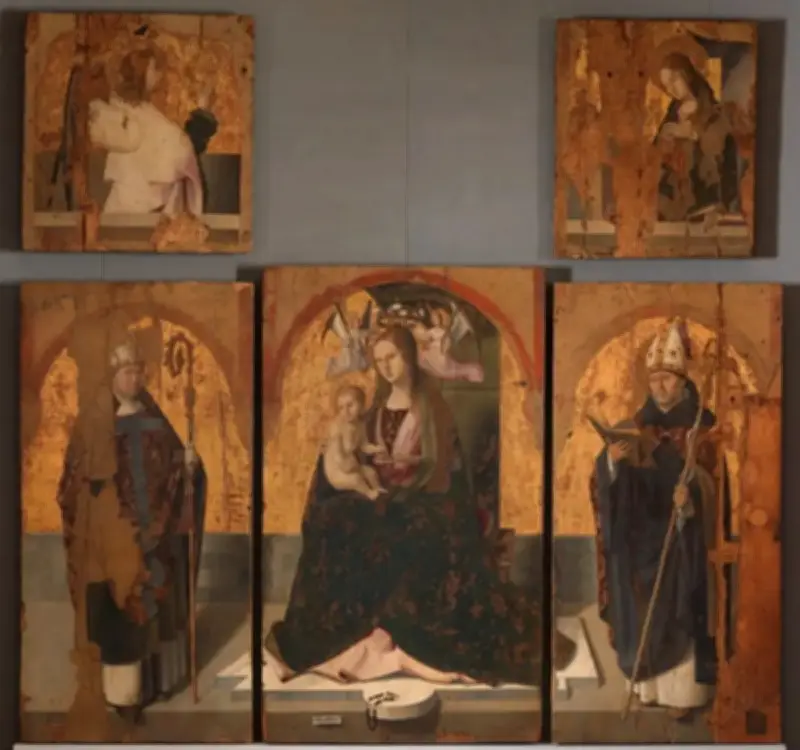
Four of the most important works by the 15th-century Renaissance master Antonello da Messina were stolen from the Regional Museum of Messina (MuMe) in Sicily during a national holiday. The theft occurred on Saturday evening, possibly capitalising on attention focused on La Vara, a large religious festival held on 15 August, when Italy marks the Ferragosto holiday.
Theft and Stolen Works
Thieves bypassed the alarm systems and broke into a security display box, taking four wood panels painted by Antonello. Three of the panels were part of the Polittico di San Gregorio, an altarpiece originally composed of six panels created for the Monastero di San Gregorio, which was destroyed in the 1908 Messina earthquake. The altarpiece was the only work by the Sicilian painter never to have left his home city.
A fourth, smaller work was also taken: a double-sided painting depicting the Virgin and Child with a Franciscan monk on one side and Christ on the other. This painting had belonged to the Wilhelm Soldan collection and was sold by Christie's to the Sicilian regional government in 2003, the year it was attributed to Antonello.

Reaction and Impact
Marisa Mercurio, the museum's director, said: "It is an extremely serious and significant loss. They have stolen works of enormous cultural, artistic and symbolic importance, not only for Messina but for Sicily as a whole. All we can do now is hope they are recovered as soon as possible."
Art historian Valentina Certo, affiliated with the University of Messina and author of the children's book The Workshop of Antonello da Messina, noted Antonello's role in bringing Flemish oil-painting techniques to Italy. "Even on very small panels, he was capable of extraordinary precision and detail," she said. Certo added: "The overnight theft is a wound inflicted on the historical memory and cultural identity of the city of Messina. These were works that had survived the earthquake, destruction and five centuries of history. To see them taken from the public in this way makes the loss impossible to measure in purely economic terms."
Investigation and Context
Prosecutors in Messina have opened an investigation. Police sources said the museum had several surveillance cameras and a sophisticated alarm system. Investigators are examining several lines of inquiry, including whether the paintings were stolen for the illicit art market. According to state news agency Ansa, they are also considering the possibility that the theft was carried out on commission for an art dealer.
The theft came after Italian police on Friday recovered three paintings by Paul Cézanne, Pierre-Auguste Renoir and Henri Matisse that were stolen earlier this year from a private museum near Parma.