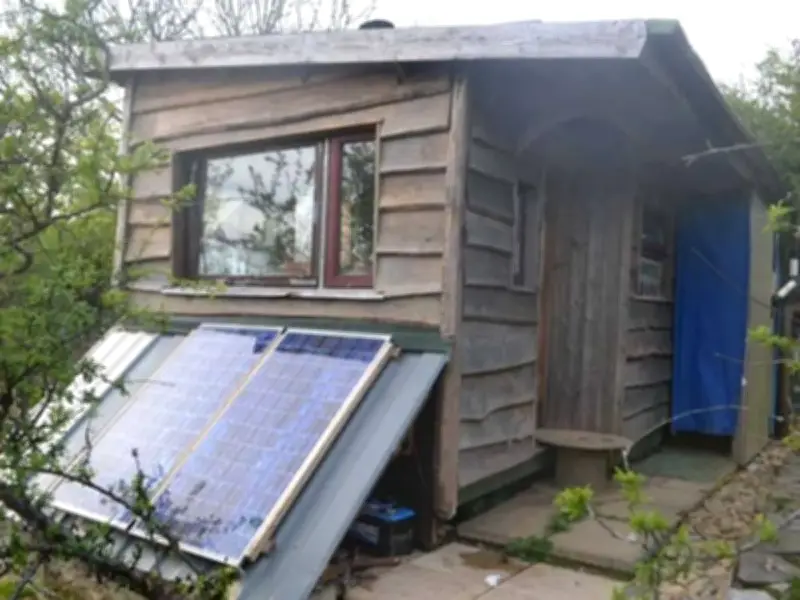
A man who has lived in an off-grid hut in the Welsh countryside without permission for years can stay because the council doesn't have the power to evict him. Geoffrey Finnimore, a self-employed architectural designer, built his hut at Tir Y Gafel, Coed Troednoeth, near Glandwr in Pembrokeshire, by hand and began living there in 2020.
After realising Mr Finnimore had been living in the hut even though he'd never notified the authorities or asked for permission, Pembrokeshire county council told him he must apply for retrospective permission in the form of a certificate of lawful development.
Certificate of lawful development granted
A certificate of lawful development is a document which can establish that a development can't be subject to enforcement action if the applicant demonstrates it has been inhabited by them for the necessary timeframe. Mr Finnimore applied to the council to establish that the property, which he built without official consent, had been lived in by him with no-one raising any concerns for four years.
Mr Finnimore has previously been contracted to assist in the roof construction of outdoor learning spaces in three different primary schools around Haverfordwest and holds 4.5 acres of land at the site. He has also been the principal custodian of the land since the previous owner left the property in 2018 and subsequently offered it for sale to him, but had previously lived at Coed Troednoeth since 2014 in his campervan alongside a lean-to structure.
History of the dwelling
A supporting statement written on behalf of Mr Finnimore reads: "This accommodation proved less than adequate for Mr Finnimore's health and wellbeing and the requirement for improved accommodation became obvious. In 2019 he began to develop the lean-to structure into an independent dwelling.
"In June 2020 the land was purchased by Mr Finnimore and in November 2020 he began using the building as his principal dwelling, hence the justification to apply for a certificate of lawful use."
Mr Finnimore said he had lived at Coed Troednoeth, formerly part of Berllan Dawel in Tir y Gafel, for more than 10 years. He said he earns less than £10,000 a year as a self-employed worker and provided evidence of his long-term residency.
Impact of the decision
"This application has been sought by the council, and I have had to comply out of a position of vulnerability with respect to the prospect of enforcement against a building and living situation that has been demonstrated to be well-established and that I hold is deemed lawful," he said.
"In the context of a housing and a cost-of-living crisis I have taken care of my own needs. So far as the council's responsibilities in that context goes, I see that as one less problem to solve. Conversely, I would consider a rejection of a well justified application like this as a contribution that exacerbates these deep and present social concerns.
"Without my home - which I created to solve my own problems without state assistance - having to pay for other accommodation would be catastrophic for my finances and wellbeing."
The off-grid home needs no external services. Its heating, electricity and water are provided or produced on site, said Mr Finnimore.
Officers granted the certificate because they found, on the balance of probabilities, that Coed Troednoeth had existed and been occupied as a home for more than four years before the application, making it immune from enforcement action.