Robin Bernstein's debut publication 'Mapalakata' takes readers to the edge of the South African frontier, weaving a visual narrative inspired by folk tales and historical artefacts. The title, meaning 'visitors' in Bapedi, originates from oral histories describing traders from the east who traversed southern Africa before European colonisation.
The Setting: Mpumalanga's Escarpment
The work is situated in Mpumalanga province, South Africa, on the escarpment bordering Mozambique and Eswatini. This geophysical symbol of the frontier's edge features lush cliffs abruptly piercing the hot, red earth of the lowlands—a collision point that has inspired countless folk tales and marks the beginnings of the modern-day gold story in the country.
Today, plantations of non-native trees blanket the landscape while mills churn steam as they pulp pine into paper. In the valleys below, gold mines that have been chiming steel against rock for the past one hundred years ring their ceaseless chorus. The surrounding terrain is littered with relics of another time—the remnants of a forgotten precolonial society.
Themes of Transience and Erasure
'Mapalakata' examines the transient nature of 'visitors' to the landscape, highlighting how the region's history is continually rewritten as different groups attempt to erase the narratives of their predecessors, each driven to occupy the space for its resources. This process leaves an archive of physical artefacts scattered across the landscape, becoming ephemeral traces of the histories that have played out.
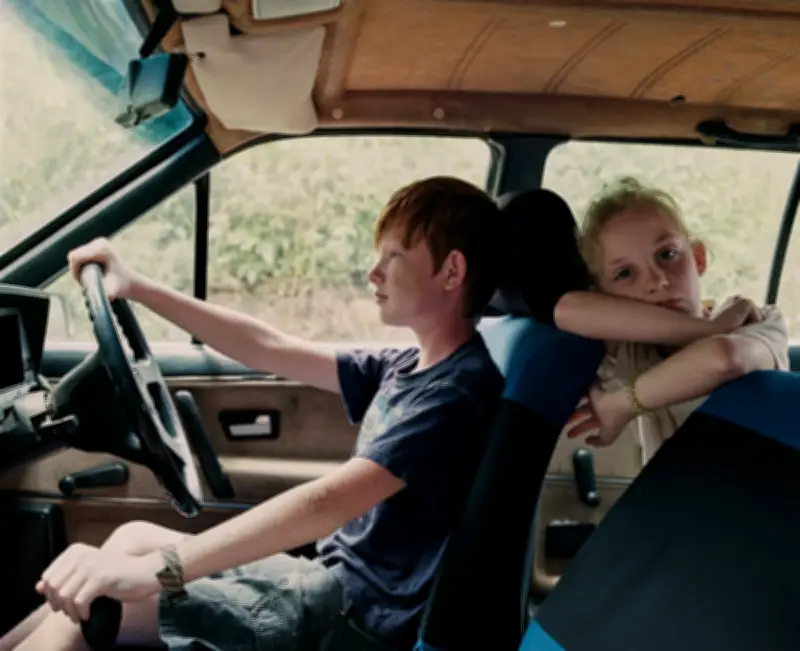
Through a photographic investigation of these remnants and the people who now inhabit these spaces, Bernstein aims to engage with the nuances of social conditions in South Africa and consider how place roots itself in the consciousness of those who inhabit it.
Key Photographs and Their Stories
One image, 'Wild Horse, 2019', was taken outside the small hamlet of Kaapsehoop. Bernstein notes: 'It was shot hand-held with a waist-level RZ finder. It was pretty tricky to get up close to the horses, but with some persistence and horse whispering, I managed to get a few frames. It's speculated that the wild horses of Kaapsehoop are descendants of horses abandoned after a failed gold rush in the region, two decades prior to the discovery of gold in Johannesburg—a formative event shaping South Africa's modern history.'
Another photograph, 'Marycate & Sibahle, 2025', depicts Marycate and her daughter Sibahle in the front room of her grandmother's home in the Emjindini location on the outskirts of Barberton. Bernstein explains: 'It was one of the first homes built in the location during the Group Areas Act of 1950, which enforced the creation of racially segregated neighbourhoods.'
Insights from the Region
Writer Desmond Latham reflects on the title's meaning: 'The name Mapalakata once meant traders. Men who came inland with cloth and beads, their packs heavy with salt and brass. They followed the flow of rivers, trading what they could carry for gold and hides and grain. The world they moved through was a web of bargains. Even now the region works with the same logic.'
Images such as 'Berlin Plantation, 2019' were made in the living room of a forestry fire officer's home in the South African Forestry Company-owned Berlin plantation, which sprawls between Mbombela and Kaapsehoop. Bernstein was invited in for tea, capturing a moment of everyday life amidst the industrial landscape.
Historical Layers: Asbestos and Mining
'Bulembu Asbestos Mine, 2025' shows asbestos samples in the Bulembu Museum. Bulembu sits just over the border of Eswatini in the Makhonjwa mountains and was once the starting point for the second longest cableway in the world, used to carry asbestos to Barberton. The asbestos mining industry saw an immediate termination in the early 2000s when the substance was banned globally. Bernstein notes: 'Bulembu is hard to get to and the museum doesn't see many visitors these days.'
Bernstein's practice examines the sociospatial intersections of land, history and globalisation. Working between London and Cape Town, his process is rooted in collaborative engagement, exploring the reciprocal relationship between individuals and their environments.
'Mapalakata' by Robin Bernstein is available from Gost.