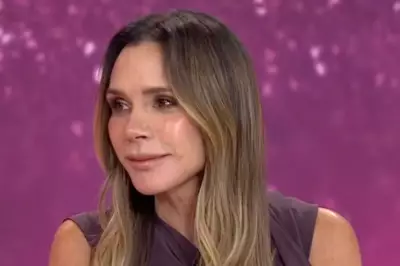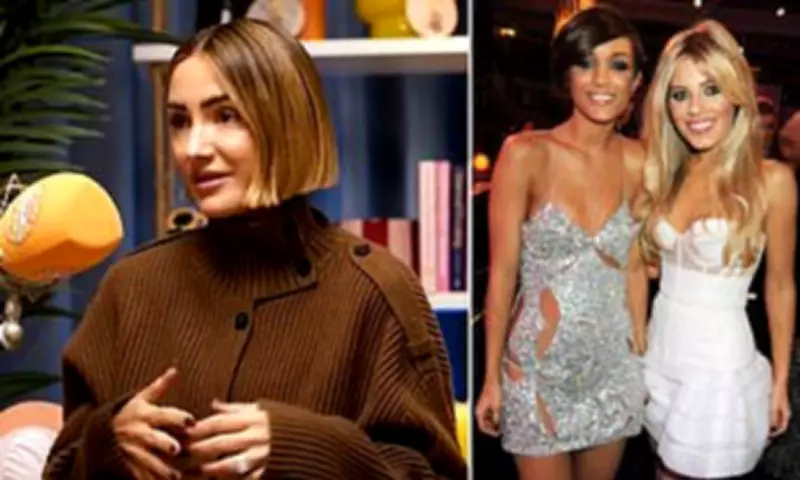
Frankie Bridge has candidly revealed how she developed a severe eating disorder during her time as a member of the chart-topping pop group The Saturdays, describing a period when she felt her life "wasn't her own." The 37-year-old singer, who was one fifth of the band alongside Mollie King, Rochelle Humes, Una Healy, and Vanessa White, struggled with both depression and disordered eating when the group was at the height of its fame.
The Struggle for Control
Speaking on the Daily Mail's The Life Of Bryony podcast, Frankie explained that food became something she could control during a time when she felt she had little autonomy in her life. "I had a real strict routine," she confessed. "I lived off drinks that would give me energy. If I was really hungry, I'd have a cereal bar or some chicken. I wouldn't touch a carb, ever."
She elaborated on the psychological drivers behind her behavior: "I think some of that was to do with how I looked, but it was mostly a control thing. I obviously felt the pressure to look a certain way, being in a girl band, but that came from me. It mainly came from, this is the only way I can take any control of my day to day life. Because my anxiety was so bad, I wasn't hungry either."

The Onset of Depression
Frankie's battle with depression began shortly after she joined The Saturdays at just 17 years old. "The depression started quite near the beginning of The Saturdays," she recalled. "When you first start in a band, you never stop working. Your life becomes not your own. I loved it, I have nothing bad to say about being in The Saturdays. You're just kind of waiting to be told everyday what it is you're doing, I never had to think for myself. I think it took its toll."
She described feeling a profound loss of control: "I think I felt a loss of control around my life and what was expected of me. I was going through a breakup quite publicly and I think it all just came to a head. Probably burnout, I had an eating disorder around that time."
A Breaking Point
The situation reached a critical point before a concert in Ireland when bandmate Mollie King discovered Frankie in a state of emotional collapse. "There was one show we did, I think it was in Ireland, and the minute we got to the hotel, I went in, shut all the lights off, closed the curtains and got straight into bed," Frankie remembered.
"I think it was Molly who came into my room and she'd never seen me like that before. I couldn't stop crying and was like, 'I can't do the show.' I managed to but like with her basically holding me up."
This incident led to medical intervention: "After that, my doctor, they all came to my house and they were like, 'you have to go to hospital.' It's the only way you'll get the time you need because of my job. I organised it all with my agent. It felt like I was keeping a dirty secret, that I was about to go into hospital. The girls didn't know, no one knew."
Support System
Frankie credited her now-husband Wayne Bridge, whom she had been dating for less than a year at the time, for being her "rock" during this difficult period. "Wayne took me into hospital. I was so ready to hand myself over," she said. "He was a real rock, he really tried to learn as much as he could by talking to my therapists. It was a tough time and he stuck it out."
Ketamine Therapy Revelation
During the extensive interview, Frankie also discussed her experience with ketamine therapy, which she described as "life-changing." Ketamine therapy uses low doses of the dissociative anesthetic to treat mental health conditions and chronic pain, often producing rapid improvement in depression symptoms.
"I got introduced to this new psychiatrist who does ketamine therapy," Frankie explained. "It was something me and my old therapist had started to talk about and I was just like you know I've got nothing to lose. I need to try something. I was terrified because I've never taken a drug in my life."
She described the profound effects of the treatment: "It has probably been one of the most effective treatments that I have had in all these years. It's about the process of while you're having it because it lowers all of your ego and it puts you into an out of body experience so you're dissociated. So things you've maybe pushed down, things you've never processed before, it gives your brain a chance to process them."

Treatment Accessibility Concerns
Despite its effectiveness for her, Frankie expressed concern about the accessibility of ketamine therapy: "It's amazing but at the minute it's really expensive and not that readily available. I think it's a real shame as it's been life changing for me. The treatment is about growing new neurons and also connecting them. It's a treatment that works while you're having it and continues to work afterwards."
Post-Band Career
Frankie also discussed her fashion business Faves, which emerged from her sharing clothing choices with followers on Instagram after leaving The Saturdays. "Fashion has always been a big part of what I do," she said. "I had two young kids and had come out of being in a girlband and people weren't telling me what to wear everyday. I was a bit lost. I didn't know what would fit my new body. It was kind of finding my style again."
She described the evolution of her business: "We turned it into Faves, took away the Frankie. We're about to do our third live event. It's all about creating a space for women to find like-minded people."
Throughout her candid discussion, Frankie Bridge offered a raw and honest look at the psychological pressures of fame, the complex relationship between control and eating disorders, and the ongoing journey toward mental health recovery.