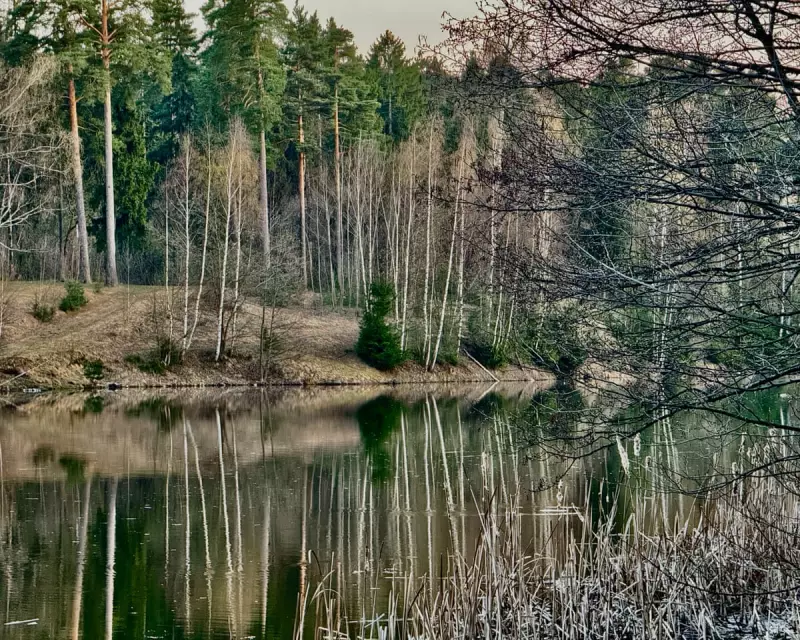
Russia's identity is deeply rooted in its soil, but perhaps more profoundly, in its forests. A new book by academic Sophie Pinkham, The Oak and the Larch: A Forest History of Russia and Its Empires, argues that the nation's sprawling woodlands are the key to understanding its historical and psychological landscape.
More Trees Than Stars: The Immensity of the Taiga
Pinkham begins with a staggering fact: Russia is home to roughly 642 billion trees. To put that in perspective, it outnumbers the estimated 200 billion stars in our Milky Way galaxy. This vast arboreal empire stretches from the Arctic tundra to the Pacific coast, forming an immense, often inhospitable barrier that has nonetheless provided riches in furs, minerals, and fish.
Pinkham, a Cornell University professor, charts how this formidable environment has left an indelible mark on the Russian psyche. The forest is a core symbol of national identity—the country itself is often represented by a bear—yet attitudes towards it have swung wildly through the centuries. Leaders from Peter the Great onwards have pursued conflicting strategies, leading to cycles of rampant deforestation and ambitious replanting, driven by goals from naval expansion to industrial mining.

A Battleground, Both Ideological and Literal
The Russian forest has never been a passive backdrop. Politically, it has served as a place of refuge for resistance and a symbol of self-sufficiency in ultranationalist rhetoric. More concretely, it has been a decisive military theatre. From the 13th-century Mongol invasions to the Second World War and the current conflict in Ukraine, knowledge of the woods has been crucial. Soviet partisans famously used the forest as their greatest ally, hiding within it to sabotage German supply lines and helping thousands of Jewish people find sanctuary.
The forest's influence permeates Russian culture. Pinkham provides a comprehensive survey, noting Alexander Pushkin's romantic visions, Leo Tolstoy's arboreal epiphanies in War and Peace, and Andrei Tarkovsky's spectral, divine trees on film. In the 19th century, the fight against deforestation became intertwined with the movement to emancipate the serfs.
Characters, Climate, and Resilience
The narrative is populated by vivid figures, from the tattooed environmental activist Andrei Khristoforov, who identified as a tree, to the Lykov family, a religious sect who lived undetected in the taiga for decades. Pinkham's prose shines in evocative descriptions of wildlife, where lynxes dance and wolf cubs nibble bark.
The looming climate crisis casts a long shadow, highlighted by a 2021 wildfire that burned an area twice the size of Ireland. Yet the forest demonstrates remarkable resilience, even rewilding the Chornobyl exclusion zone with bison, lynx, and bears. Pinkham suggests we may err in applying a human timeframe to an ecosystem where an oak can live over a millennium. As one activist poignantly remarks, urging patience in the face of transient political power: "Do you know how many Putins there have been in our time? Go into the woods, hide, don't stick your head out, and wait."
While the book's structure meanders like a forest path, sometimes dense with names, it builds a compelling case for the taiga as the essential prism through which to view Russia. It is a place of constant contradiction—offering both nourishment and danger, freedom and entrapment—and, as Pinkham masterfully shows, it remains central to the nation's past, present, and uncertain future.