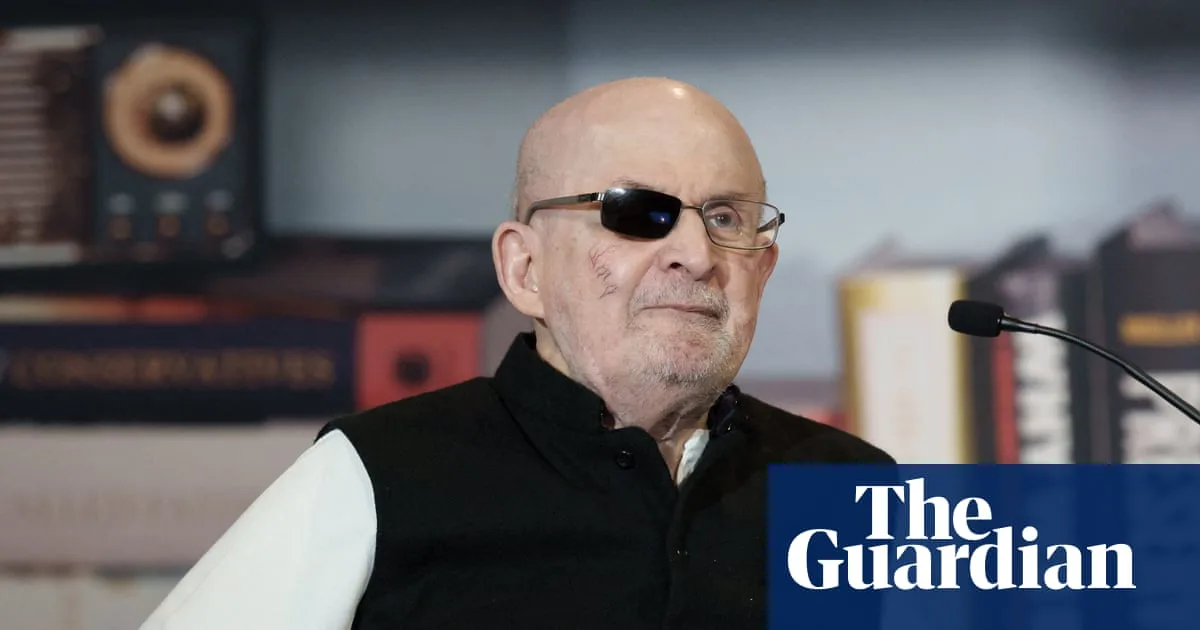
Salman Rushdie has said he is tired of being seen as a 'free speech Barbie' nearly four years after surviving an assassination attempt that left him blind in one eye. Speaking at Tulane University's New Orleans book festival, the author expressed frustration at being defined by the attack rather than his literary work.
'It's a subject I'm anxious to change,' Rushdie said during a talk with the Atlantic's George Packer. 'I don't feel symbolic. I feel actual. I feel like I'm a working writer trying to make his work.'
The Indian-born, British-American author was stabbed on stage at New York's Chautauqua Institution in August 2022 by Hadi Matar, who was later sentenced to 25 years in prison. The attack was motivated by Rushdie's novel The Satanic Verses, which Iranian religious leaders deemed blasphemous. Rushdie suffered critical wounds to his liver, intestines and right eye, which he can no longer see from.
Rushdie admitted it was 'a little frustrating to be not known for a book – but for something that happened to a book'. Referring to The Satanic Verses, his fifth published book, he said: 'Can we please talk about books? I keep trying to say.' He was at the festival to discuss his short story collection The Eleventh Hour, his first fiction since the attack.
The author said he felt relief at being able to write fiction again after publishing his memoir Knife in April 2024. 'After I finished writing the memoir, almost immediately, it's like a door in my head opened and the stories came back,' he said. 'I'd been really worried that I wouldn't be able to write fiction any more because of trauma.'
Despite his reluctance to be a symbol, Rushdie has championed free speech, serving as president of PEN America. He noted that attacks on free expression historically came from the rich and powerful, but now there is a 'different kind of problem' of self-censorship among young writers worried about unpopular opinions or cultural appropriation. Rushdie said he had no such worries himself.