Siri Hustvedt's Ghost Stories: A Memoir of Love, Loss, and Life After Paul Auster
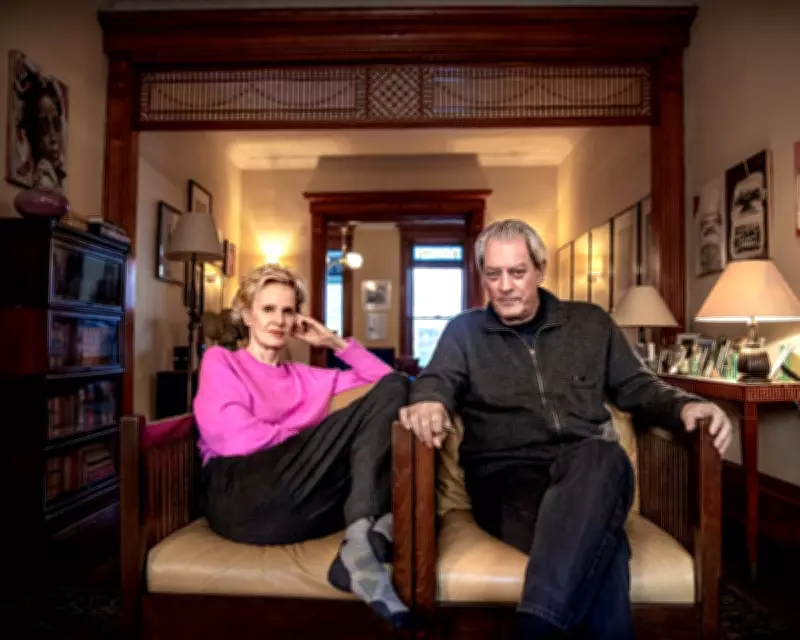
In her poignant new memoir Ghost Stories, acclaimed novelist and essayist Siri Hustvedt offers a raw and intimate exploration of grief following the death of her husband, literary icon Paul Auster, from cancer in 2024. The book serves as both a tribute to their more than forty-year marriage and a profound meditation on the seismic shift from partnership to solitude.
A Literary Partnership Forged in Brooklyn
Hustvedt vividly recalls their first meeting at a poetry reading, where she was a tall blonde PhD student in a jumpsuit encountering "a beautiful man in a black leather jacket." Auster was then separated from his first wife, writer Lydia Davis, living alone in a gloomy Brooklyn apartment and yet to publish his major works. Despite his later fame—which reached near-Beatlemania levels in the 1980s and 1990s with screaming fans in Buenos Aires and mobbed bookshop events in Paris—Hustvedt emphasizes that their bond was always rooted in literature. Both had decided on writing careers remarkably young, with Auster at fifteen and Hustvedt even earlier.
Their early courtship involved nights in New York City, cab rides downtown, and endless conversations in smoke-filled bars. When Auster briefly returned to his wife and son, Hustvedt wrote to him: "I think you are the best and it is very sad to lose the best." They married the following year, with a poet friend toasting: "To the bride and groom – two people so good-looking I'd like to slice their faces with a razor."

The Dialogue of a Marriage
Hustvedt describes their union as a continuous creative and intellectual dialogue. They read and edited each other's work extensively, with sentences from her novels appearing verbatim in his books and vice versa. This collaborative spirit made their partnership an "AND"—a conjunction Hustvedt now mourns deeply. "Yes, I am mourning Paul," she writes, "but most of the time, I am mourning Siri and Paul. I am mourning AND. I am mourning how the AND made me feel in the world."
The memoir captures the disorienting nature of grief through fragmented, often single-sentence paragraphs that mirror her shattered reality. Hustvedt finds herself unable to locate familiar subway entrances, constantly checking for keys, and encountering painful reminders throughout their home—from the smell of Auster's cigars to postcards in his handwriting.
Navigating Identity and Loss
Hustvedt reflects on earlier challenges to her identity within their marriage, recalling moments when she was treated as merely "Paul's beautiful wife" rather than as an accomplished writer in her own right. Film producer Harvey Weinstein once introduced her this way at a party, which she describes as being treated like "a nameless, inanimate thing that belonged to my husband." This experience fueled what she calls a "defensive, prickly attitude" about being seen as an appendage, particularly before her novels What I Loved and The Summer Without Men achieved international bestseller status.
Interestingly, while Auster was often perceived as the postmodern theorist, it was Hustvedt who more systematically engaged with thinkers like Lacan and Bakhtin—a scholarly dimension evident in her academic work lecturing in psychiatry at a New York medical college and in her references to phenomenologist Maurice Merleau-Ponty's concept of "intercorporeality."
Absurdity and Tragedy in Equal Measure
The memoir balances profound sorrow with moments of absurdist humor. Hustvedt notes that Auster wanted to die telling a joke, and she finds grim comedy in the fact that his immunotherapy treatment was partly derived from Chinese hamster ovarian cells. She laughs at herself for arguments over library organization ("'Where's Gertrude Stein, for God's sake?' I would yell at him") and for climbing into a half-filled bathtub with her socks still on after his death.

Yet the darkness is pervasive. The couple's friend Salman Rushdie visits after losing his right eye in an attack. Hustvedt herself suffers a smashed wrist from a fall. Her longtime analyst dies. Most devastatingly, Auster's ten-month-old granddaughter Ruby dies from acute intoxication by heroin and fentanyl, followed by the overdose death of Ruby's father Daniel—Auster's son from his first marriage, whose troubled life included stealing $13,000 from Hustvedt's bank account as a teenager and forging academic records.
Anger as Counterpoint to Melancholy
What gives Ghost Stories its vital energy amid the grief is its incandescent political anger. Hustvedt connects Auster's decline to what she sees as America's deterioration, noting that he refused to say Donald Trump's name, referring to him only as "45." She contrasts his intellectualism—he was once interviewed by the president of Finland and had a research library dedicated to him in Copenhagen—with the "know-nothing nationalism" of figures like JD Vance.
Drawing on her Norwegian mother's experience under Nazi occupation, Hustvedt warns that shutting down agencies like USAID "will kill millions of people." At Auster's memorial, she quoted her father: "'When fascism comes to America, they'll call it Americanism.' It has, and they do."
Structured as a collection of "Grief Reports," email bulletins "from Cancerland," heroic couplets written for Auster's last Christmas, and letters to their grandson, the memoir acknowledges its own incompleteness. "Like many diaries," Hustvedt declares, Ghost Stories is "full of holes – a geography of telling and not telling." Yet in its honest portrayal of love, loss, and the painful reconstruction of self, it stands as a powerful testament to both a remarkable partnership and the solitary journey that follows its end.