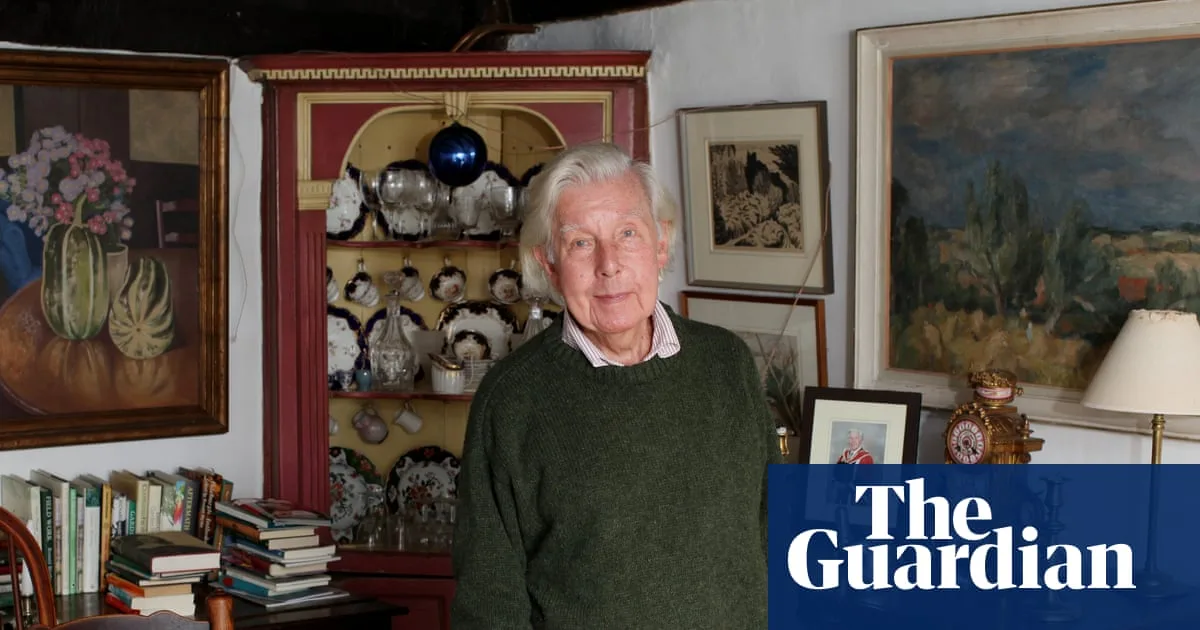
The British Library has secured a literary treasure, acquiring the extensive personal archive of the celebrated writer Ronald Blythe. This significant collection promises to offer an unparalleled window into a century of English rural life, as seen through the eyes of one of its most perceptive chroniclers.
A Century of Rural History Preserved
Ronald Blythe, who died in 2023 at the remarkable age of 100, was the author of the global bestseller Akenfield. This seminal work, published in 1969, painted a vivid and unflinching portrait of a Suffolk village navigating profound agricultural and social change. Blythe lived and wrote in East Anglia for most of his long life, producing over 40 books encompassing social history, fiction, poetry, and nature writing.
His archive, which will now be available to readers and researchers, is a testament to a unique mind. Despite never attending school or university, Blythe was a meticulous self-taught scholar. His papers, found in his home, were immaculately ordered, comprising a million words or more in neat handwriting. They are contained within humble school workbooks and on countless index cards, reflecting his lifelong preference for pre-digital methods.
The Meticulous Mind Behind 'Akenfield'
The archive provides a fascinating deep dive into the research behind Akenfield. Blythe's methods were thorough and immersive. His papers include correspondence with bodies like the Ministry of Agriculture to obtain detailed records of livestock in Charsfield, the real Suffolk village that inspired fictional Akenfield. His index cards reveal he spoke to hundreds of local people, from otter hunters to commuters, building a kaleidoscopic and authentic account.
According to his biographer and literary executor, Ian Collins, Blythe possessed an incredible memory. He would write up interviews from memory immediately after conducting them, skillfully capturing the distinct voice of each subject. "Oral history tells us what people did; Ronnie tells us what people are," Collins remarked, highlighting the deeper, novelistic truth Blythe achieved, comparing his technique to that of Thomas Hardy.
Frugality, Faith, and a Complex Private Life
The collection also reveals Blythe's character in intimate detail. His frugality is evident in reused index cards and paper, with every inch of his cheap notebooks filled with careful script. Collins connects this directly to his genius: "Every word has to work so he's constantly revisiting and honing it down to get the essence of it all. There's no waste."
While publicly known as a somewhat hermetic figure with a sturdy Anglican faith, living alone on the Essex border, the archive unveils a more complex private world. It includes letters from the American novelist Patricia Highsmith, with whom he shared an unlikely friendship. Collins's biography, supported by the archive, revealed Blythe's sociability and uninhibited gay sex life, lived discreetly in an era when homosexuality was outlawed.
The archive also contains feedback from readers, including critical notes from figures like the Earl of Stradbroke, who felt Blythe's honest depiction of feudal exploitation "smirched" Suffolk's name. Blythe's polite but firm reply defended his work: "Akenfield was never intended to be a public relations exercise for Suffolk but a statement about human nature."
Helen Melody, lead curator for contemporary literary archives at the British Library, stated: "We are delighted to have acquired Ronald Blythe's archive, which will be a wonderful resource for Blythe scholars and those interested in the societal and cultural changes that Blythe's work chronicled." Curators estimate it will take a year to fully catalogue the collection, unlocking its many hidden treasures for the nation.