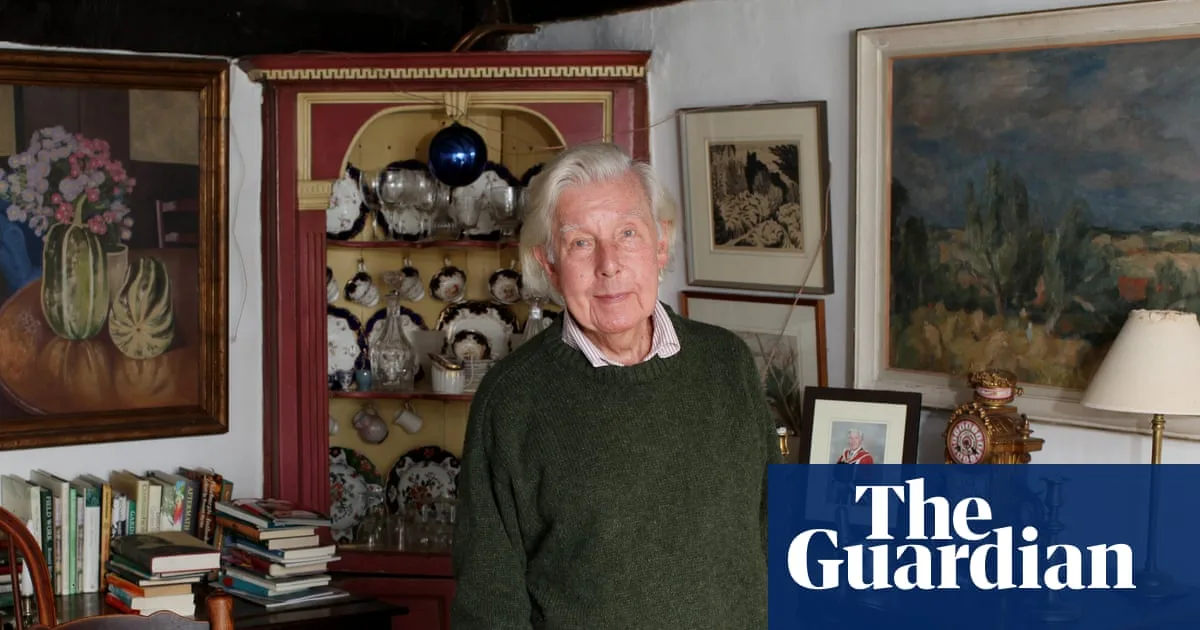
The British Library has secured a literary treasure trove, acquiring the complete archive of the celebrated rural writer and essayist Ronald Blythe. This significant collection, which documents a unique century of English country life, will now be preserved and made available for public study and research.
A Meticulously Ordered Life's Work
Blythe, who lived and wrote in East Anglia until his death last year at the remarkable age of 100, was the author of the global bestseller Akenfield. This seminal work captured a Suffolk village navigating the profound agricultural and social changes of the late 1960s. Despite never attending school or university, Blythe was a prolific author, publishing more than 40 books spanning social history, fiction, poetry, and nature writing.
A former librarian who eschewed computers, Blythe left behind an immaculately organised archive. His life's work—amounting to a million words or more—was meticulously recorded in humble school workbooks and on countless index cards. Ian Collins, Blythe's biographer and literary executor, noted the unusual orderliness, stating, "With Ronnie you can tell it's the product of an amazing, self-trained mind."
Uncovering the Roots of 'Akenfield'
The archive provides a fascinating deep dive into Blythe's research process for Akenfield. The book's vivid, unvarnished portrait of village life was built from hundreds of interviews. His papers reveal how he wrote to the Ministry of Agriculture for records of livestock in Charsfield, the real village that inspired fictional Akenfield. His index cards catalogue conversations with everyone from otter hunters to commuters, painting a kaleidoscopic and authentic picture.
According to Collins, Blythe possessed an incredible memory, honed from a watchful childhood spent in abject poverty as a labourer's son. "He listened very, very attentively... and he was very good at catching his interviewees' voice," Collins explained. He argues Blythe's work conveys a "deeper and broader truth than verbatim," akin to Thomas Hardy conducting interviews, revealing not just what people did, but what people are.
A Complex Life Revealed in Letters
The collection also sheds light on Blythe's complex personal life. A seemingly hermetic figure with a sturdy Anglican faith, he was in fact highly sociable and led an uninhibited gay sex life in an era when homosexuality was illegal. This side of Blythe emerges in correspondence, including letters from the American novelist Patricia Highsmith, with whom he shared an unlikely friendship.
The archive contains fan mail from the United States, where Akenfield was a surprise hit, as well as occasional criticism. This includes a missive from the Earl of Stradbroke, who objected to Blythe's honest depiction of feudal exploitation and misery in Suffolk. Blythe's characteristically polite but firm reply defended his work: "Akenfield was never intended to be a public relations exercise for Suffolk but a statement about human nature."
Helen Melody, lead curator for contemporary literary archives at the British Library, said the institution is "delighted" with the acquisition. She highlighted that the archive offers "an amazing insight into the century he lived through" due to Blythe's habit of reflecting on the past while engaging with contemporary events. Curators estimate it will take a year to fully catalogue the rich collection, which stands as a vital resource for understanding Britain's rural and social history.