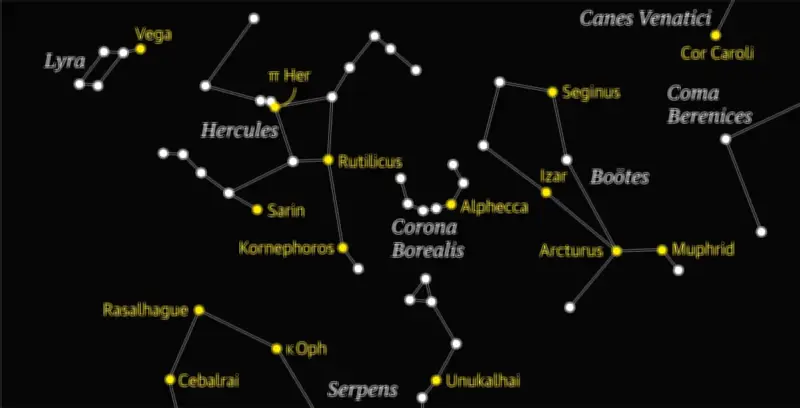
Finding Hercules in the Night Sky
The constellation Hercules, named after the Roman mythological hero, is a prominent feature of the summer skies in the Northern Hemisphere. According to astronomers, the best time to observe Hercules is during the months of June, July, and August, when it reaches its highest point in the sky around midnight. To locate Hercules, look for the bright star Vega in the constellation Lyra, which is easily identifiable as one of the brightest stars in the summer sky. Hercules lies to the east of Lyra, forming a distinctive pattern often described as a "keystone" or a lopsided square.
The Keystone Asterism
The central part of Hercules is marked by the Keystone, an asterism formed by four stars: Pi, Eta, Zeta, and Epsilon Herculis. This asterism represents the torso of the hero. From the Keystone, you can trace the limbs of Hercules extending outward. The constellation covers a large area of the sky, spanning about 1,225 square degrees, making it the fifth-largest constellation.
Highlight: The Great Globular Cluster M13
One of the most spectacular deep-sky objects in Hercules is the Great Globular Cluster, also known as M13. Located between the stars Zeta and Eta Herculis in the Keystone, M13 is a dense cluster of several hundred thousand stars. Under dark skies, it is visible to the naked eye as a faint, fuzzy patch. Binoculars or a small telescope will reveal a stunning ball of stars. M13 is approximately 25,000 light-years away from Earth and is one of the most prominent globular clusters in the northern sky.
Observing Tips
For the best viewing experience, find a location away from city lights and allow your eyes to adapt to the darkness for at least 20 minutes. A star chart or a stargazing app can help you pinpoint Hercules and M13. The constellation is also home to other notable objects, including the globular cluster M92 and the double star Ras Algethi. Whether you are a seasoned astronomer or a casual observer, Hercules offers a rewarding target for summer stargazing.