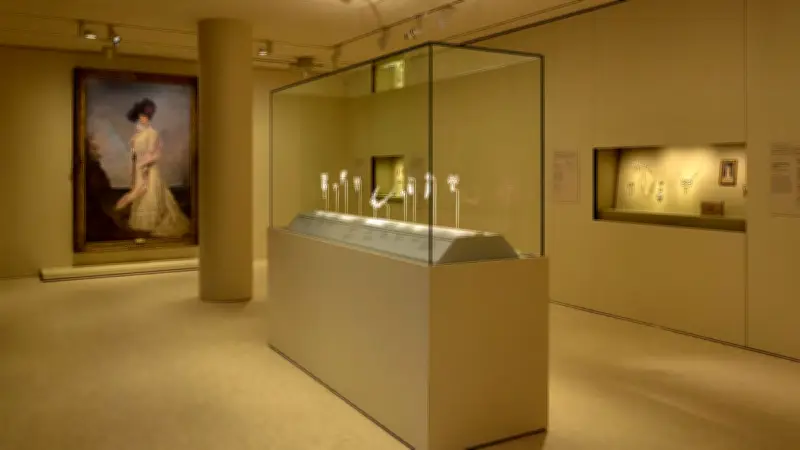
Following a sold-out presentation at London’s Victoria and Albert Museum, Cartier is now showcasing its collection at the National Gallery of Victoria in Melbourne as part of the Winter Masterpieces series. The exhibition includes over 350 jewels, some the size of golf balls, and traces the journey of the three Cartier brothers—Louis, Pierre, and Jacques—who transformed their grandfather’s modest Parisian shop into a global luxury brand. Throughout the turbulent 20th century, Cartier became the jeweller of choice for the elite, adorning aristocrats, industrialists, and celebrities. Many of the maison’s most lavish pieces drew inspiration from nature. Here, NGV senior curators Dr Miranda Wallace and Amanda Dunsmore delve into Cartier’s enduring fascination with animals.
Great Dynasties of the World: The Cartiers
Cartier on display at NGV International in Melbourne. Photograph: Sean Fennessy/NGV
Alyx Gorman Wed 10 Jun 2026 20.43 EDT

Pelican Brooch (1929)
This small pelican brooch, created in 1929, exemplifies Cartier’s innovative use of colour, particularly red and green. Made from jade, coral, sapphire, and diamonds, the cabochon-cut jade body represents an early example of the ‘sculptural idiom’ that would later define Cartier’s style, according to curator Amanda Dunsmore.
Caged Bird Brooch (1942)
During the Nazi occupation of Paris, Cartier produced a caged bird motif as a symbol of resistance, seen in this brooch from 1942. The bird represented France under German occupation, and several pieces featuring it were displayed in the jeweller’s shop windows. ‘It didn’t go unnoticed,’ curator Miranda Wallace says. Jeanne Toussaint, the maison’s director of fine jewellery, ‘was hauled in for questioning by the Gestapo’. At the time, platinum was reserved for the war effort, ‘so a lot of cutting of this period and those immediate postwar years was actually made more in gold than platinum’.
Liberation Bird Pendant (1944)
A counterpart to Toussaint’s caged bird, this pendant was made in 1944, shortly after the liberation. ‘It’s on the brink with its wings out, so it’s being freed, essentially,’ Dunsmore says.
Bird of Paradise Brooch (1944)
The ruby and emerald in this brooch, also created under Toussaint’s direction, are gems she used frequently, Wallace notes. The cabochon cut gives the piece a sculptural element and sense of fullness, adds Dunsmore. Made in 1944, the piece was adapted three years later to remove a long chased gold tail, transforming it from a bird of paradise into something resembling a woodpecker. The ruby cabochon at the centre is about the size of a lollipop, so even without the tail ‘it’s quite substantial’, Wallace says. ‘If you were wearing it on your lapel, people would certainly notice it.’
Kingfisher Brooch (1950s)
During Frederick Mew’s tenure as lead designer of Cartier London in the 1950s, he produced a series of exquisite kingfisher designs, along with other birds. This brooch likely features an Australian opal, an uncommon gem for the maison.
Flamingo Brooch (Commissioned by Duchess of Windsor)
This flamingo was commissioned for the Duchess of Windsor, who, like the bird, was American. Creating the Duchess’s jewels was a major undertaking for Cartier, and the flamingo is one of her most famous treasures. ‘It’s very noticeable when you see her wearing it … And it’s got this little cabochon sapphire on the end of its beak, which is quite amazing,’ Dunsmore says. Wallace adds: ‘The designers possibly were … going to the Jardin des Plantes, which was the major zoo in Paris … and taking inspiration from the wild animals there.’
Pug Pin (Duchess of Windsor)
Throughout their life together, jewellery was a love language for the Duke and Duchess of Windsor, Wallace says. ‘They’re often inscribed with personal messages and it was part of their expression.’ This enamel pug pin was one such commission. Wallace notes it is not a portrait of a particular pug, ‘but she did own a number of pugs, certainly [they were] her favourite dogs’.

Panther Brooch (152.35-carat Kashmir Sapphire)
The 152.35-carat Kashmir sapphire cabochon in this piece is the size of a small strawberry. Bought by the Duke of Windsor for his wife while the couple lived in Paris, it was designed by Toussaint, who frequently collaborated with the duchess. The panther is an oft-repeated motif for Cartier, and Toussaint’s own nickname was La Panthère, Wallace says. In the early 20th century, there was a fashion for all forms of wild cat. ‘I’m thinking of the movie Bringing Up Baby,’ Dunsmore says.
Panther Brooch (1980s)
‘This languorous panther is not unlike some of the earlier panthers,’ Wallace says. Cartier’s earliest use of a big cat skin pattern dates to 1914. The treatment seen in this 1980s brooch, where the skin surface is rendered in pavé diamonds and darker stones (sapphires in this case), has been consistent throughout the decades. The three legs dangling off the coral branch are articulated. ‘You can just see some of the lines where there’s that tiniest hinge in there for the legs to swing,’ Wallace says. For a 1980s piece, ‘it’s actually a very subtle jewel’.
Double-Headed Panther Bangle (1980s)
Rendered in gold and enamel, this double-headed panther bangle is much more typical of its era. ‘In the 80s, they did use quite a bit more gold,’ Dunsmore says. Throughout the 1980s and 1990s, the panther became a central aspect of Cartier’s marketing, with live panthers depicted in their advertisements.
Lapis Lazuli Owl (1969)
Cartier is one of the few remaining jewellers with a dedicated glyptics (stone carving) workshop. Designed by Toussaint in 1969, the year before her retirement, this piece features carved lapis lazuli that lends it an almost psychedelic character. ‘[It has] very big eyes, this one, doesn’t it?’ Wallace says.
Jaguar on Yellow Beryl (Later Creation)
The jaguar atop this 121.81-carat cushion-shaped yellow beryl is carved from Australian nephrite. ‘Australian jade, they call that,’ Wallace says. It is a later creation that also ‘harks back to the designs of the 1940s’. Dunsmore notes the ‘pretty hefty’ beryl is about two-thirds the size of a Tim Tam. ‘You’ve bitten the end off it, and then you have lots left.’
Chinchilla Sculpture (c. 1910, Fabergé)
Stone carving has always been an element of Cartier’s capabilities. When the maison began its expansion in the early 20th century, its chief rival for aristocratic patronage was the Russian jeweller Fabergé, which made this small sculpture of a chinchilla nibbling on an ear of corn, circa 1910. ‘It’s a luxury object, essentially,’ Dunsmore says. Carved-stone animals were hugely fashionable in the late 19th and early 20th centuries, so in an effort to expand its clientele, Cartier began making carvings in the Russian style as well.
Kangaroo Sculptures
Cartier produced a wide range of exotic animal sculptures, including these kangaroos. ‘I’m sure that whoever … designed them or carved them both perhaps actually saw live kangaroos, because they really have that detail and level of realism about them,’ Dunsmore says. She notes the faces, pear-shaped forms, and musculature of the kangaroos’ chests have ‘a level of refinement’. The sculpture on the left has two joeys in the kangaroo’s pouch. Wallace called a kangaroo sanctuary in Alice Springs and was told it is incredibly rare for a kangaroo to have twins. ‘Did this kangaroo have twins in their pouch or did the designer make it up? I can’t tell you the answer to that, but it’s lovely to see it.’
Reptile Jewellery
Since antiquity, jewellers have drawn inspiration from reptiles, and Cartier ‘do quite a lot of reptile jewellery’, Dunsmore says. The brown and yellow diamonds in this piece shine in a really interesting way that allows museum attendees to appreciate the coloured stones, she says. ‘It’s articulated, its head swivels, its tail can be moved.’
Crocodile Necklace (Commissioned by Maria Félix)
Rumour has it that the Mexican actor Maria Félix brought a real baby crocodile into Cartier’s Paris workshop when she commissioned this bold necklace. ‘She’d leave it with them because she wanted them to really make it realistic,’ Wallace says. It takes the concept of a reptile jewel and ‘puts it on steroids’. ‘It’s not like the vision of a designer at Cartier, it’s very much Cartier executing her vision,’ Wallace says. Dunsmore notes the crocodiles can be split into two brooches, and their claws can be swapped out for softer versions to avoid scratching when the necklace is worn against bare skin.
Snake Necklace (Commissioned by Maria Félix)
Also commissioned by Félix, this fully articulated snake necklace is so lifelike it’s ‘sort of creepy’, Dunsmore says. The colours on the snake’s belly are drawn from the Mexican flag – ‘a really important aspect of that piece’, Wallace says.
Dragonfly Brooch
Produced in the same vein as 18th-century tremblant jewellery, the wings of this dragonfly are set on small springs. ‘Being set with diamonds they really would just catch the light beautifully,’ Wallace says. ‘It’s another piece from the period of Toussaint as creative director and speaks once again to the eclecticism and the sculptural quality of her pieces.’ Cartier’s pieces often drew inspiration from 18th-century decorative arts, especially the style from the time of King Louis XVI.
Chimera Bracelet (Commissioned by Maria Félix)
Not every animal in Cartier’s menagerie was analogous to a living creature. This coral and emerald bracelet, commissioned for Félix, is a chimera. ‘A mythical beast actually, which has resonances from both classical antiquity and Asian cultures,’ Dunsmore says. ‘I think it is one of the most beautiful pieces in the exhibition.’
Double-Chimera Bracelet (Commissioned by Daisy Fellowes)
Dunsmore is less taken with this chimera, commissioned for another devoted Cartier patron, the French socialite Daisy Fellowes. ‘It’s a double-chimera-headed bracelet, also in coral and also set with diamonds and emeralds, but very, very different in aesthetic – not half as beautiful, in my personal opinion.’
Scarab Brooch (1920s)
After the discovery of King Tutankhamun’s tomb in the early 1920s, a mania for all things Egyptian swept Europe. In addition to being inspired by Egyptian styles, Louis Cartier took this one step further, incorporating ancient antiques into some of the maison’s jewels, including the scarab at the centre of this brooch. The wings are entirely Cartier’s creation, Dunsmore says, and they’re ‘off the scale in terms of decorative ornament in the way those feathers have been represented with the various stones – there’s onyx and citrines and rubies and emeralds and diamonds, of course’.
Mystery Clock with Jade Elephant (1928)
Cartier incorporated antiques from around the world, including Persia, India, and China. This mystery clock, made for the maharaja of Nawanagar in 1928, features an 18th-century jade elephant sourced from China.
Koala Watch (2012)
From the year 2012, the koala face in this watch was made using a technique called straw marquetry. The practice, in which coloured straw is laid out into a decorative form, dates back to at least the 18th century, Dunsmore says. ‘It’s one of those métier or creative practices that’s actually been revived in more recent times.’ While Cartier made many animals, marsupials are ‘not common in the pantheon of Cartier jewels’, she says, ‘so when they do use them, as Australians, you do notice them’.
Cartier will be on show at NGV International from 12 June to 4 October. Guardian Australia travelled to Melbourne courtesy of the NGV.