WNO's The Flying Dutchman: A Haunting, Unconventional Wagner Staging
Welsh National Opera's new production of The Flying Dutchman, directed by Jack Furness, presents a compelling and unconventional take on Richard Wagner's legendary opera. Staged at the Wales Millennium Centre in Cardiff, this interpretation delves deep into themes of delusion, torment, and menace, supported by a detailed and finely sung performance that captivates audiences.
Inspired by Peril: Wagner's Legendary Opera
In 1839, a 26-year-old Richard Wagner nearly drowned during a treacherous voyage across the Baltic Sea from Riga. This harrowing experience inspired The Flying Dutchman, the tale of a man condemned to sail the oceans for eternity. Wagner considered his libretto a poem, grappling with epic questions of birth, life, love, and death, making it his first mature opera.
Unconventional Staging and Visual Metaphors
Jack Furness's staging begins with a woman in childbirth, her contractions syncing with the wild, stormy surges of the overture. This introduces Senta, born into tragedy as her mother dies shortly after, whisked away on a hospital bed into the abyss. Senta grows into a damaged soul, obsessed to the point of derangement by the story of the Dutchman, whose only hope for redemption is the love of a true woman, possible only when he touches land every seven years.

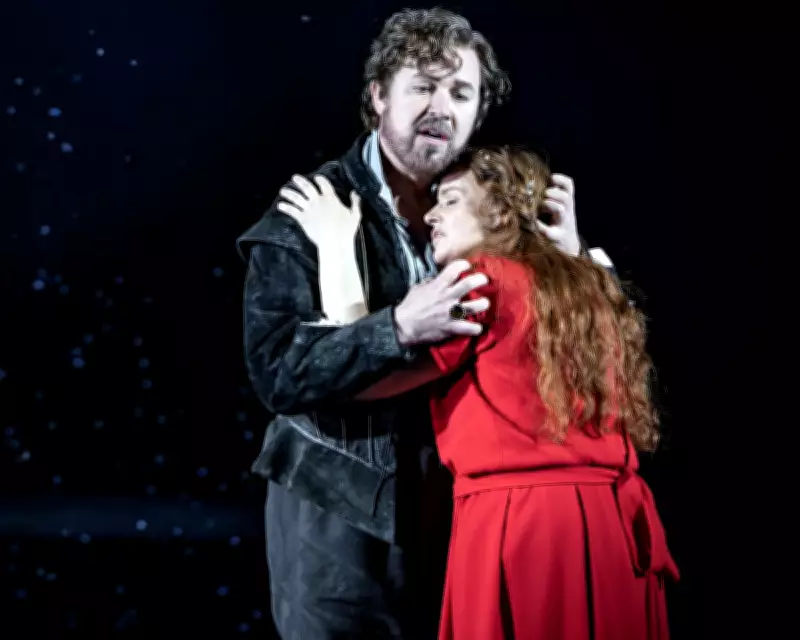
The production avoids traditional ship settings, instead using visual metaphors to convey the narrative. Elin Steele's design and Lizzie Powell's lighting create turbulent seas and skies in muted colours, with enveloping mists adding to the menace. Senta's character is highlighted through sweeping circles run by her as a young girl and later as a woman, paralleling the Dutchman's septennial cycles. Their dresses symbolise the blood-red sails of his ghost ship, with these metaphors recurring throughout the performance.
Musical Excellence and Vocal Clarity
The cast delivers a musically rewarding experience, with clarity of German diction as a prime virtue. James Creswell's fine portrayal of Daland stands out, while Simon Bailey's Dutchman, dressed in a doublet with slashed sleeves denoting centuries of voyaging, depicts a tormented yet sympathetic individual. Bailey is most impassioned in the final act, capturing the character's eternal struggle.
Rachel Nicholls's Senta is particularly impressive, making her deluded love for the Dutchman plausible with absolutely true pitch and lovely bel canto lines. Tenors Trystan Llŷr Griffiths as the hapless Steersman and Leonardo Caimi as Erik also make their mark, though Wagner's tendency to extend their roles and the many choruses, despite full-blooded singing, can feel prolonged.
Orchestral Storm and Company Resilience
The WNO orchestra, under the authoritative baton of outgoing music director Tomáš Hanus, plays up a proper storm, enhancing the opera's dramatic intensity. This production comes at a critical time for Welsh National Opera, as the company seeks to prove it is not a sinking ship despite a thin 2026/27 season. Catching these performances is imperative for opera enthusiasts, though audiences should not expect a conventional ending.
Performance Dates:
- Wales Millennium Centre, Cardiff: 19 April
- Theatre Royal Plymouth: 24 April
- Birmingham Hippodrome: 7 May
- Milton Keynes Theatre: 15 May
This staging of The Flying Dutchman offers a fresh perspective on Wagner's work, blending innovative visuals with powerful musical performances to explore timeless themes of redemption and obsession.