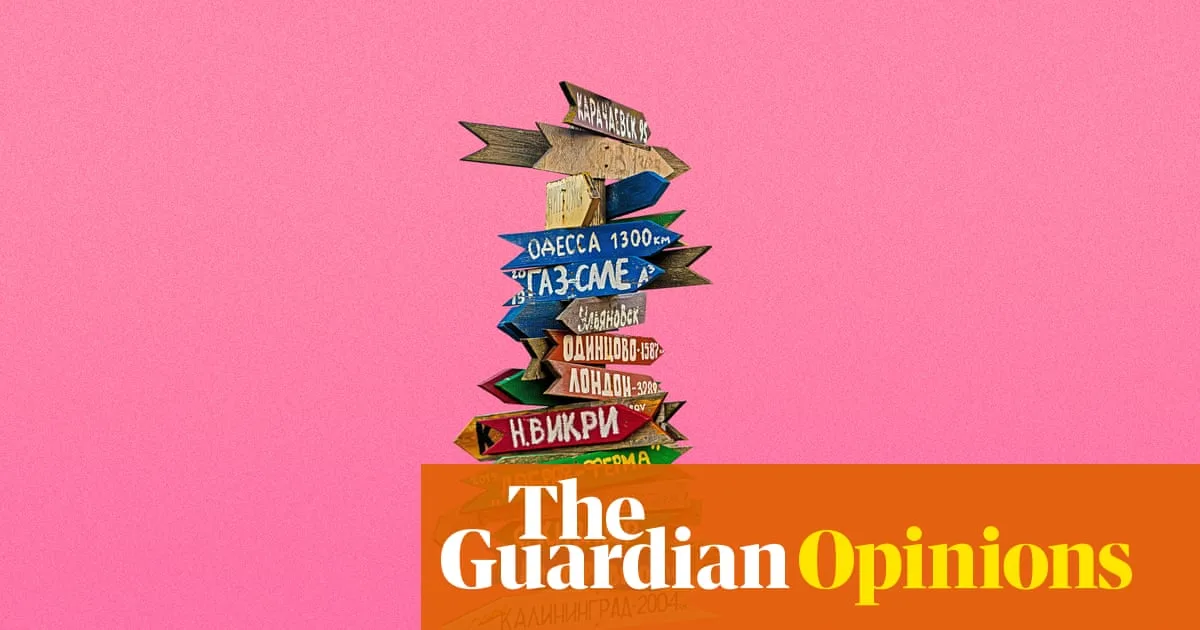
Faux Cyrillic: Why 250 Million Readers Deserve Better Than 'Fdtsx Schrillic'
The Hill I Will Die On: Faux Cyrillic is a Load of Old Crдp

For those who can read it, the sight of the Cyrillic alphabet being mangled for dramatic effect on film posters and book covers is a uniquely irritating experience. It's a hill that writer and comedian Viv Groskop is prepared to die on, and she's not as alone as you might think.

The Typographic Travesty Grinding Gears

This design trend, known as Faux Cyrillic, involves substituting Latin letters with visually similar Cyrillic characters to create a vague, often incorrect, 'Russian' or 'Eastern European' vibe. The result is linguistic nonsense that reads as gibberish to the quarter of a billion people worldwide who use the Cyrillic script.

Groskop highlights the infamous example of spelling 'STALIN' as 'STДLIN'. The problem? The Cyrillic 'Д' is pronounced as a 'D', rendering the name as 'STDLIN'. "Which would be fine if you were attempting some kind of wordplay comparing the impact of the one-time Soviet leader to a sexually transmitted disease," she wryly notes. But the intent is rarely clever wordplay; it's a shallow shorthand for 'creepy exoticism'.

From Red Heat to Borat: A Hall of Shame

The practice is rampant in popular culture. Groskop points to the opening credits of Arnold Schwarzenegger's Red Heat, where his name is bizarrely transliterated. The posters for The Death of Stalin, Chernobyl Diaries, and Borat are also key offenders. In Borat's case, his name is written as 'ВОRДT', which Cyrillic readers will instantly parse as 'Voyadt'.

"I did not suffer decades of learning Russian and Ukrainian to deserve this cerebral meltdown," Groskop declares. She emphasises that this sloppy design disrespects not just Russians and Ukrainians, but 250 million global users of the alphabet, including Bulgarians, Serbians, Macedonians, and millions of Kazakhs.

A Lonely Furrow? Finding the Tribe

While it may seem a niche bugbear, Groskop has found solidarity in unlikely places, notably on Reddit. Comments from fellow sufferers echo her frustration: "My eyes are bleeding," and "It's annoying and maybe even a little bit racist." She also draws a parallel with German speakers who object to the gratuitous use of the umlaut in heavy metal band names like Mötley Crüe and Motörhead.

As Motörhead's Lemmy once said of his umlaut, "I only put it there to look mean." Groskop argues Faux Cyrillic operates on the same principle: it's there to menace, to emphasise the 'other', and to separate 'them' from 'us'. But ultimately, she concludes, it isn't mean or scary—it's just very, very silly indeed.

The phenomenon is now formally documented, with its own Wikipedia page that ironically uses the painful rendering 'Fдцx Cчrillic' (read as 'Fdtsx Schrillic'). For Groskop and millions of Cyrillic readers, it's high time for this lazy design cliché to be retired, encouraging a world that is more, not less, sane.