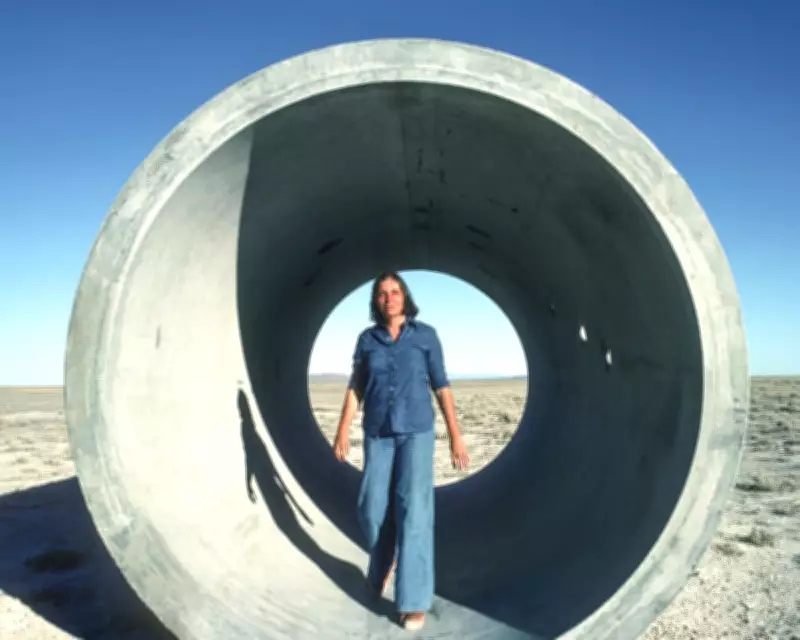
The two most prominent features of the 1960s and 70s art movement known as land art are the use of dramatic natural locations and monumental scale. Nancy Holt (1938-2014), one of the few women associated with the medium, is the subject of a new exhibition at the Goodwood Art Foundation in Sussex. She is best known for Sun Tunnels, her 1976 work in the Utah desert, where four concrete cylinders align with cosmic movements.
Key Works and Themes
The exhibition includes a small sheet of paper, 30cm x 45cm, featuring a concrete poem: MOONSUNSTAR EARTHSKYWATER. Curator Ann Gallagher notes, "It was made before her grand landscape works, but points to concerns that stayed with her for over 40 years." Circles appear frequently, serving as framing devices and linking to her interest in systems—in the skies, on Earth, and in life.
Goodwood's is the first UK exhibition to bring together Holt's photographic work, films, poetry, indoor and outdoor installations, and a film about Sun Tunnels. Visitors encounter an installation of ventilation pipes that extends from the gallery into the landscape. "It's another system we take for granted," says Gallagher. A previous version contained oil; this one uses air.

Cosmic and Earthly Systems
Circles are everywhere. Mirrors of Light uses a single light source bounced off mirrors to produce ellipses on walls. Photographic works play with circular light. Hydra's Head, in a chalk quarry, features six round pools arranged according to the Hydra constellation. "She was concerned with cosmological systems," Gallagher explains. "Sun Tunnels align with the solstice and have holes matching star constellations, making invisible systems briefly visible."
Holt studied biology before moving into art. She was married to Robert Smithson, creator of Spiral Jetty. Together they visited the UK in 1969, exploring Dartmoor and Salisbury, where Holt's Trail Markers documents small orange circles painted on rocks to guide hikers—a nonverbal system in the landscape.
After Smithson's death in 1973, Holt curated his legacy and her own. The Holt/Smithson Foundation now manages both artists' works, with a sunset clause ensuring closure in 2038, the year of their joint centenaries.
Gallagher, who met Holt late in her life, recalls: "She was pragmatic, down to earth, relatable, friendly, and informed. A playful graph in the exhibition plots her fluctuating identity as 'artist', 'feminist', and 'mystic' over 24 hours. All this comes across in a body of work that concerns itself with the largest canvases on Earth while always aware of a human presence."
Nancy Holt: MOONSUNSTAR EARTHSKYWATER is at Goodwood Art Foundation, near Chichester, from 2 May to 1 November.

Key Works by Nancy Holt
- Sun Tunnels (1976): Four concrete tunnels in Utah aligned with the solstice and star constellations. They accommodate a standing human body, emphasizing human scale in the landscape.
- Hydra's Head (1974): Six round pools of water near the Niagara River, arranged to reflect the sky and respond to insect life. Filled with gravel after the residency.
- Trail Markers (1969): Photographs capturing orange circles that guide walkers on Dartmoor, reflecting Holt's interest in human constructs within natural expanses.
- Ventilation IV: Hampton Air (1992): A site-responsive work drawing attention to hidden infrastructure systems, configured differently in each location.
- MOONSUNSTAREARTHSKYWATER (1969): A concrete poem created while Holt was literary editor at Harper's Bazaar, foreshadowing her preoccupation with systems and perception.