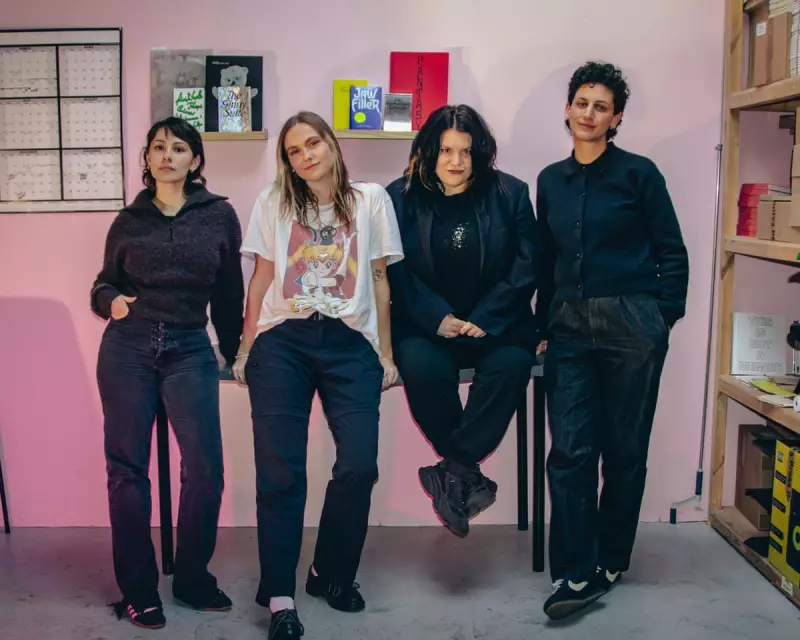
In a vibrant London fundraiser, artist Stuart McKenzie takes to a makeshift stage, his long brunette hair catching the breeze from a fan. Dressed in a power suit and thick-rimmed glasses, he flamboyantly smokes a cigarette while performing confessional poetry written since the 1980s. "Stuart is this fantastic London staple who is just coming out of the woodwork now," remarks Emily Pope, director of Montez Press, which hosted the event to support its queer and feminist press and radio operations.
A Radical Response to a Heteronormative Landscape
Founded in 2012 by exchange students from Goldsmiths College of Art and the Hamburg School of Art, Montez Press emerged as a direct challenge to a publishing world perceived as dominated by heteronormative journalists and academics. From its inception, the collective aimed to champion experimental writing and amplify feminist and queer perspectives through artist-led projects.
Their debut publication, Chubz by Huw Lemmey, set the tone: a nightmarish, homoerotic satire following a protagonist who dates a leftwing journalist inspired by the Guardian's Owen Jones. The narrative, unfolding against Nigel Farage's political ascent, weaves together themes of class struggle, populism, technological dependency, and explicit sexuality.

Pushing Boundaries in Print and Radio
Annually, Montez Press commissions a novel from a younger artist exploring "auto-speculative or fan fiction"—literature blending personal experience with futuristic or fantastical elements, often reimagining copyrighted media. The latest, Jaw Filler by Maz Murray and Charlie Markbreiter, is a pulpy neo-noir detective story set in a virtual reality commune funded by a shadowy tech firm.
The team frequently authors works themselves. Stacy Skolnick, co-director of Montez Press Radio, penned The Ginny Suite in 2024, a mystery centred on a global condition inducing submissiveness and aphasia in women. Assistant editor Elida Silvey is currently crafting a vampire narrative.
Extracts from these books and plays air on Montez Press Radio, alongside eclectic transmissions. Artist Lux Pyre, for instance, blends ASMR with readings from his fan fiction fantasies about sexual desire. "He'd never done this before. Neither had we actually, so we had to build this little DIY soundproof box," explains Miranda Shutler, who oversees London programming. "It's a really great space for experimentation in the same way that the press is."
Building a Global Countercultural Community
Launched in 2018 from a Manhattan art gallery, Montez Press Radio captures underground art, literature, nightlife, and music with a lo-fi, community-radio energy. Programming spans from East Village record shop curations to 12-hour marathons on Palestinian liberation in collaboration with Radio Alhara. One notable broadcast featured Forensic Architecture researchers advocating for land restitution in Namibia by re-enacting colonial violence.
Anna Clark, a founding member, contrasts this with public radio in the US, which has "been completely slashed and undermined." Living under Trump's America, Clark adds: "The rise of fascism is really challenging and makes the work that we do both even more important, doubling down on our commitment to support trans people, feminist perspectives, underrepresented voices, as that becomes more and more under attack."
Unlike traditional community radio tied to one city, Montez Press operates internationally across Hamburg, New York, and London, with offshoots in Mexico, events in Vietnam and Korea, and its Interjection Calendar—mapping the year in contemporary art writing—edited in Taiwan. "We're really interested in how to connect hyper-local, grassroots, counter-cultural scenes in contemporary art, writing and music, and how to foster a global community," says Pope.

Evolving from Periphery to Pillar
Over a decade, Montez Press has transitioned from the fringes to a cornerstone of independent publishing. The queer feminist landscape in London now boasts a diverse ecosystem of small presses, self-publishing artists, alternative fairs, and dedicated shops. Pope reflects: "A really interesting question is how to remain relevant when something that you were doing was countercultural and then there seems to be more of it." As fascism rises globally, their mission to push boundaries and ask questions feels more urgent than ever.