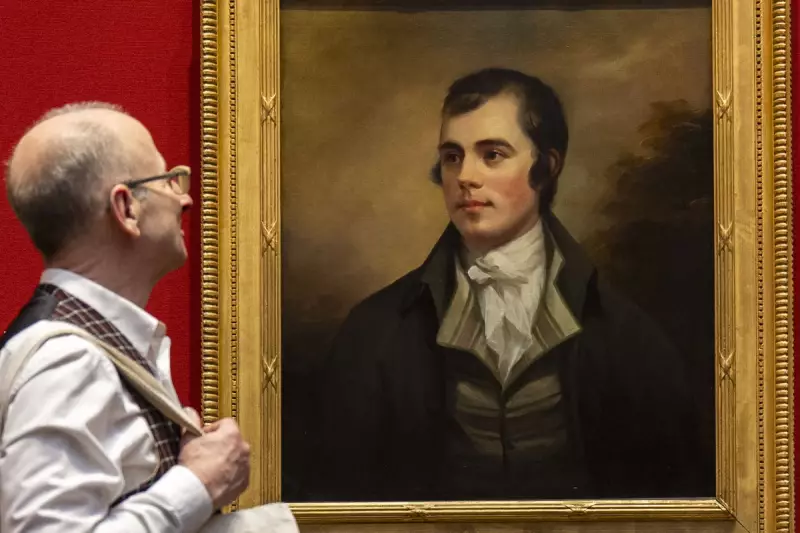
A remarkable piece of Scottish cultural heritage has resurfaced after more than two centuries, captivating poetry enthusiasts and art historians alike. A long-lost portrait of Scotland's national bard, Robert Burns, painted by the esteemed artist Sir Henry Raeburn, has gone on public display for the very first time at the National Galleries Scotland in Edinburgh.
Centuries-Long Disappearance and Surprising Rediscovery
The portrait, which had been commissioned back in 1803, seemingly vanished from existence for approximately 220 years, leaving its whereabouts a mystery pondered by experts for decades. Its incredible rediscovery occurred entirely by chance in March of last year during a routine house clearout in Surrey, England. Following this unexpected find, the painting underwent a meticulous process of cleaning and professional examination, with specialists confirming its authenticity as the long-lost artwork.
Auction Acquisition and Public Loan
Shortly after its authentication, the portrait was put up for auction in London, where it fetched a substantial sum of £84,320, including the buyer's premium. The successful bidder was William Zachs, a dedicated Burns enthusiast and director of the Blackie House Library and Museum in Edinburgh. Demonstrating a commitment to public access, Mr Zachs has generously loaned the painting to the National Galleries Scotland, allowing visitors to view it free of charge.

Exhibition Details and Future Display
Art and poetry lovers now have a unique opportunity to see this historic portrait in the Scottish capital ahead of the annual Burns Night celebrations on January 25th. Following its stint in Edinburgh, the painting is scheduled to travel to the Robert Burns Birthplace Museum in Alloway, South Ayrshire, where it will be on display from July 21st onwards. This touring exhibition ensures that audiences across Scotland can engage with this significant cultural artifact.
Artistic Significance and Expert Commentary
The portrait holds particular artistic importance as Sir Henry Raeburn, who served as King George IV's own painter, based this work on an earlier image of Burns created by Alexander Nasmyth in 1787. Despite working from another artist's depiction, Raeburn infused the portrait with his characteristic style.
Lesley Stevenson, senior conservator of paintings at the National Galleries of Scotland, expressed her admiration, stating: "Raeburn's expressive, seemingly effortless brushwork, the characteristic warm palette, soft, atmospheric lighting and sensitive rendering of the instantly recognisable Robert Burns are a joy. This is a significant discovery and one we can all celebrate."
Duncan Thomson, former keeper of the Scottish National Portrait Gallery and curator of the last major exhibition on Sir Henry Raeburn, highlighted the portrait's profound connection: "The rediscovery of this portrait of Burns, after having disappeared for 200 years, is of enormous significance, linking the poet with Scotland's greatest artist. Although Raeburn was working from an image made by another painter, the portrait has that wonderful freshness of observation that marks Raeburn's work at its best."
Thomson further speculated on Raeburn's potential firsthand observation of Burns, noting: "It is more than likely that Raeburn had seen Burns in his heyday in Edinburgh a decade earlier and had observed that glowing eye that had so impressed the young Walter Scott. The result is a portrait that speaks in an entirely new way of the warmth, the sensuality and the profound intelligence that we find in Burns's poetry."
A New Visual Memory for Burns Enthusiasts
William Zachs, the portrait's owner, connected the painting's unveiling to the global celebrations of Burns Night, remarking: "This week at Burns suppers in Scotland and around the world we toast the immortal memory of the poet. Now we have a new immortal visual memory – a once lost painting by Sir Henry Raeburn, the Scottish great portrait artist, that depicts Robert Burns not just as a genius poet but as a celebrated (and handsome) Scotsman whose significance would endure 'till a' the seas gang dry'."

The public display of this rediscovered masterpiece offers a tangible connection to one of Scotland's most revered literary figures, providing both a historical artifact and a fresh perspective on Robert Burns through the eyes of one of the nation's most accomplished portrait artists.