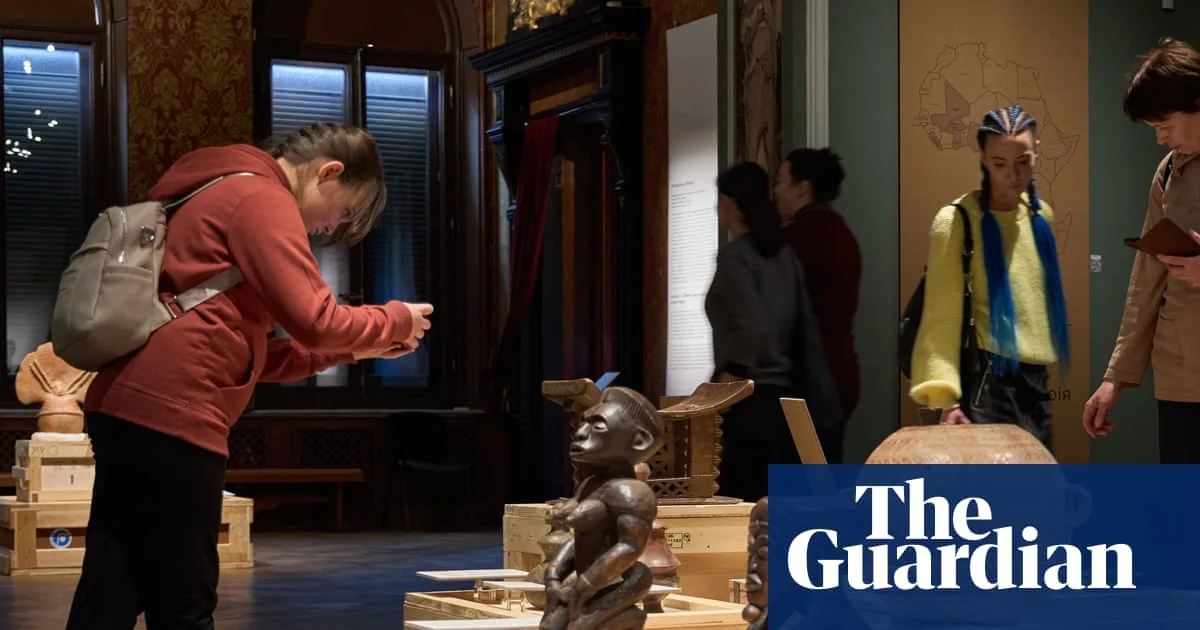
On a quiet street in central Kyiv, where monuments are wrapped in sandbags and shrapnel shields, the Khanenko Museum has opened an exhibition about Africa. Its title, Africa Direct, is a statement and a method: a call to approach the continent not through inherited filters (Soviet, colonial, or western) but through direct engagement with its histories, philosophies and living cultures.
The museum, which holds one of the most distinguished private collections of the 19th century in eastern Europe, was badly damaged when a Russian missile struck nearby in October 2022. Windows and show cases were shattered and the glass ceiling collapsed. Yet the museum’s collections were unharmed: Byzantine icons, Islamic artwork, and old master paintings had already been secured, some of them safely evacuated to partner institutions in Paris, Vilnius, Warsaw and The Hague.
The museum did not close. Its staff kept the institution open, empty but active, organising lectures, readings, and mental health workshops with the neighbouring hospital. Some of the glass fragments were later turned into brooches by a local goldsmith, offered as a sign of endurance to guests and friends.
Now, on the third anniversary of the attack, Africa Direct has opened in the same building, this time filled with objects and voices from another continent. Curated by Yulia Fil and Daria Sukhostavets, and initiated by the deputy director Hanna Rudyk, the exhibition brings together 40 works from 18 African countries, collected over two decades by the Ukrainian couple Tetyana Deshko and Andriy Klepikov, who have worked extensively in African public health. Historical artefacts sit alongside works by contemporary artists such as the Ghanaian-British artist Adelaide Damoah, Christian Nyampeta (Rwanda/the Netherlands/US), Seyni Awa Camara (Senegal) and Esther Mahlangu (South Africa).
No attempt is made to emulate the encyclopaedic ethnographic displays of other European museums. Instead, the selection privileges a sensuous engagement with African art and material culture: things made to be touched, carried, embraced. At the heart of the exhibition is a group of magnificent ceramic vessels, some serving, in their living worlds, as temporary homes for ancestors. As in all museums, one cannot help but wonder what these pieces are doing here, far from the ecologies and relationships that once gave them meaning. Yet the curator has chosen to resist the usual distance imposed by glass, placing the works on simple wooden boxes, an act of humility that suggests fragility and protection.
At the opening, Anika Johnson, a longtime resident of Ukraine and representative of the African community there, drew a parallel between African and Ukrainian experiences of oppression and resistance. “We are both freedom fighters,” he said. “Africa fought colonialism, Ukraine fights now for its freedom.” The words resonated beyond diplomacy or solidarity. They articulated a shared vocabulary of independence that connects two histories often seen as separate.