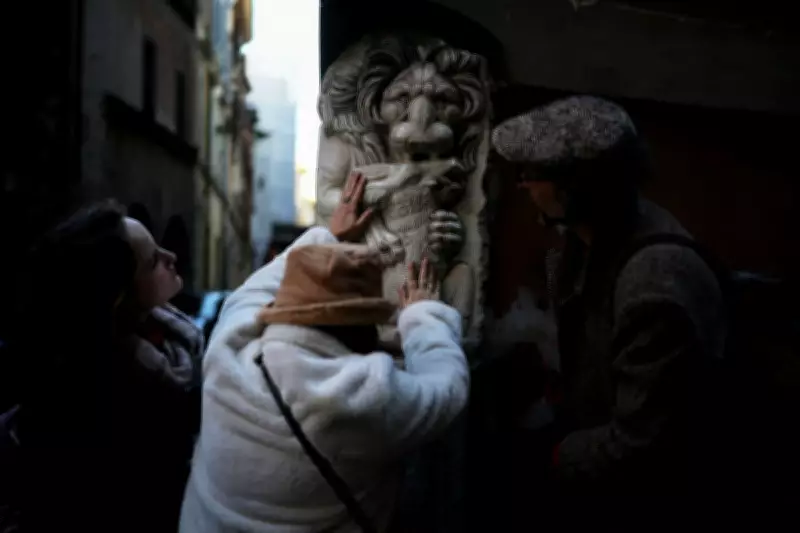
Italy is undergoing a remarkable cultural transformation, reinventing how its world-renowned artistic treasures are experienced by blind and visually impaired visitors. Across historic cities from Rome to Florence, innovative initiatives are making Italy's vast heritage accessible through touch, sound, and creative sensory engagement, fundamentally changing how art is perceived by all.
A New Approach to Ancient Monuments
Long after the daytime crowds had dispersed from Rome's iconic Colosseum, a small group recently explored the darkened amphitheatre, absorbing its history and architecture through senses beyond sight. Among them was Michela Marcato, 54, who has been blind since birth, touring with her partially sighted partner. Their experience represents Italy's renewed commitment to inclusive cultural access.
As her guide described the ancient structure, Ms Marcato's fingers traced a detailed souvenir model of the Colosseum. Feeling the grooves of archways and rugged textures of crumbled sections revealed something she had never previously grasped: the building's elliptical shape. "Walking around it, I personally would never have realised it," she explained. "But with that little model in your hand, it's obvious!"

EU Funding Accelerates Accessibility
Italy, despite its art-filled cities, has historically struggled to accommodate visitors with disabilities. Wheelchair users frequently encounter narrow elevators, inaccessible doorways, and uneven pavements. However, a significant shift began in 2021 when, as a condition for receiving European Union pandemic recovery funds, Italy accelerated accessibility initiatives with increased resources dedicated to dismantling architectural barriers.
The ancient city of Pompeii has implemented a comprehensive new signage system designed specifically for blind and disabled visitors. This innovative project incorporates Braille signs, QR-coded audio guides, tactile models, and bas-relief replicas of excavated artefacts. Similarly, Florence has published detailed accessibility guides for major institutions like the Uffizi Gallery, providing specific route information and companion requirements for historic sites like the Boboli Gardens.
The Economic and Human Benefits
This inclusive tourism model not only upholds fundamental human rights but also offers significant economic advantages. According to the World Tourism Organisation, nearly half of the global population over 60 lives with a disability, and disabled travellers typically bring two or more companions, substantially increasing tourism revenue.
Giorgio Guardi, a tour guide with the Radici Association which has organised Rome tours for people with disabilities since 2015, explains that accessible tourism aims to create enjoyable experiences for everyone involved. "This often involves a slower pace, encouraging visitors to touch permissible elements, and engaging with artwork through diverse senses," he notes. The association frequently arranges walking tours at night when reduced crowds and ambient noise allow for more focused sensory engagement.
Creative Solutions for Inaccessible Art
When direct physical interaction with artworks proves impossible, guides employ innovative approaches. At Rome's Campo dei Fiori piazza, the imposing statue of 16th-century philosopher Giordano Bruno stands too high on its pedestal for touch. During a recent nighttime tour, Mr Guardi encouraged clients to embody Bruno's posture: hunched over, cloaked in a heavy hooded cape, clutching a book. As one client adopted the pose, others lined up to touch this 'Bruno impersonator', feeling the contours of slumped shoulders heavy with symbolic weight.
Deaf visitors also participated in these tours, assisted by sign-language interpreters who recounted Bruno's tragic execution during the Inquisition, demonstrating how multiple accessibility needs can be addressed simultaneously.
The Museo Omero: A Tactile Revolution
Aldo and Daniela Grassini, both blind passionate travellers and art collectors, grew increasingly frustrated by museum restrictions on touching art worldwide. In the early 1990s, they founded what would become Italy's only publicly funded tactile museum, the Museo Omero in Ancona, where all art is specifically designed for handling.

Named after the blind poet Homer, the museum showcases life-sized replicas of Italy's most celebrated artworks, from ancient Roman and Greek statues to Michelangelo's David, alongside contemporary pieces. "Touching something isn't like looking at it," explains Aldo Grassini. "Not just because of the emotion it offers, but because of the type of knowledge that sensation provides."
He argues that sight tends to monopolise reality, whereas touch offers a distinct dimension of understanding. "We love with our eyes and with our hands. If we are in love with a person or object particularly dear to us, is it enough to just look? No, we need to caress it, because caressing gives you a different emotion."
Artists Embracing Tactile Creation
Felice Tagliaferri, a blind artist whose work is displayed at the Museo Omero, exemplifies this philosophy. In his Cesena studio, he points to a marble bust he sculpted of his late friend Angela. Before she succumbed to breast cancer, he lay in bed caressing her bald head. "When she passed away, Angela remained in my hands, and I recreated this sculpture thinking of her," he recalls, demonstrating how touch informs both artistic creation and emotional connection.
Personal Experiences Shape Art Appreciation
Back in Rome, Michela Marcato shares a smart apartment with her partner Massimiliano Naccarato. Their living room features a large painting of the sea that Mr Naccarato, who can see by enlarging images on his phone with special lights, bought to commemorate a professional award. He installed specific lighting behind the artwork to enhance his view.
Ms Marcato cannot see the painting at all but remains acutely aware of its presence. Her personal beach experiences profoundly shape her appreciation. For her, the artwork evokes deep affection for the sea, "for the noise it makes, for the thousand different sounds it produces, for the smell you breathe in, for the walks you can take in any season." This represents a profoundly sensory way of appreciating art, entirely independent of visual perception.
Italy's tactile renaissance demonstrates how cultural institutions can evolve to include all visitors, transforming not just accessibility but the fundamental nature of artistic engagement itself.