Artist Hugo Flavelle's 'Let Me In, Let Me Out' Protests Perth Venue Accessibility
In a bold and innovative performance at the 2026 Perth festival, artist Hugo Flavelle is leading a unique protest against accessibility barriers in Western Australia's cultural institutions. His work, titled Let Me In, Let Me Out, combines elements of a street protest, mobile rave, and walking tour to spotlight the challenges faced by disabled individuals in accessing major art venues.
A Night of Chanting and Celebration
On a warm Tuesday evening in Perth, a group of about 20 people gathered outside the Art Gallery of Western Australia, shouting demands like "WHERE IS YOUR AUDIO DESCRIPTION?" and "FONT TOO SMALL!" This alfresco protest was part of Flavelle's free, roving performance, which runs nightly during the festival's closing week. The atmosphere was one of low-key jubilation, with participants whooping and cackling as they voiced their righteous cause.
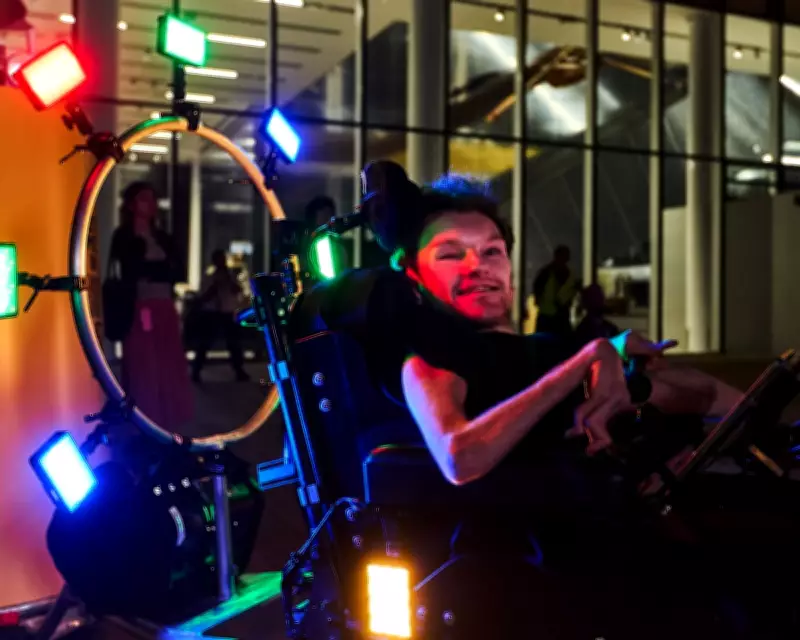
Flavelle, a 26-year-old local artist who uses a wheelchair and has vision in only his left eye, leads the procession in his customised "Wonderchair." This wheelchair is equipped with LED lights, a microphone, a subwoofer, and an iPad controller, with a portable projection rig attached that resembles a festive Dalek. Over two hours, the tour visits four key cultural sites: the Art Gallery of Western Australia, the State Theatre Centre, the WA Museum Boola Bardip, and His Majesty's theatre.

Blending Protest with Party
Let Me In, Let Me Out feels like a hybrid of a protest and a street party, with Flavelle blasting his own electronic compositions as he moves from venue to venue. Assisted by creative collaborators Roly Skender, Mark Haslam, and Lincoln Mackinnon, he uses a microphone to direct the audience. At each stop, projections on building facades highlight specific accessibility issues, such as the lack of audio descriptions or inadequate seating for wheelchair users.
Flavelle's personal experiences inform the performance. For instance, at the Art Gallery of Western Australia, he struggles to read wall text due to its size and height, and audio descriptions are unavailable. When asked if he would visit more often if he could read the text, he simply replies, "Yes." Similarly, at His Majesty's theatre, he projects the message "I can't see the show from the access rows," citing difficulties with the heritage architecture that hinders his entry and exit.
Calling for Improvement
Despite some positive aspects, such as the accessible seating at the State Theatre Centre, Flavelle gently calls out venues for shortcomings. He projects messages like "You've been great, but there's room for improvement" and "Happy to hear you've cleared the artist access toilet. Make space in dressing rooms." These critiques stem from past incidents, like finding accessible bathrooms cluttered with cleaning equipment during a 2019 performance.
Flavelle emphasises that these issues are not unique to Perth. Across cultural institutions, common problems include poor seating for wheelchair users, inappropriate display heights, and lack of access to content like audio guides. With one in five Australians identifying as living with a disability, these barriers affect a significant portion of the population, often making them feel invisible in public spaces.
Broader Implications and Responses
David Doyle, executive director of WA's peak disability arts organisation DADAA, notes that Australia's culture sector has "a long way to go" on accessibility. He points to heritage-listed buildings and outdated regulations, such as the Disability Discrimination Act, as key obstacles. However, hope is on the horizon with a new government arts and disability strategy, including a code of practice for accessibility set to be released later this year.
Morwenna Collett, an access and inclusion consultant involved in developing the code, expresses optimism that it will provide clearer guidance for organisations. Meanwhile, Doyle praises Perth festival for its commitment to showcasing disabled artists, highlighting how such performances can transform audience perceptions and promote inclusion.

Audience Reactions and Institutional Support
Audience members, like Bertie and Vye, attended the show out of curiosity and appreciation for its groundbreaking nature. Vye remarked, "I've not seen an artist with a disability in my mainstream feed before. This is very cool. I think it's breaking down the stigma a little bit." Despite initial fears, Flavelle received support from all venues approached for the performance, with none declining participation.
Anna Reece, Perth festival's artistic director, who commissioned the project, explains that the work is intended as a "cheeky, but very genuine, provocation" rather than an act of shaming. The venues collectively issued a statement acknowledging the performance as part of a shared commitment to improving access, equity, and inclusion.
Reflecting on the experience, Flavelle shared, "I felt nervous at the start, showing off my work, words, music. It got a little bit safer when I played the music. I got used to the audience. By the end I felt great. Relieved. As the audience clapped at my words, my confidence grew." Let Me In, Let Me Out continues to run nightly until 28 February, offering a powerful reminder of the ongoing struggle for accessibility in the arts.