Throughout their 30-year history, Geelong's Back to Back Theatre have built a body of work remarkable for its generosity, courage and intellectual acuity; they're seemingly incapable of glibness or conceptual laziness. The company won the world's richest theatre prize, the Ibsen award (2.5m Norwegian kroner; A$380,000), in 2022, following it up with the Gold Lion at Venice in 2024.
Ganesh Versus the Third Reich – which has toured the world since its 2011 premiere and is now in Melbourne before heading to the Festival d'Automne in Paris – is one of their finest and most daring works, reminding audiences of this company's genius and gumption. It is returning right when we needed it. The play is, as the title suggests, a provocation that interrogates spirituality, politics and the enduring power of symbols, refracted through the meta-theatrical device of the rehearsal room. Given that Back to Back is a company primarily composed of people who identify as having an intellectual disability or neurodivergence, the themes of power imbalance, reclamation and self-actualisation reverberate thrillingly.
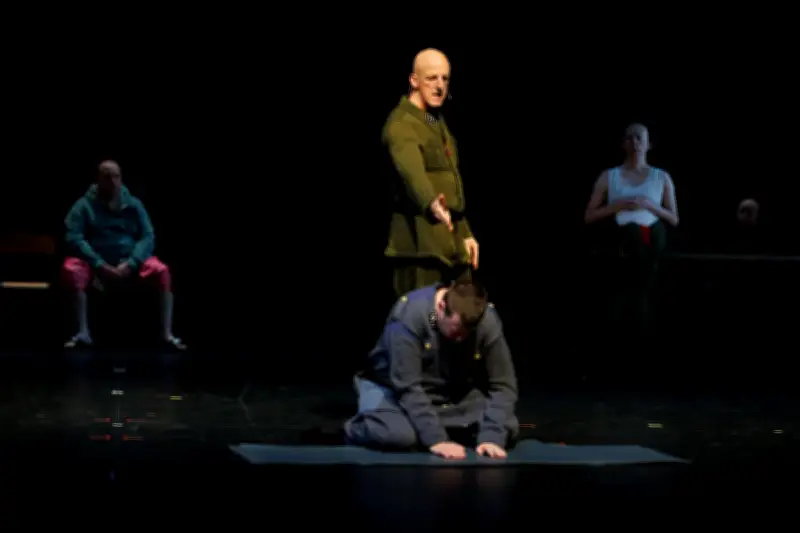
In the beginning, Ganesh (Brian Tilley) is urged by his parents Shiva and Parvati to reclaim the ancient Hindu symbol of the swastika from the Nazis. He travels by train to Berlin – in an eerie reminder of the trains that carried people with disability to the concentration camps – to confront Hitler (Simon Laherty) directly. This narrative line converges with another, the putting on of the play, as the actors break the fourth wall and address each other by their real names. In this way, the devastating resonances of epic theatre are given quotidian real world mirrors, and we see the horrors of ideology play out in the lives of the performers.

Central to the work's sense of danger is the presence of neurotypical actor David Woods, who seems to be the show's director. He is initially calm and supportive, but soon grows tetchy and then abusive. This altered mood culminates in an ugly assault on a cast member who refuses to die correctly (Scott Price), a moment of chilling clarity that pierces the shambolic bonhomie driving much of the rest of the show. Like Ganesh himself, the play is a shape-shifter, altering its appearance in order to flip or underscore its message.
Two key ideas animate Ganesh Versus the Third Reich: the distinction between the real and the imaginary, including the blurred line between the actor and their role; and the need for connection between people. Woods claims at one point he just wants 'one single moment of connection between two people' on stage, but he's being facetious; the entire show is an attachment bond, buzzing and magnanimous. The ensemble's humour and vulnerability create an infectious communalism, but they are capable too of moments of otherworldly theatrical effect that shock the audience into uncomfortable silence. We're never allowed to settle into any single register so are constantly surprised out of our own complacency (a defining feature of Brechtian theatre).
Technically, it's a wonder of ingenuity, economy and conceit. Using the most prosaic materials, Back to Back's artistic director Bruce Gladwin marshals the elements of mood and design to often stunning effect. Long plastic curtains hang to the sides of a large, relatively empty playing space, drawn and parted throughout to create the various scenes of Ganesh's journey. Shadow puppetry, projections and the chiaroscuro in Andrew Livingston and Bluebottle's lighting design create scenes that alternate between lush poeticism and charming frugality. Shio Otani's costumes are witty – Woods constantly undresses to a pair of skimpy blue shorts, like a geriatric raver – and Jóhann Jóhannsson's gorgeous score thrums and soars.
Seeing this show again after such a hiatus is a fascinating, bracing experience. The work hasn't altered at all apart from a single cast change – curiously, Tamika Simpson takes over from Mark Deans, but the ensemble still refer to the character as Mark – but it feels as if everything has changed around it. Fascism is back and anyone considered marginalised or othered is feeling the heat. In that context, Ganesh feels like a statement of solidarity, a plea to our intrinsic messiness and shared humanity.

Symbols are powerful, but they can also be easily corrupted. The theft of the swastika, its debasement from symbol of prosperity to symbol of hate, illustrates how societies co-opt the emblems of enlightenment to foment disunity and grievance. Ganesh Versus the Third Reich depicts an act of restitution, a taking back of power – even if Hitler ominously tells Ganesh 'you'll never get it back'. Back to Back's ensemble, defiant and cooperative, refuses to be reduced to a symbol or allow their individual experiences to stand in lazily for disability in general.
These Brechtian cultural warriors have returned at a pivotal moment of rising fascism, as if to tell populists like Nigel Farage, Donald Trump and Pauline Hanson where to shove their monoculturalism. Thank the gods for that. Ganesh Versus the Third Reich runs until 19 June at Union Theatre at the University of Melbourne Arts and Culture (UMAC). It will then travel to Paris for the Festival d'Automne in November.