The Remarkable Rediscovery of Elizabeth Allen's Textile Art
Elizabeth Allen, a reclusive and largely forgotten textile artist, is experiencing a profound resurgence in recognition through a new exhibition at Compton Verney in Warwickshire. Born in 1883 in Tottenham, London, as one of seventeen children to German and Irish tailor parents, Allen learned sewing from an early age. Her life was marked by obscurity until a fateful visit in 1965 by the artist Patrick Heron, which catapulted her into the art world spotlight. The Guardian praised her as "a remarkable colourist," noting that masters like Klee and Matisse would have admired her work. However, after her death in 1967, her creations faded from public view, only to be unearthed anew decades later.
A Life of Struggle and Creativity
Allen lived in a dilapidated hut at the end of a steep, muddy track in Biggin Hill, Bromley, with a sign on the door instructing visitors to "Knock very loudly." Her humble abode, filled with fabric offcuts from her parents' tailoring workshop, served as both inspiration and palette for her art. She used a tailor's thimble without a top for faster stitching and sourced materials like ribbons and braids from bankrupt textile businesses. Despite her physical disability—she was born with one leg shorter than the other, often depicted in her works through orthopaedic footwear—Allen devoted herself to needlework, perhaps as an alternative to activities like dancing.
Key Works and Themes
The exhibition features several of Allen's textile pieces, many hidden in storage or private collections for nearly half a century. Notable works include:

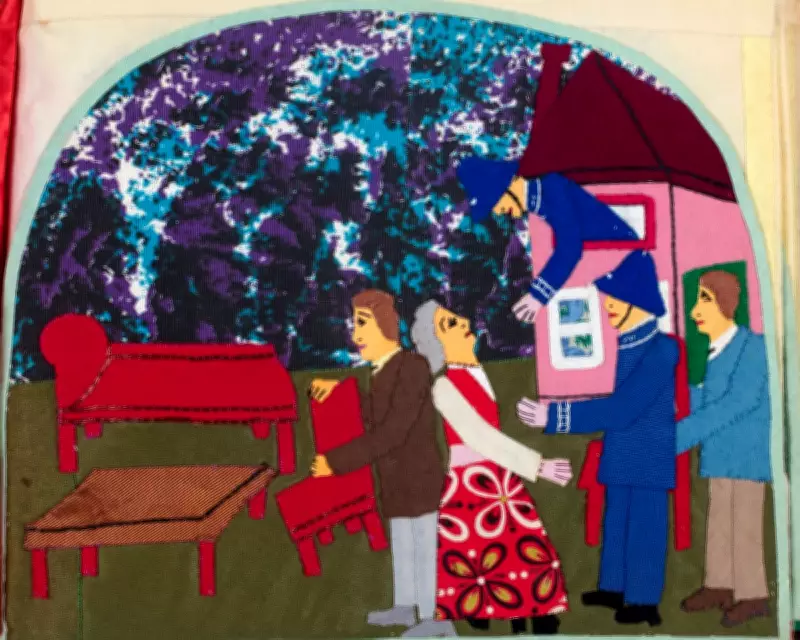
- Autobiraggraphy: This piece, shown publicly for the first time, depicts scenes from Allen's life, such as her birth in a romanticised cottage setting and a wrongful eviction in 1934 from a Suffolk cottage. In the eviction scene, police officers are rendered in felt, with Allen, known as Queen to her family, wearing a floral skirt and gazing up in despair.
- The Great Swan Song (1966): Reflecting her surprise at sudden fame, this work features a black bird in a cobalt-blue pond, with red eyes gazing at a vermilion sky, symbolising her hut with bright green striped cloth.
- The Black Feet Are Kicking: A powerful response to African nations gaining independence in the 1950s and 60s, it shows appliqued black figures marching against a cream satin background, dominated by giant black feet and an eye in a golden box, suggesting imminent power transfer.
- Lunar-Ticks Picnic (1965): A playful commentary on the US-Soviet space race, depicting creatures peacefully gathered around a campfire, implying that celestial realms should remain free from earthly conflicts.
Personal Beliefs and Influences
Allen had a complex relationship with religion, rejecting traditional God concepts after her mother attributed her disability to "the sins of the fathers." She was even thrown out of her family home for atheism. Yet, biblical themes permeate her art, such as in pieces depicting Jonah and the whale or the "fallen woman of Babylon." According to Ila Colley, folk art curator at Compton Verney, Allen was critical of institutionalised religion but deeply engaged with biblical narratives. Her work Beetles Come and Go But Christ Remains Forever critiques celebrity culture, inspired by John Lennon's claim that the Beatles were more popular than Jesus.
Rediscovery and Legacy
Allen's resurgence is partly due to Bridget, an art student who lived nearby in Biggin Hill and became fascinated by her work. Bridget moved in with Allen, assisting her and later facilitating visits from tutors and Patrick Heron. Now in her 80s, Bridget's letters have been instrumental in curating the exhibition. Colley emphasises that Allen, as a working-class woman with no formal training and a disability, was marginalised by art history, barely recognised as an artist. The exhibition aims to promote a more inclusive view of art, highlighting voices often overlooked.

Colley hopes this show will lead to discovering more of Allen's works and a deeper understanding of her life. "It's an investigative project," she says, expressing aspirations for a larger future exhibition. Elizabeth Allen's art is featured in Troublemakers and Prophets at Compton Verney until 31 August, offering a rare glimpse into the vibrant world of a once-forgotten visionary.