The Dog's Gaze: A Cultural History Through Art
In the Chauvet cave of France's Ardèche region, Paleolithic artists created stunning depictions of apex predators like lions and mammoths around 35,000 years ago. Notably absent from these ancient artworks are dogs, yet the soft limestone floor preserves a poignant trace: canid pawprints alongside human footprints. This discovery suggests a moment of shared contemplation between a boy and a dog, gazing up at the walls in wonder approximately 10,000 years after the art was made. It is this intimate connection that forms the foundation of Thomas Laqueur's illuminating exploration in his new book, The Dog's Gaze.
Dogs as Threshold Figures Between Nature and Culture
Laqueur, an American cultural historian, argues that dogs hold a unique position as the first animals to live companionably with humans, marking a boundary between nature and culture. This threshold status has endowed dogs with a rich symbolic role in Western art. By including dogs in paintings—such as the snuffling canines in Seurat's La Grande Jatte or the weary hounds in Bruegel the Elder's Hunters in the Snow—artists infuse their works with additional resonance and layered meanings.
Laqueur's book takes readers on a beautifully illustrated journey through art history, from Rembrandt's etching The Good Samaritan, featuring a shitting cur, to Jeff Koons' iconic balloon dog, and even touching on cinema star Lassie. However, his primary focus is on instances where dogs are engaged in acts of looking. He identifies two key scenarios: dogs peering deeper into a scene to decipher its events, or turning to gaze at the viewer, as if to ask, "Are you seeing this?" or "Can you believe it?"

Velázquez's Mastiff and Picasso's Dachshund
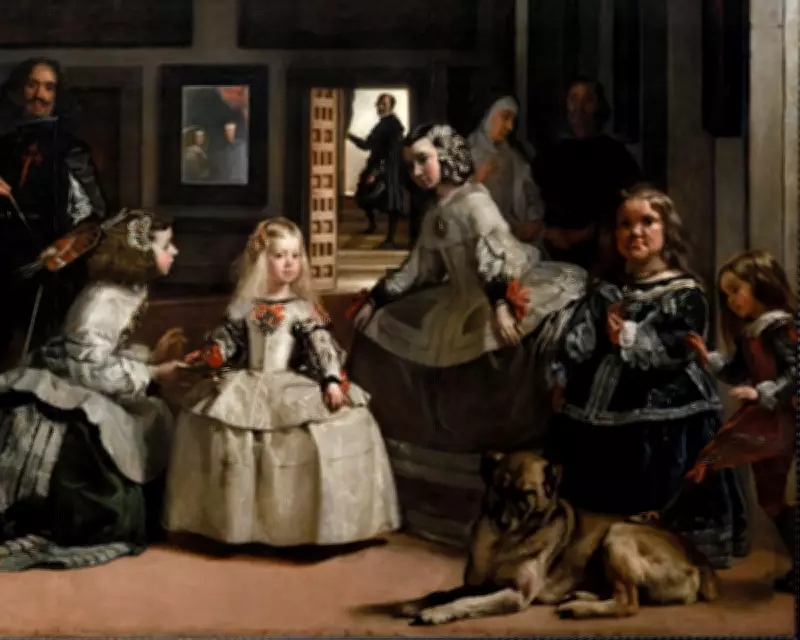
A prime example is the sleepy mastiff in the bottom right-hand corner of Diego Velázquez's masterpiece, Las Meninas, set in the bustling court of Philip IV in Madrid. Compositionally, the dog's solid form grounds the chaotic scene, where ladies-in-waiting attend to the Infanta, a chamberlain lingers in a doorway, and the king and queen appear in a mirror. Velázquez even includes himself in the painting. The mastiff's droopy-eyed glance out of the frame towards the viewer is both matter-of-fact and subtly cynical, seeming to say, "Don't worry about the tricks of perspective above; you and I know what's real."
Despite centuries of scholarly analysis on Las Meninas, the mastiff often goes unnoticed. Yet, Pablo Picasso saw it clearly. In 1957, he created a series of paintings riffing on Velázquez's work, replacing the mastiff with his beloved dachshund, Lump, in 15 of them. Lump romps through this Cubist universe with what Laqueur describes as a "brazen" gaze, challenging viewers to find meaning in a scene that defies stable interpretation.
Dogs as Viewers' Alter Egos in Sacred Scenes
Laqueur persuasively concludes that dogs in Western art serve as entry points or alter egos for viewers who might feel overwhelmed. In Veronese's The Wedding Feast at Cana, six dogs are present. While some gaze piously at the miracle, a scruffy dog in the corner focuses on fallen scraps, allowing greedy viewers a place in the sacred scene. However, when Veronese attempted to include a dog in his Last Supper interpretation in 1573, the Inquisition accused him of blasphemy. Undeterred, he renamed the painting The Feast in the House of Levi and kept the dog, showcasing art's enduring defiance.
The Dog's Gaze by Thomas Laqueur is published by Allen Lane, priced at £35. This clever and beautiful survey not only highlights dogs' artistic roles but also deepens our understanding of human-animal bonds through history.