The art world mourns the passing of Derek Morris, the esteemed sculptor and dedicated educator who taught at Norwich School of Art for twenty-five years until his retirement in 1990. Morris, who has died aged 85, leaves behind a profound legacy in British sculpture education and practice.
A Quarter-Century of Artistic Leadership
Morris became the sculpture course leader at Norwich School of Art in 1971, a position he held with distinction for nearly two decades. Under his guidance, he and his colleagues cultivated an exceptional reputation for the institution's sculpture department, transforming it into a premier destination for art students throughout the 1980s. The school has since evolved into Norwich University of the Arts, building upon the foundations Morris helped establish.
Philosophy of Material Mastery
Central to Morris's teaching philosophy was the conviction that meaningful sculptural concepts must emerge from deep, practical knowledge of materials and processes. This principle was evident in his own artistic work and became the cornerstone of the curriculum he developed. His approach emphasised hands-on understanding, preparing students to engage with sculpture through both technical skill and creative vision.

This dedication to material expertise became even more pronounced after Morris retired from teaching, allowing him to focus entirely on his personal artistic practice. He once remarked that regular studio work was essential to his sense of purpose, stating: "if I cannot enter my studio on a regular basis, my life becomes disjointed and lacking in serious purpose."
Early Life and Artistic Foundations
Derek Morris was born into a creative Birmingham household where making was second nature. By age six, he was already mixing plaster, influenced by his mother Connie, an accomplished weaver and embroiderer, and his father Jack, a draughtsman and pattern maker for decorative sculpture. His elder sister Jean broke barriers as the first female jewellery student at the Royal College of Art, becoming a respected jeweller and silversmith.
After attending King Edward's grammar school in Birmingham, Morris pursued fine art at the University of Newcastle upon Tyne, graduating with first-class honours. A Hatton scholarship in 1962 enabled him to continue his studies for an additional year at Newcastle, where he met Christina Rich, an undergraduate who would become his wife in 1963.
Academic and Teaching Journey
Morris's educational path included further study at Chelsea School of Art and a return to Newcastle University before he began his teaching career. In 1966, he joined the foundation course at Norwich School of Art, progressing to become a sculpture tutor and eventually course leader. During his teaching years, he settled with his family in Tasburgh, Norfolk, where he renovated a historic 15th-century thatched cottage.
Retirement: A New Chapter of Creativity
Upon retiring in 1990, Morris immersed himself fully in sculpture, exhibiting regularly across East Anglia and maintaining a disciplined studio practice. His retirement years also revealed other talents: he developed into an expert gardener and accomplished cook. In 1992, he was runner-up in an Observer newspaper cookery competition, and in 1995 he won a regional semi-final of BBC TV's MasterChef series.
From 1998 to 2004, Morris served as president of the Royal British Society of Sculptors (now the Royal Society of Sculptors), where he played a crucial role in expanding the organisation's international membership and influence.
Family and Legacy
Derek Morris is survived by his wife Christina, their children Abigail, Nathan, Simeon and Lucy, and grandchildren Ottilie, Rufus and Agatha. His contributions to sculpture education continue to resonate through the countless artists he mentored and the institutional excellence he helped build at Norwich.
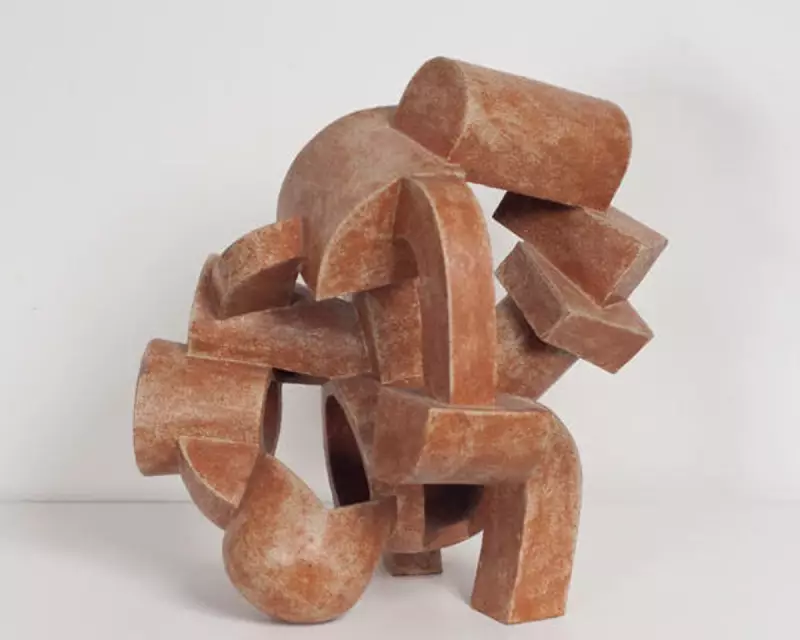
His artistic works, including ceramic pieces like Red Configuration (1993) and plywood constructions such as Seven Coloured Trapezoids (2019), stand as testaments to his lifelong engagement with material and form. Morris's legacy encompasses not only his own sculptures but also the generations of sculptors he inspired through his teaching and leadership.