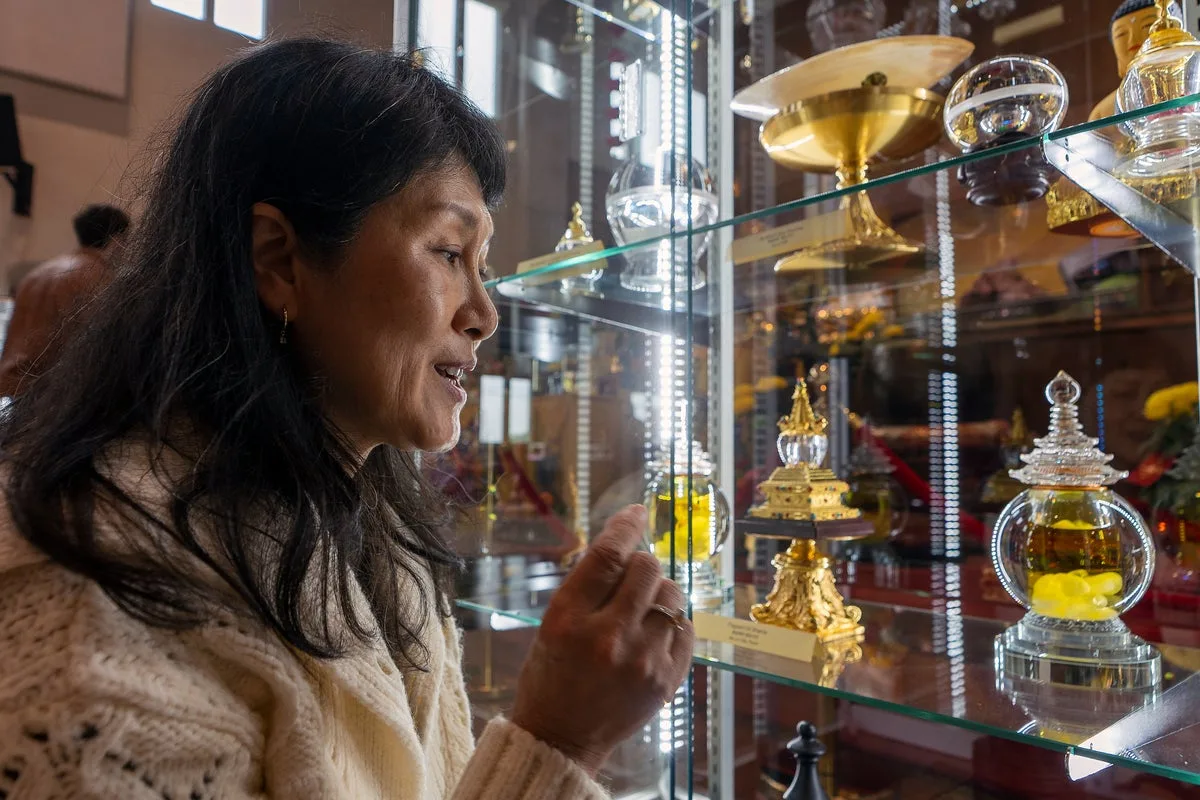
Katherine Nguyen stood with hands folded and head bowed at the altar of a Buddhist temple in Southern California. Before her were tooth and finger bone relics believed to belong to Shakyamuni Buddha, the founder of Buddhism who is said to have attained enlightenment in India about 2,500 years ago.
“To be able to see the Buddha, to get close to him and feel the energy — it’s very special for a Buddhist,” Nguyen said. Every Lunar New Year, the Wei Mountain Temple in Rosemead, California, publicly displays what it calls the “10,000 Buddha Relics,” though the actual number contained in several glass display cases and miniature stupas or reliquaries is far larger, according to the temple’s founder, Master YongHua.
The collection prominently features bones and teeth believed to have come from the bodies of the Buddha, his relatives and disciples. It also includes numerous shariras — colourful pearl- or crystal-like objects said to have been culled from the cremated ashes of Buddhist masters and the Buddha. At the Rosemead temple, the teeth and finger bone relics are significantly larger than those in the average human body. YongHua said that's because they have “grown” over the years. The tooth relic, he said, produces “baby shariras,” the multicoloured crystals believed to have multiplied and filled several containers in their exhibit.

Most Buddhist sects acknowledge the spiritual significance of relics even if some teachers have tried to shift the focus to Buddha's teachings that emphasise mindfulness and kindness. Over the years, there have been many reports of fake tooth and bone relics as well as manufactured acrylic shariras flooding markets in Asia and online shopping platforms, often sold with falsified authenticity certificates. Singapore's Buddha Tooth Relic Temple and Museum houses a tooth relic said to have been recovered from the Buddha's funeral pyre in a giant stupa fashioned from 705 pounds (320 kilograms) of gold. That relic came under scrutiny in 2007 after dental experts pointed out that the 3-inch (7.5 centimetre) tooth's characteristics were incompatible with the dimensions of a human tooth and most likely belonged to a cow or a buffalo.
YongHua says the main purpose of the relics donated to the Rosemead temple about 14 years ago by a collector is to inspire faith. He has no doubts about their ethereal nature. “I have seen them multiply with my own eyes,” he said. “They move on their own, they levitate. ... I’ve seen people get cured of various ailments just by being in their presence.” John Strong, professor emeritus of religion at Bates College in Lewiston, Maine, wrote the book “Relics of the Buddha” in 2004. He said the earliest accounts of Buddha’s funeral are found in Pali texts dating from about the 2nd century B.C.E. Later commentaries describe the relics that came out of the Buddha’s ashes as glittering jewels — some as small as mustard seeds and others resembling gems or golden nuggets.
Geshe Tenzin Zopa, a Tibetan monk and educator, said relics are “the most precious, most sacred, most powerful holy objects in our understanding.” As a young monk in Nepal, he believes he witnessed relics multiplying. “It’s a sign of the presence of the Buddha,” he said.