Simon Stephens's new play A Slow Fire, now running at Jermyn Street Theatre, places two men in a bunker after an unspecified holocaust, but the execution feels too wilfully obscure. The production, directed by Rex Ryan for Dublin company Glass Mask, runs to 26 September.
Two men in a bunker
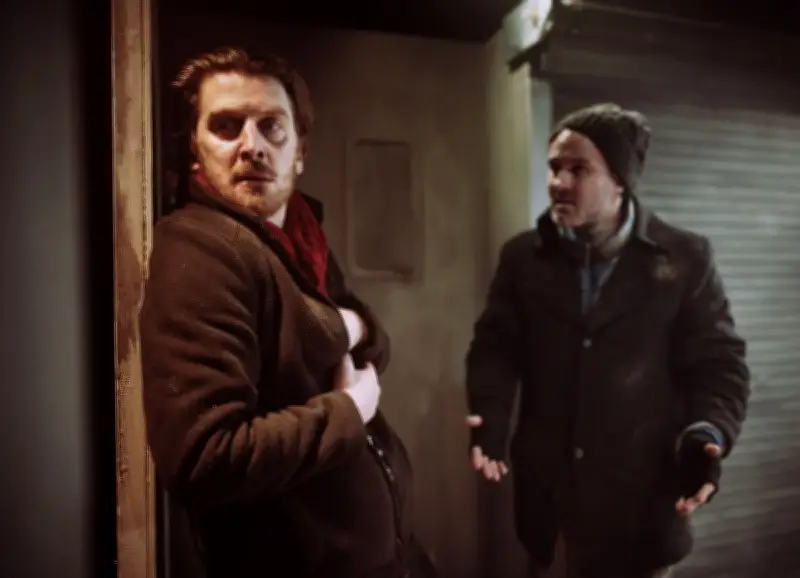
Reece (Ian Toner) and Ashton (Ross Gaynor) cower in a bunker, testily acting out ritualised exchanges to stave off despair. If the scenario vaguely recalls Samuel Beckett's Endgame, the characters are more like the two clowns in Waiting for Godot, only younger. They seem to have been students when nuclear war or climate change or something else devastated the world.
Both are childlike, though Reece apparently has a surly teenage son, whom he vaguely hopes to see again one day, and bequeath his crappy but coveted digital watch. The two flirt, bicker and dance, performing dialogue about Christmas celebrations, university interviews and a surprise pregnancy. They speak with Irish accents, but the town they live in is imagined: features include “the Chelsea Mines” and “Alaska Beach”.

A fragile equilibrium
They have a vase of plastic tulips, a paraffin stove to cook rice, and one LP — the greatest hits of 1930s vocal harmony group The Ink Spots — but no power for their record player. There is no sun or rain outside any more, only winds and fires.
In due course, the fragile equilibrium of their world is unbalanced by the arrival of a stranger, Presley (Fionn Ó Loingsigh), who has a gun, a portable generator and some “pork”. Andrew Clancy's set is dominated by a huge, slatted shutter through which ominous red light seeps. Like the gun, you know it will be deployed at some point.
Initially, though, we're baffled. Are Ashton and Reece friends, lovers or actors rehearsing scenes? Slowly we realise that they're playing out past exchanges from their respective lives, each complaining when the other gets a line or an intention wrong. These moments have the hectic gabble of a read-through, the characters exaggerated, with little emotion behind them apart from annoyance. Ashton also obsessively recreates lost maps, “to symbolically articulate where we are in space”, and gets shirty when Reece points out that he's missed a street or two. The performances of all the actors are unremittingly blazing-eyed and shouty in this tiny venue.
Vagueness and stasis
There's a teeth-itching sense of vagueness and stasis about the whole thing. What form did the apocalypse take? Why and how did Ashton build the bunker? Reece regularly ventures outside, so why don't they leave? Why do Presley and Reece bang on about going to the seaside for an ice cream if they know the world is blasted?
Nick Curtis, normally a huge fan of Stephens, finds fine writing here, especially in a single speech that marks the major, jack-in-the-box surprise of Ryan's production (a second surprise can be seen coming a mile off). But there is also a sense of archness and artificiality to the dialogue and the plot — of random elements thrown in to trip the audience up again. At one point Ashton seems to fall seriously ill, then recovers. At a moment of high tension, Reece becomes deaf or distracted, responding to Presley only with the repeated word “what?” Mechanical clatter intrudes, then abates, and is never explained.
Maybe the critic is being over-literal. Maybe this fractured, looping doomsday scenario is a legitimate response to a world that seems to be going to hell in a handcart (or perhaps in a MAGA hat). Maybe survivors will regress into comfortable memories and familiar desires (while Reece craves ice cream, Presley says he misses blowjobs). But the dynamics of A Slow Fire feel too familiar, the execution too wilfully obscure. One of Stephens's lines that Curtis wrote down is: “I don't have to understand the words, I just have to say them.” Well, quite.