The Dark Side of the Disney Legend
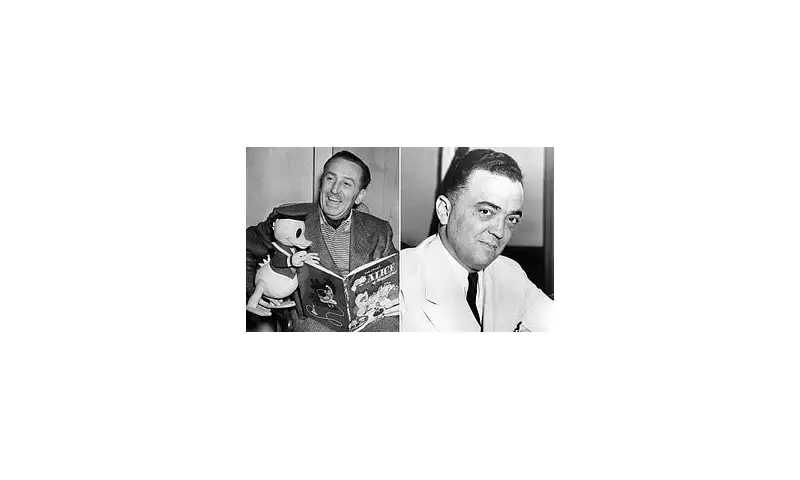
To generations of children worldwide, Walt Disney remains the beloved creator of Mickey Mouse and the architect of magical childhood memories. However, newly uncovered documents reveal a startling aspect of the animation pioneer's life that contrasts sharply with his public image. Walt Disney maintained a decades-long confidential relationship with the FBI, actively informing on staff he suspected of Communist sympathies during the height of the Cold War.
A Friendship Forged in Suspicion
The extraordinary alliance began in 1936 when FBI Director J. Edgar Hoover sent Disney a letter, sparking a friendship that would last thirty years until Disney's death in 1966. This relationship went far beyond casual acquaintance, with Disney regularly alerting FBI agents about Hollywood figures he believed were engaged in what he termed 'subversive activities.'
In 1947, Disney took his cooperation to new levels by testifying before the House Un-American Activities Committee about a strike that had disrupted his studio six years earlier. He confidently asserted that the industrial action resulted from 'Communistic agitation' and identified numerous animators by name as Communist aggravators, effectively ending many careers during the Red Scare era.

Disney's Propaganda Machine
Disney's support for the FBI extended beyond mere informant work. He reportedly altered scripts for films and television shows to ensure the bureau was portrayed favourably. When Disneyland opened its gates in 1955, Disney provided FBI agents with complimentary access to the magical kingdom.
According to documents released by the FBI: 'Mr. Disney has volunteered representative of this office complete access to the facilities of Disneyland for use in connection with official matters and recreational purposes.'
The animation magnate even proposed giving the FBI a dedicated space in his Tomorrowland exhibition to showcase the agency's work to young visitors. Documents reveal that Disney questioned 'whether it would be possible to prepare a display or demonstration of how science is employed by the FBI through its Laboratory and Identification Divisions.'
Disney's promotional efforts culminated in 1958 with a three-part series aired on the Mickey Mouse Club that glorified the FBI's work. The programmes followed a 13-year-old reporter named Dirk Metzger, who received an extensive tour of FBI facilities. Viewers watched as agents fired at targets featuring the face of notorious bank robber Baby Faced Nelson, while Metzger met with Disney's friend Hoover and learned basic hand-to-hand combat techniques.
A Complex Legacy
Historical accounts suggest Disney was a demanding leader who inspired fear among his employees. Historian Neal Gabler, who extensively researched Disney for his biography, noted that everyone who worked at Disney 'was terrified' of him, describing the animator as a stern taskmaster who insisted on strict adherence to his creative vision.
However, not all recollections paint such a harsh picture. Composer Richard Sherman, who began working for Disney in 1960, recalled a different man at the panel discussion in 2015. 'He was a great soul, he really was. And he had his flaws, of course. Who doesn't? But the main thing is he was driven to do good things,' Sherman stated, suggesting Disney had mellowed in his later years after decades of achievement.
Disney remained driven until his final days. On his deathbed in 1966, he was reportedly briefing his brother Roy about plans for the EPCOT theme park at Walt Disney World Resort in Orlando, Florida. His collaboration with the FBI earned him the honorary title of Special Agent in Charge Contact, a testament to his extensive cooperation with the bureau.
These revelations present a complex portrait of a man celebrated for bringing joy to millions while simultaneously participating in political persecution during one of America's most paranoid eras. The documents challenge the sanitised version of Disney's legacy, revealing a figure deeply embedded in the political machinations of his time.