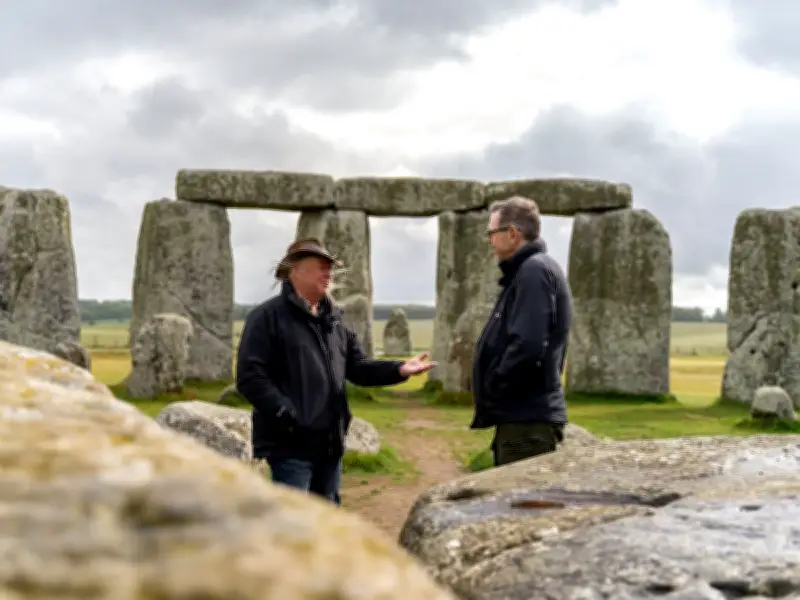
A new discovery by archaeologists is believed to be an earlier 'prototype' of Stonehenge, roughly three miles from the prehistoric monument. However, the remains of the older structure are simply two holes in the ground. Despite this, scientists say they, in the same manner as Stonehenge, once held wooden posts that lined up with the sun on the summer and winter solstices.
Discovery Led by Phil Harding
The discovery, led by Phil Harding of Wessex Archaeology, has revealed a 5,000-year-old 'prototype' for Stonehenge's solar alignment. Findings suggest that the site dates back around 5,000 years, predating Stonehenge by 500 years. At the site, archaeologists also found artefacts that suggested gatherings were held there, including pottery, flint tools, and animal bone.
Harding said it was one of the best finds of his expansive career. He stated: "Two post pits tell me [much] more about the people 5,000 years ago. This tells me about the whole community, this tells me about how they were thinking, how they were behaving, how they were revering the heavens."

Alignment and Significance
The positioning of the posts mimicked how the stones at Stonehenge are precisely placed to line up with the sun on the shortest and longest days of the year. If stood central to the stones, you would see the sun rise over a stone called the heel to the north east of the circle on the summer solstice and then set over the altar stone to the south west in midwinter.
Signs of the earlier structure were discovered in Bulford ten years ago when the ground was cleared for new army housing, but it has taken until now for a detailed analysis of the alignment to be carried out. This involved turning back the celestial clock. The original excavations at Bulford, carried out between 2015 and 2017, revealed 48 pits that were radiocarbon dated to around 2950 BC.
Expert Insights
Harding added: "Up 'till now, our knowledge of this ancient feat of astronomy was based on Stonehenge and other monuments of a similar period, but what we've discovered at Bulford is 500 years earlier than the famous stones we know so well."
Dr Fabio Silva, Skyscape Archaeologist at Stone x Sky and the Skyscape Academy, who conducted the analysis that confirmed the alignment, said: "This discovery helps us understand Stonehenge not as a singular creation, but as part of a much longer conversation between people, the land, and the sky. The alignment shows that communities were already engaging with both the summer and winter solstices in the Stonehenge landscape, centuries before the sarsen stones were raised. Rather than marking the beginning of a story, Stonehenge now more clearly appears to have emerged from traditions and practices with much deeper roots in this landscape."
Notable Artefacts
A rare Neolithic knife that has been rounded into a disc-shape was one of the tools uncovered and what Harding labelled their "star find." He said: "What is so special about it is the workmanship that's gone into it. That is the work of real craftsmanship." He noted that the knife was discovered in an upright position as if to have been purposefully placed.