Oxbridge Admission Figures Unveil Courses with Highest Success Rates
Newly released admission statistics from Oxford and Cambridge universities have highlighted the subjects where applicants stand the best chance of securing a coveted place. The data reveals a significant disparity in success rates across different disciplines, with modern languages, classics, and music emerging as the most accessible pathways into these prestigious institutions.
Cambridge's Leading Subjects for Admission Success
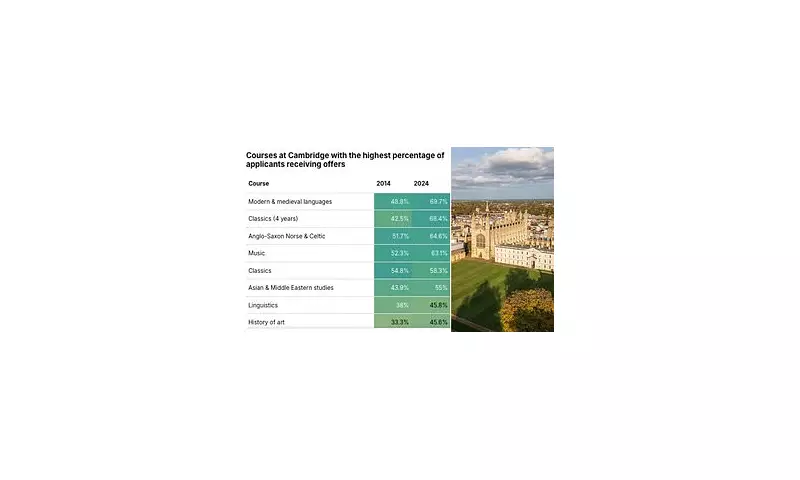
At the University of Cambridge, modern and medieval languages demonstrated the highest acceptance rate for the 2024 intake. An impressive 69.7 per cent of applicants received offers, marking a substantial increase from 48.8 per cent a decade earlier according to The Times. This represents the most favourable odds across all Cambridge subjects.
Asian and Middle Eastern studies along with linguistics also showed notably higher success rates compared to more competitive disciplines. In stark contrast, engineering proved to be the most sought-after degree at Cambridge with 2,654 applications, yet only 371 candidates received offers - a mere 13.9 per cent acceptance rate.

Oxford's Most Accessible Academic Pathways
Oxford University displayed similar patterns, with European and Middle Eastern languages accepting half of all applicants. This represents a remarkable improvement from the 8.1 per cent acceptance rate recorded in 2014. Philosophy combined with modern languages achieved a 42.6 per cent success rate, while geography followed closely at 33.8 per cent.
These figures emerge against a backdrop of declining overall admission chances at both universities over the past decade. Oxford's acceptance rate has fallen from 20 per cent to 16 per cent as applications surged from 17,500 to 23,000. Cambridge experienced a similar trend, with offer rates dropping from 25 per cent to 22 per cent while applications increased from 16,750 to 22,150.
Expert Warnings Against Strategic Course Selection
Admissions specialists have issued strong cautions to prospective students considering applying for subjects based solely on statistical advantage. Tom Moon, head of consultancy at Oxbridge Applications, emphasised the potential pitfalls of this approach.
'A student at Oxford or Cambridge is typically working harder than they have ever done in their life, and if they're doing this studying a subject they don't care about, they're likely to have a miserable time,' he told The Times. Moon stressed that the application process should not be reduced to 'just an exercise in data analysis' but rather a genuine pursuit of academic passion at world-leading institutions.
Ariana Azad, founder of educational consultancy Figtree Learning, confirmed observing a subset of students primarily focused on 'getting into Oxbridge' with course selection treated as secondary consideration. This strategic approach appears to be growing in response to intensifying competition for places.
University Perspectives on Changing Admission Landscape
A Cambridge University spokesman acknowledged the steady rise in applications over the past decade, attributing this trend to multiple factors including demographic changes, evolving social attitudes, and enhanced outreach activities across the nation. The university highlighted its high graduate employability rate and the highest continuation rate of any UK university as contributing factors to its enduring appeal.
The Daily Mail has contacted the University of Oxford for comment regarding these admission patterns and the implications for prospective students navigating increasingly competitive application processes.