A South Korean mathematician has finally solved the moving sofa problem, a geometric puzzle that has baffled researchers for nearly 60 years. Dr Baek Jin Eon, a 31-year-old research fellow at the Korea Institute for Advanced Study, has proven that no shape larger than a previously proposed design can navigate a right-angled corridor of fixed width.
The problem, first posed in 1966, asks for the two-dimensional shape with the largest possible area that can be manoeuvred through an L-shaped corridor of width one. In 1992, mathematician Joseph Gerver proposed a complex curved shape, known as Gerver's sofa, as a likely solution, but a proof of optimality remained elusive.
After seven years of work, Dr Baek demonstrated that Gerver's design is indeed optimal. His 119-page proof, published on the preprint server arXiv in late 2024, relies entirely on logical reasoning rather than computer simulations. The research has been named by Scientific American as one of its top 10 math discoveries of 2025.
Dr Baek began working on the problem during his mandatory military service and continued through his doctoral studies in the US and as a postdoctoral researcher in South Korea. The proof is currently under peer review at the Annals of Mathematics, one of the discipline's most prestigious journals.
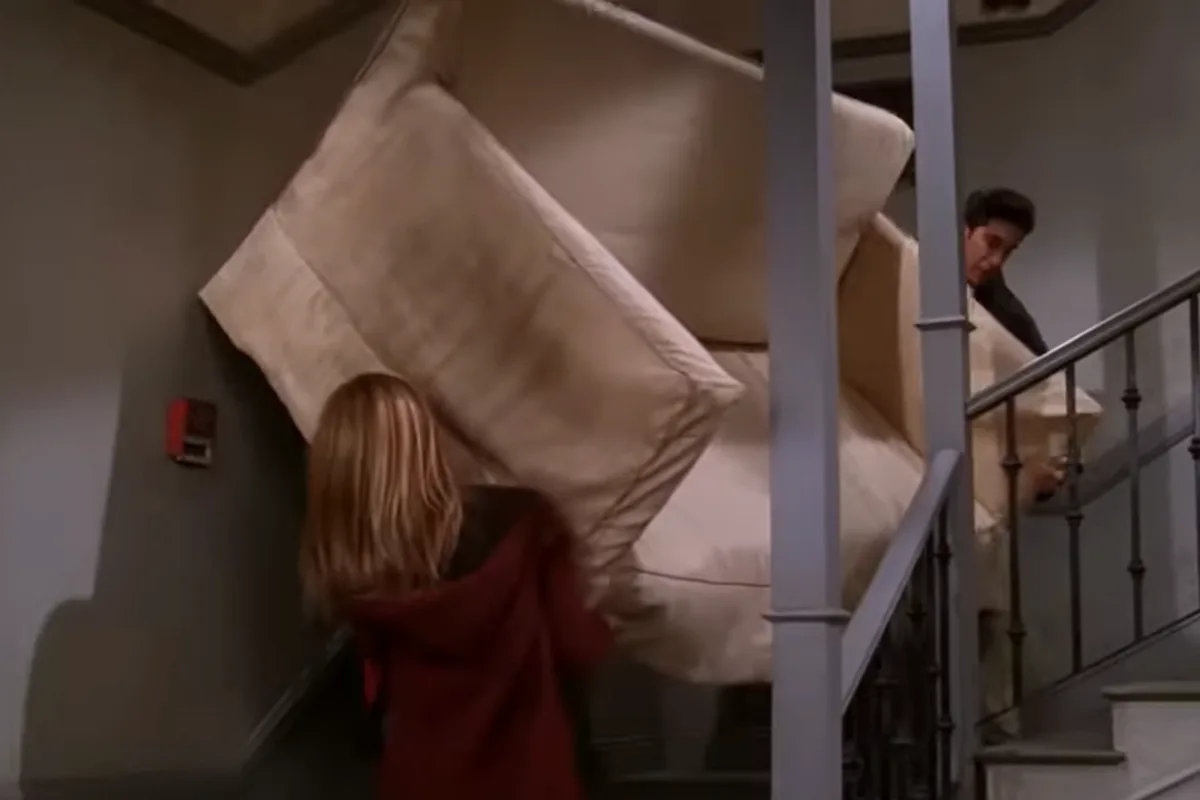
The moving sofa problem gained popular attention through the US sitcom Friends, in which characters famously struggle to move a sofa up a staircase, shouting 'Pivot!'. Scientific American joked that explaining that scene required a 119-page paper.