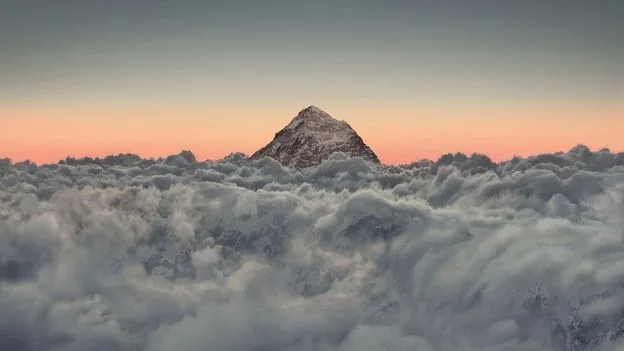
Arching over 8,849 metres (29,032ft) into the sky, Everest is the world’s tallest mountain. But will it always be? Mount Everest, along with the rest of the Himalayas, inches further skyward every year, raising an intriguing question – with enough time, just how tall can it grow?
Mount Everest towers 8,848.86m (29,032ft) above sea level, according to the most recent official joint survey by China and Nepal, whose borders run across its summit. But it isn't the only giant in these lands – 10 of the world's 14 peaks higher than 8,000m (26,247ft) above sea level can be found in the Himalayan range. Everest, says geologist Aurora Elmore, is among friends.
The history of measuring the tallest mountain in the world stretches back to 1852. Radhanath Sikdar, an Indian mathematician employed by the British, used trigonometry to measure the horizontal and vertical angles of Everest's summit from other mountaintops. He made a momentous discovery: the tallest mountain ever recorded, standing at 8,839.8m (29,002ft) tall. Though technology has advanced, his figure was astonishingly accurate, just nine metres off the latest official height.
Since then, teams have continued to work to understand Mount Everest's height. In 1954 an Indian survey determined it to be 8,848m (29,029ft) tall, a figure accepted by the Nepalese government. But in 2005, the Chinese measured it at 8,844.43m (29,017ft) – nearly four metres lower. In 2020, teams from China and Nepal jointly agreed upon a new officially accepted height that was 0.86m higher than the Survey of India's 1954 measurement.