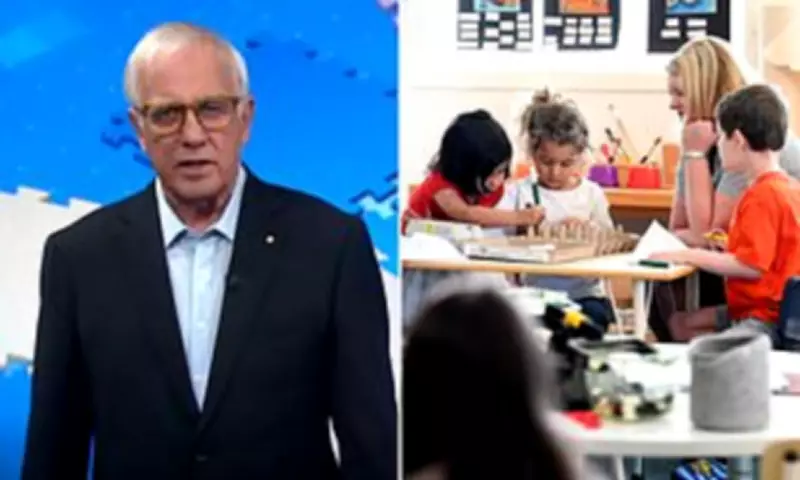
Australian Finance Guru Advocates for Nationalised Childcare System
In a bold and controversial proposal, one of Australia's foremost financial commentators has called upon the Albanese government to nationalise the entire childcare industry. ABC presenter Alan Kohler has urged policymakers to make early childhood education completely free for all children under five years old, framing it as a critical solution to pressing social and economic challenges.
'Crazy Talk' Proposal with Serious Intent
Kohler openly acknowledged that his suggestion might be perceived as "crazy talk" and likely arrives too late for consideration in next month's federal budget. However, he insisted that the fundamental premise deserves serious examination. "Extend public education to children under five," Kohler told his audience. "It should never have been allowed to be entirely private."
The proposal emerges against a backdrop of significant government intervention in the childcare sector, prompted by a troubling spike in reports of alleged abuse over the past twelve months. While current subsidies cover up to 90 percent of fees for low-income families, Kohler highlighted how middle-income households often find themselves with nothing remaining after covering mortgage payments and childcare costs.

Gender Equality and Economic Participation at Stake
Kohler framed the issue as extending far beyond simple childcare provision. He identified it as a multidimensional problem encompassing gender equality, housing affordability, and the broader cost-of-living crisis. Supporting his argument, he cited Productivity Commission data revealing that while workforce participation among fathers has remained stagnant for three decades, the percentage of working mothers has surged from 60 percent to 80 percent.
"But nationalisation? That's crazy talk," Kohler conceded before adding, "Well, yes, but anyone who examines this always concludes that something needs to be done."
Financial Mechanics of a Nationalised System
The finance expert presented detailed calculations to support his radical vision. He estimated that acquiring Australia's nearly 10,000 childcare centres, which provide over 733,000 approved places, would require approximately $60 billion. Kohler proposed financing this through "childcare bonds" issued to superannuation funds, costing around $3 billion annually in interest at current bond rates.
Annual operational costs, including staff employment, would amount to roughly $20 billion. However, Kohler projected that making childcare free would significantly increase usage, potentially raising running costs to $30 billion. This would bring the total annual expenditure to approximately $33 billion.
"Call the rest an investment in workforce participation, productivity and gender equality," Kohler suggested. "It would also be an effective way to deal with housing affordability, the cost of living, and staying in power."
Industry Structure and Subsidy Questions
Kohler raised pointed questions about the current subsidy framework, noting that 70 percent of childcare operators function as for-profit entities. He contrasted this with the private school system, where only not-for-profit institutions receive federal subsidies and tax deductibility for donations.
"Should we really be giving the shareholders of private childcare companies subsidies of 90 or 100 percent of their product?" Kohler questioned. "Would it really be that expensive to nationalise the industry and then run it?"
Mixed Reactions and Political Backlash
The proposal has ignited fierce debate across Australian society. Supporters applauded the vision of extending public education to younger children. "Yes, extend the education system to under fives," one commentator urged. "It's not childcare anymore, it's early childhood education. The workers are mostly tertiary trained. The level of care and education is exceptional."
Another supporter suggested: "Every public school should have an early childhood department and childcare." Some even proposed expanding the nationalisation concept to other sectors like aged care.

However, significant opposition emerged, led by lawyer and former federal Liberal candidate Katherine Deves. "No thanks," Deves declared. "Why would we hand our kids over to institutionalised day care - so you can indoctrinate them into a globalist communist Fabian worldview from infancy?" She advocated instead for attaching childcare stipends directly to children, allowing parents to make their own choices.
Other critics challenged the proposal's financial feasibility and philosophical foundations. "If they make childcare free, where are they going to get the money from?" one skeptic asked. Another suggested a more moderate approach: "No reason to buy the existing centres, just hand childcare to states and territories to run under existing education departments and fund the same as public schools."
Policy Context and Recent Reforms
This debate occurs within a broader policy landscape. In 2024, the Productivity Commission recommended either raising the childcare subsidy to 100 percent for families earning under $80,000, with gradual reductions for higher incomes, or implementing a flat 90 percent subsidy for all households regardless of income.
The Commission also advised scrapping the activity-means test, arguing it disproportionately harmed families in genuine need without delivering "substantial" improvements in workforce participation. This recommendation prompted Prime Minister Anthony Albanese to replace the previous government's activity test with a guaranteed minimum of three subsidised childcare days weekly for all Australian parents, irrespective of work or study commitments.
Implemented on January 1 this year, this reform has already made approximately 100,000 additional families eligible for extra childcare days. Kohler's nationalisation proposal represents a far more radical departure from current policy, challenging fundamental assumptions about the state's role in early childhood education and care.