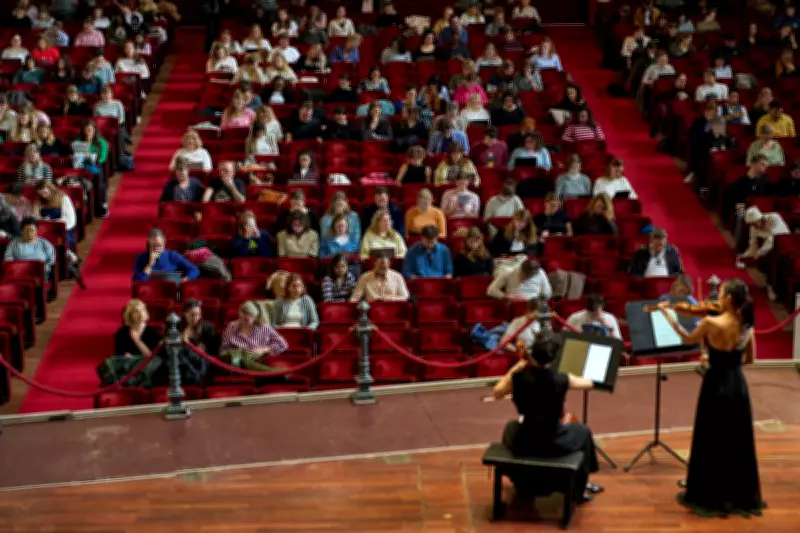
Amsterdam's iconic Concertgebouw has ingeniously repurposed its world-renowned main auditorium into a tranquil study haven, where students can immerse themselves in their academic work while live classical music provides a soothing backdrop. This innovative initiative, blending education and culture, offers a unique alternative to traditional libraries or cafes.
A Symphony of Focus and Productivity
From the historic stage, musicians like violinist Hyunjin Cho and cellist Efstratia Chaloulakou perform for an audience of diligent students, whose faces are softly lit by laptop screens as they occupy the plush red seats. The hall, adorned with gilded names of legendary composers such as Ravel, Mahler, Wagner, and Mozart, resonates with melodies ranging from Johann Pachelbel's Canon in D to pieces by Handel, Schubert, and even Studio Ghibli film scores.
Origins and Impact of the Study Sessions
The study sessions were first launched during the COVID-19 pandemic by Entree, the youth association of the Concertgebouw, with a dual purpose: to aid students in improving their concentration and to gently introduce them to the enriching world of classical music. Since their inception, these events have proven immensely popular, attracting a steady stream of young attendees.

For a modest fee of just 2.50 euros (approximately $2.85), students gain access to this inspiring environment, complete with free Wi-Fi, making it an affordable and accessible option. Many arrive clutching coffee cups, computers, and books, settling in for productive study marathons.
Student Experiences and Testimonials
Kyra Mulder, a 21-year-old occupational therapy student at the Amsterdam University of Applied Sciences, shared her positive experience. "It's actually very calming and helping in concentrating on the work that we have to do, which is something that surprises me because normally I don't really listen to classical music," she remarked. "So that's a new experience for me."
Medicine student Thijmen Broekman echoed this sentiment, noting that the combination of music and a change of scenery enhanced his learning. "It's a really quiet environment and nice, quiet music," he said. "So that helps me to concentrate."
Expert Insights on Music and Concentration
Professor Bas Bloem, a neurologist at Radboud University Medical Center in Nijmegen, provided scientific perspective on the phenomenon. He explained that while music can disrupt concentration for some, it can foster focus for others by inducing a state of flow. "So it's not a one size fits all. And I don't think it's been well researched, but I think the reason why music in the background can be so soothing almost, is that it creates a state of flow," he told The Associated Press. "And I think music in the background can help you to reach a state of flow. And everybody knows when you reach a state of flow, you can go on endlessly and be enormously productive."
Future Goals and Cultural Outreach
Simon Reinink, the general director of the Concertgebouw, highlighted the broader mission behind these sessions. "It's one of the many ways to welcome younger audiences to the Concertgebouw," he stated. "And it's such an inspiring place to study with great music in this wonderful, beautiful environment." He expressed hope that the events would not only aid in studying but also cultivate a lasting appreciation for classical music, encouraging a new generation to return for future performances.
"It is one of ways to more or less seduce younger audiences to discover the Concertgebouw and hopefully they will be enthusiastic and ... they will come back," Reinink added, underscoring the venue's commitment to cultural engagement and innovation.