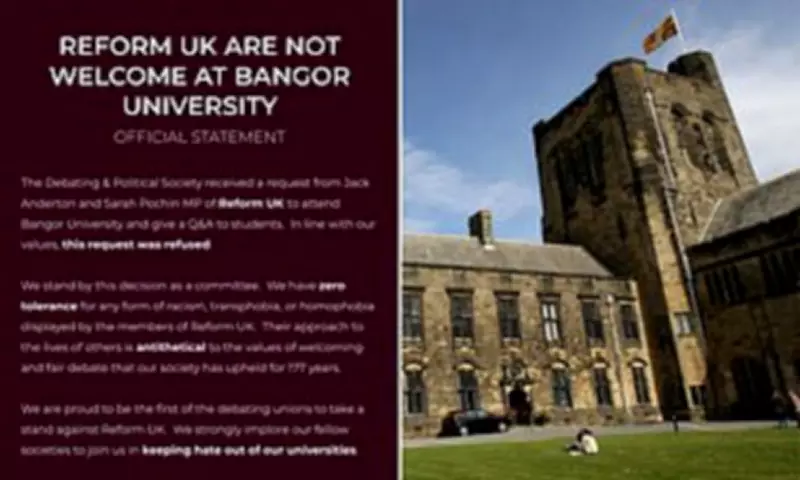
Bangor University Debating Society Implements Ban on Reform UK MP
A university debating society in Wales that promotes free speech principles has prohibited a Reform UK Member of Parliament from delivering a talk to its members, citing an unwavering stance against racism and transphobia. The Debating & Political Society at Bangor University has explicitly declared that Sarah Pochin, the MP for Runcorn and Helsby, is not welcome to address its gathering.
Society's Firm Stance on Inclusivity
In an official statement, the society committee affirmed it "stands by the decision" and expressed pride in announcing the new prohibition. The group hopes that other academic institutions will emulate their approach to maintaining what they describe as a welcoming environment.
A spokesperson elaborated: "We stand by this decision as a committee. We have zero tolerance for any form of racism, transphobia or homophobia displayed by the members of Reform UK. Their approach to the lives of others is antithetical to the values of welcoming and fair debate that our society has upheld for 177 years."

The society further emphasized its pioneering role, stating it was "proud to be the first of the debating unions to take a stand against Reform UK." The statement concluded with a strong appeal: "We strongly implore our fellow societies to join us in keeping hate out of our universities."
Historical Context and University Response
The Bangor Debating & Political Society holds the distinction of being the oldest student society in Wales, describing itself as "the home for students who love to challenge ideas, explore diverse perspectives, and master the art of persuasion." Despite this tradition of open discourse, the committee maintained its position against hosting the Reform MP.
Bangor University administration quickly distanced itself from the student society's sentiments when contacted by media outlets. A university spokesman clarified: "Student societies are created and run by students through the independent Students’ Union. The views expressed by societies are their own and do not reflect University policy. Bangor University remains politically neutral and supports freedom of speech. Bangor University welcomes debate from across the political spectrum."
Political Reactions and Broader Implications
Sarah Pochin responded with criticism, questioning: "So much for free speech in our universities. How can Bangor University’s debating society be afraid of debate?" She was barred alongside party adviser Jack Anderton, a 25-year-old political campaigner known as a 'TikTok guru.'
Reform UK chairman Zia Yusuf issued a pointed rebuke: "Bangor University has banned Reform and called us 'racist, transphobic and homophobic.' Bangor receives £30 million in state funding a year, much of which comes from Reform-voting taxpayers. I am sure they won’t mind losing every penny of that state funding under a Reform government. After all, they wouldn’t want a racist’s money, would they?"
Growing Trend of Campus Speech Restrictions
This incident reflects a broader pattern of political discourse limitations within academic settings. Recent polling data reveals that approximately one in three students now advocate for banning Reform UK from university campuses entirely. This represents a record high for any political group in such surveys.
Nick Hillman, director of the Higher Education Policy Institute which conducted the research, expressed concern: "I am shocked that more than one in three students support banning Reform UK from university campuses. The best way to take down democratic political parties that you disagree with is surely through free, fair and fierce debate – whether that is on campus or beyond."
Parallel Developments in Academic Debating
The controversy at Bangor follows similar developments elsewhere in British academic debating circles. The Oxford Schools' debating competition, recognized as the largest British Parliamentary school-level debate competition globally, has implemented a gender pronoun policy requiring participants as young as 14 to declare their pronouns at the start of each round.

Helen Joyce, director of advocacy for human rights charity Sex Matters, criticized such policies: "It’s outrageous that schoolchildren are being made to pay lip service to gender identity beliefs in order to participate in a debate. It’s very concerning that such a requirement is being used to teach children the fringe idea that everybody has a gender identity before those youngsters have learned to think critically. This is indoctrination, pure and simple."
The Bangor debating society maintains that its commitment to "reasoned, inclusive debate" remains vital as public discourse continues to evolve. The society balances three core objectives:
- Providing a welcoming space to learn public speaking and critical thinking
- Supporting competitive teams on national and international stages
- Running public debates that engage both the university and wider community
As universities navigate the complex intersection of free speech principles and inclusive environments, the Bangor incident highlights the ongoing tensions between these values in contemporary academic life.