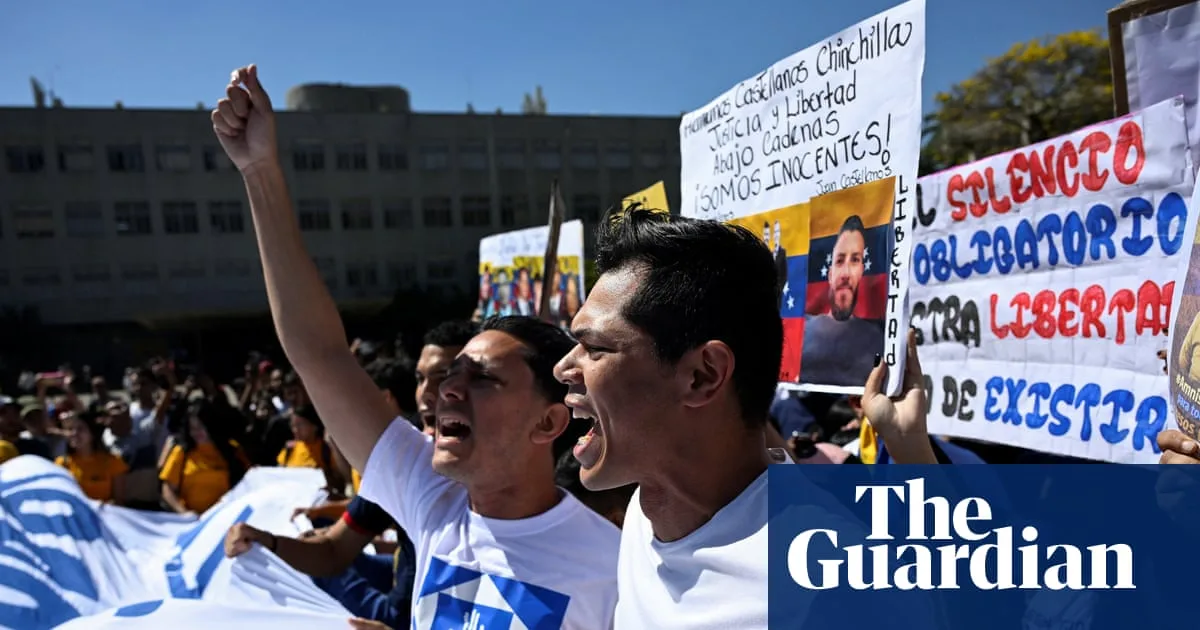
Protesters have taken to the streets of cities across Venezuela in the latest sign of an embryonic political shift after Nicolás Maduro’s recent downfall. Student demonstrators gathered on the campus of the Central University of Venezuela in Caracas on Thursday to demand the release of all political prisoners, the return of exiled activists and a full transition to democracy. “Who are we? Venezuela! What do we want? Freedom!” they shouted.
“I refuse to live in a country without freedom of expression,” said Angel Gutiérrez, a literature student who was one of hundreds to attend the peaceful march – a public show of dissent unthinkable just a few weeks ago, before US special forces seized Venezuela’s 63-year-old dictator. As the crowd grew, Gutiérrez complained that throughout his entire adult life the will of the people had been ignored. “I’m here because I refuse to continue to accept my country carrying on under these conditions … A young person without hope is dead,” he said.
In another hint of a possible thaw, the protest was publicised by Venezuelan television networks including Venevisión, which for years have been forbidden from covering such events. Rallies were also held in cities including Barquisimeto, Ciudad Guayana, Maracaibo and Mérida. “It’s incredible that we are back in the streets. They should know that they will never silence us,” said John Pérez, an international relations student, who joined the march in Venezuela’s capital.
The student-led demonstrations were the latest – and largest – of a series to take place since US troops abducted Maduro on 3 January and partially transformed Venezuela’s authoritarian political landscape. While much of Maduro’s regime remains in place, led by his vice-president Delcy Rodríguez, the country’s new leaders have been forced to make a series of important concessions, including freeing more than 430 political prisoners, proposing an amnesty, tolerating a growing number of protests and rewriting energy laws to allow the greater involvement of foreign oil firms. A small number of foreign journalists were also allowed into the country this week.
“It’s a really weird moment because we are not really in a transition to democracy. We don’t have a date for a fair and free election. The same regime is in power,” said Jesús Armas, a prominent opposition leader who was released on Sunday after 14 months behind bars and attended the university protest. “But at the same time, because of the pressure of the United States, we are starting to see things like the freedom of political prisoners and the people are starting to lose [their] fear,” Armas said, adding: “But of course the regime is the same.”
Yerwin Torrealba, a youth leader from the mid-western state of Yaracuy who was released from prison last month, said he had been astonished to attend a recent protest without being molested by the police. “Two months ago, you couldn’t do this,” said Torrealba, an activist for the movement led by the exiled Nobel laureate María Corina Machado. “This is a big step forwards. People are becoming active in the streets once again,” said Torrealba, voicing confidence that Venezuela was entering a new, less authoritarian era. “It’s still moving a little slowly, but the transition is steadily playing out.”