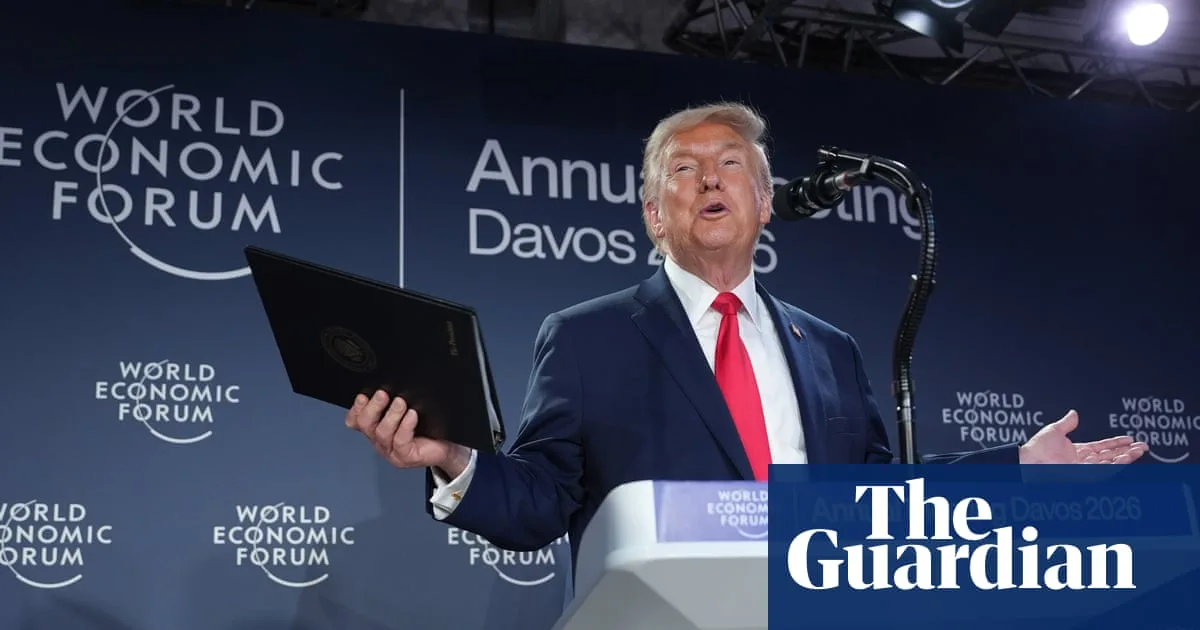
Scrutinising Trump's Dubious Assertions at the Davos Summit
Donald Trump's recent address to the World Economic Forum in Davos, Switzerland, was punctuated by a series of contentious claims spanning international diplomacy, technological supremacy, and energy policy. The former president's speech, delivered on Wednesday, presented a narrative that upon closer examination reveals significant discrepancies with established facts and expert assessments.
Questionable Claims About Conflict Resolution
"I've now been working on this war for one year, during which time I settled eight other wars."
Trump offered no specific details regarding which conflicts he was referencing, though he has repeated similar assertions throughout his political career. Analysis suggests he may be referring to various ceasefire agreements and diplomatic interventions. His administration did participate in brokering temporary ceasefires between Israel and Iran, India and Pakistan, and Armenia and Azerbaijan. However, these agreements were largely incremental, and several leaders have disputed the extent of Trump's personal involvement.
The Israel-Hamas ceasefire and hostage deal, while secured with Trump's involvement, remains incomplete with multiple stages yet to be fulfilled. Reports indicate hundreds have been killed in Gaza since the initial phase took effect in October. Meanwhile, the temporary peace agreement between Rwanda and the Democratic Republic of Congo has collapsed, resulting in hundreds of civilian casualties since its signing in June. Cambodia and Thailand continue to exchange accusations regarding broken ceasefires and border clashes.
The Egypt-Ethiopia dispute primarily concerns a dam on the Nile River—a significant diplomatic issue but not an active military conflict. Regarding Kosovo and Serbia, it remains unclear what specific brewing conflict Trump believes he prevented through his diplomatic efforts.
Exaggerated Technological Superiority Claims
"We're leading the world in AI by a lot. We're leading China by a lot."
Industry experts have offered more nuanced assessments of the artificial intelligence race between the United States and China. Nvidia's chief executive Jensen Huang stated in September that China trails the US by mere "nanoseconds" in AI development. White House AI czar David Sacks estimated in June that Chinese models lag behind American counterparts by approximately three to six months.
Chinese companies, including DeepSeek, have released competitively priced models that rival America's most advanced offerings, despite restrictions on accessing advanced semiconductor technology. Interestingly, Trump himself has described DeepSeek as a "wake-up call" for US technology companies, suggesting a more complex competitive landscape than his public statements acknowledge.
Inaccurate Portrayal of Chinese Wind Energy
"China makes almost all of the windmills, and yet I haven't been able to find any windfarms in China."
This assertion is demonstrably false. China possesses more wind energy capacity than any other nation globally and has twice as much capacity under construction as the rest of the world combined. According to data from the think tank Ember Energy, China's wind generation in 2024 accounted for approximately 40% of global wind energy production.
Global Energy Monitor reports that China is currently developing 180 gigawatts of solar projects alongside 159 gigawatts of wind projects. These renewable energy initiatives represent nearly two-thirds of the renewable capacity being brought online worldwide. Rather than avoiding wind power domestically as Trump suggested, China stands as the world's largest generator of wind energy.
Mischaracterising NATO Commitments
"We're there for NATO 100%. I'm not sure if they'd be there for us."
NATO allies have repeatedly demonstrated their willingness to support American-led military operations, often sustaining significant casualties. In Afghanistan, according to data from the independent nonprofit tracker icasualties.org, NATO allies suffered 1,144 fatalities out of 3,609 total coalition deaths between 2001 and 2021. The United Kingdom lost 455 service members, Canada 158, France 86, Germany 54, and Denmark 43.
During the Iraq conflict, coalition partners sustained 324 deaths out of 4,910 total fatalities, with the United Kingdom alone suffering 182 casualties. These figures represent substantial commitments to American-led military initiatives that contradict Trump's suggestion of insufficient allied support.
Selective Quotation and Historical Revisionism
"They called me daddy."
NATO Secretary General Mark Rutte did indeed use the term "daddy" during a summit last June, following Trump's comparison of Israel and Iran to "two kids in a schoolyard" engaged in conflict. Rutte quipped that "daddy has to sometimes use strong language" in such situations. However, Trump's use of the plural "they called me" implies a pattern of NATO leaders addressing him this way, for which there is currently no supporting evidence beyond this isolated incident.
"After the war, we gave Greenland back to Denmark. How stupid were we to do that?"
This statement involves significant historical revisionism. The United States never possessed sovereignty over Greenland. In 1916, Secretary of State Robert Lansing declared that the US "will not object to the Danish government extending their political and economic interests to the whole of Greenland" as part of an agreement in which Denmark sold the US Virgin Islands to America.
When Norway attempted to claim part of Greenland in 1931, the International Court ruled in Denmark's favour in 1933, citing an 1814 treaty that confirmed Denmark retained Greenland when it ceded Norway to Sweden. Subsequent US-Denmark agreements in 1941 and 1951 permitting American military bases explicitly stated these arrangements were "without prejudice to the sovereignty of the Kingdom of Denmark." At no point did the United States hold sovereignty over Greenland that could be returned to Denmark.
Mathematically Flawed Fiscal Assertions
"If we were able to cut out 50% of the fraud ... we would have a balanced budget without having to talk about even growth."
The arithmetic underlying this claim fails to withstand scrutiny. According to the Government Accountability Office, the highest estimate of fraud losses within the US government stands at approximately $521 billion annually. Even eliminating all fraud entirely—an unprecedented achievement—would cover less than one-third of the projected 2025 deficit of about $1.7 trillion.
Cutting fraud by half, as Trump proposed, would yield roughly $260 billion if targeting the highest estimated fraud figure. This amount represents less than one-sixth of the projected deficit, leaving the federal government more than $1.5 trillion short of achieving a balanced budget.
The Davos address revealed a pattern of exaggerated claims and factual inaccuracies that contrast sharply with verifiable data and expert analysis. While political rhetoric often involves simplification, these particular assertions demonstrate significant divergence from established facts across multiple policy domains.