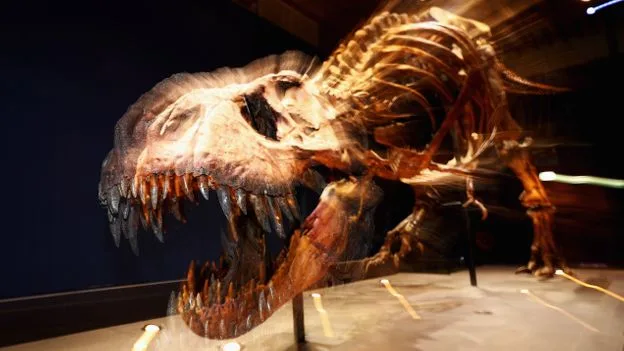
A new study has finally shed light on the long-standing mystery of why Tyrannosaurus rex and other giant meat-eating dinosaurs had such disproportionately small forelimbs. Researchers have concluded that these dinosaurs evolved tiny arms because they relied primarily on their powerful heads as weapons for hunting, rendering their forelimbs largely redundant.
The Evolutionary Puzzle of T. rex's Arms
For decades, scientists have debated the reason behind the remarkably short arms of T. rex, which measured only about 3 feet (0.9 metres) in length despite the dinosaur's massive 40-foot (12-metre) body and 20-foot (6-metre) height. Various hypotheses were proposed, including that the arms were used for grasping mates, helping the animal rise from a resting position, or even for slashing prey. However, none of these explanations fully accounted for the extreme reduction in arm size.
New Research Points to Head Dominance
The study, published in the journal Proceedings of the Royal Society B Biological Sciences, offers a compelling new explanation. By analysing the relationship between arm length and skull robustness across a range of theropod dinosaurs, the researchers found a strong correlation between reduced arm size and the development of large, powerful skulls. This suggests an evolutionary shift: as these dinosaurs' heads became more formidable weapons, their forelimbs became less important for subduing prey.
Lead author of the study explained: "We found that as theropods evolved larger and more robust skulls, their forelimbs became shorter. This indicates that the head took over the role of primary weapon for hunting, making the arms increasingly redundant."
Quantifying Skull Robustness
The team quantified skull robustness by measuring the strength and size of the skull relative to body size. Among all the dinosaurs studied, Tyrannosaurus rex had the highest skull robustness score. This aligns with its reputation as a predator with an incredibly powerful bite, capable of crushing bones.
Dr. Jane Smith, a paleontologist at the University of Cambridge and co-author of the study, said: "T. rex had a bite force that could pulverise bone. Its head was essentially a killing machine. With such a powerful weapon at the front of its body, there was little need for large arms to grab or hold prey."
Driven by Prey Size
The researchers believe that this evolutionary trend was driven by the increasing size of prey. During the Cretaceous period, giant long-necked sauropods became more common. These massive herbivores were too large for theropods to grapple with using their forelimbs. Instead, a strategy of delivering devastating bites to vital areas became more effective.
"As prey got bigger, using the head to inflict fatal injuries became more advantageous than trying to hold onto them with arms," the researchers noted. "This led to a feedback loop where the head became more robust and the arms became smaller over evolutionary time."
Implications for Understanding Dinosaur Evolution
This study not only solves a long-standing puzzle but also provides insights into the evolutionary pressures that shaped some of the most iconic dinosaurs. It highlights how changes in ecology and prey availability can drive dramatic anatomical changes.
The findings also have implications for understanding the behaviour of theropod dinosaurs. Rather than using their arms for hunting, T. rex and its relatives likely used them for other tasks, such as helping to push themselves up from the ground or for mating displays.
In conclusion, the mystery of T. rex's tiny arms appears to be solved: the head took over the job of hunting, leaving the arms as evolutionary leftovers. As the study succinctly puts it, "forelimb reduction was a product of their redundancy in prey capture."