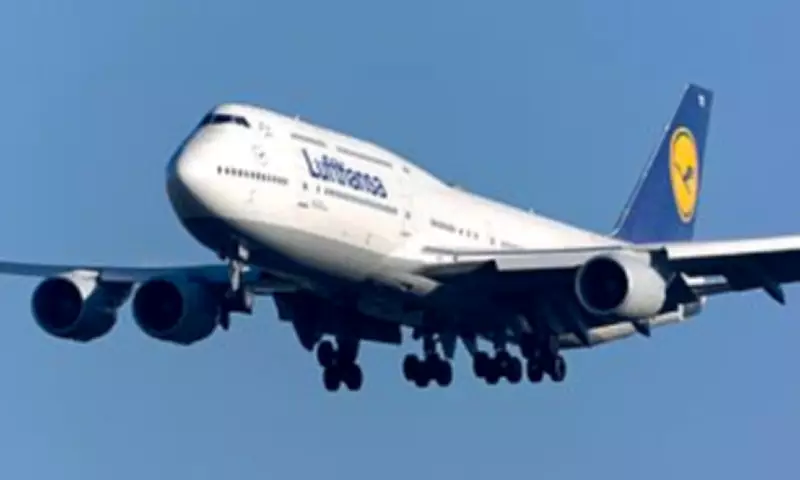
In a significant historical reckoning, the prominent German airline Lufthansa has formally recognised its active participation within the Nazi system during the period of National Socialist rule. The carrier has initiated a comprehensive study to investigate its specific connections with the Nazi party, with particular focus on its extensive utilisation of forced labourers. This marks a departure from the company's longstanding position, which previously emphasised that the post-1953 entity had no operational continuity with the original Deutsche Luft Hansa AG that functioned from 1926 until 1945.
CEO's Public Admission at Frankfurt Press Conference
Carsten Spohr, the Chief Executive Officer of Lufthansa, delivered a stark admission during a press conference held at the airline's headquarters in Frankfurt Airport this Tuesday. Spohr stated unequivocally, 'Lufthansa was clearly part of the system.' He elaborated that this complicity encompassed the airline's role as a 'clandestine air force' and its substantial contributions to the Nazi war economy. Furthermore, Spohr confirmed the company's direct involvement in the exploitation of forced labourers within its workshops and armaments factories.
Centenary Anniversary Spurs Deep Historical Examination
Coinciding with the 100th anniversary of its initial founding, Lufthansa has commissioned a fresh, detailed analysis by professional historians to scrutinise this dark chapter. The airline has declared that the era of National Socialism represents 'the darkest chapter in Lufthansa's history,' during which it became an integral component of the Nazi regime, its war crimes, and its criminal undertakings. As part of this commemorative year, Lufthansa will also launch a public exhibition examining its role under the National Socialist government and publish a dedicated book on the subject.

The company asserts that examining its full history is essential, stating it does not limit itself to post-war narratives. The years from its founding to the dissolution of the first Lufthansa are acknowledged as a fundamental part of its corporate legacy. Historical records indicate Lufthansa actively supported the Nazi regime's military rearmament programmes and trained pilots for the Luftwaffe. Technical advancements during this period were underpinned by severe exploitation; from 1940 onwards, forced labourers were compelled to work in company workshops, sustaining operations throughout the war.
Scale of Wartime Operations and Forced Labour Revealed
By 1944, the company reportedly derived approximately two-thirds of its total revenue from armaments contracts. To fulfil these contracts, it relied on a workforce of around 10,000 forced labourers. This group included deported Ukrainians and German Jews, among others, who were subjected to coercive labour conditions. Historian Manfred Grieger notes that Luft Hansa aligned itself voluntarily with the Nazi party, initially operating as a state-subsidised airline before transforming into a full armaments company during the Second World War, eventually functioning as a unit within the German Air Force.
It is important to clarify that the contemporary Deutsche Lufthansa AG is not the legal successor to the original Deutsche Luft Hansa AG, which was founded in 1926 and subsequently dissolved in 1946 following post-war liquidation. However, the modern entity did acquire the rights to the historic company name, its distinctive colour scheme, and the iconic crane symbol. Despite this legal distinction, CEO Carsten Spohr argues it remains critically important for the present-day company to thoroughly uncover and confront its historical past and any links to the Nazi regime, acknowledging a moral and historical responsibility beyond mere legal continuity.