The Kimbanguist Church: A Beacon of Resilience in Troubled Congo
In the heart of Central Africa, an unconventional Christian movement founded by a prophet who died in colonial imprisonment has grown into one of the continent's largest independent churches. The Kimbanguist Church, officially known as the Church of Jesus Christ on Earth Through the Prophet Simon Kimbangu, now boasts between 6 and 17 million members, with followers even in Belgium, the former colonial power that once banished its founder.
From Colonial Persecution to National Holiday
Simon Kimbangu, a lay Baptist catechist, began his ministry in 1921 when Congo was a Belgian colony exploited for rubber, timber, and minerals. Despite urging followers to pay taxes, his religious ideas proved too provocative for authorities. Kimbangu identified God with Nzambi, the deity in the Kikongo language, and presented himself as God's envoy on Earth—implying the Blackness of God and subverting European cultural representations.
After just five months of ministry, Kimbangu was sentenced to death on insurrection charges. King Albert I of Belgium commuted the punishment to life imprisonment, exiling the prophet to present-day Lubumbashi, approximately 1,000 miles from his home. He spent 30 years in jail and died a prisoner at age 64 in 1951. Today, April 6 is marked in Congo as Kimbangu Day, a holiday celebrating the "struggle of Simon Kimbangu and African consciousness" since 2023.

A Movement of Nonviolence and Organization
As Congo faces instability from a violent rebellion in the east—the worst territorial crisis since independence in 1960—many Congolese see Kimbangu's movement as a positive example. The church is nonviolent, independent, well-organized, and resilient. Its spiritual seat is Nkamba, a town southwest of Kinshasa that believers call the New Jerusalem, where pilgrims visit to pay homage to Kimbangu.
"The first challenge for African leaders, or Congolese leaders, is that they are not free," said Bwatshia Kambayi, a historian of Congo who sees similarities in the struggles of Nelson Mandela and Simon Kimbangu. "African leaders, they do not realize that they have a slavery mindset. We are independent, but we are not free."
Distinctive Teachings and Social Impact
Although its primary teachings refer to the Bible, the Kimbanguist Church is distinguished by its veneration of Kimbangu as the Black embodiment of the Holy Spirit. The church maintains a hierarchical structure and is currently in its third generation of leadership under Simon Kimbangu Kiangani, the founder's grandson.
The church prohibits polygamy—socially accepted in Congo—and encourages peaceful conflict resolution. A sense of community is evident in sharing foodstuffs for communal events, and the church has invested widely in schools and social enterprises. Women can rise to positions of authority, a progressive stance in the region.
"Women are ministering in the church. They have a key role to play because the church is so thankful for what the wife of Simon Kimbangu did when her husband was in prison," said André Kibangudi, a church elder. "We should have more female leadership."
Political Relevance and Contemporary Challenges
President Félix Tshisekedi's government has embraced Kimbanguists; his prime minister, Judith Suminwa, is one of them. This highlights the movement's importance as a source of votes and respect for Kimbangu as a champion of Black emancipation. Tshisekedi's major challenge is the armed conflict in eastern Congo, where Rwanda-backed M23 rebels have controlled Goma since January 2025, causing hundreds of thousands to flee and raising fears of secession.
In response, Tshisekedi has offered U.S. companies access to eastern Congo's minerals—estimated to be worth $24 trillion—as a bargaining chip for U.S. support. Critics warn this could intensify resource rivalry in a region where China has long been active in mineral extraction. Some lawyers and activists have filed a petition arguing such partnerships threaten Congo's sovereignty.
"The church today is very dynamic, very influential," said Paul Kasonga, a Kimbanguist pastor of millions in Mongala province. What Congo's leaders can learn from Kimbangu "is that the guy didn't work for himself. He sacrificed himself to free people who had been in slavery, who had been suffering."

Enduring Legacy and Spiritual Lessons
Toussaint Mungwala, pastor of Kimbanguists in Kwilu province, converted from Catholicism in 1986 after seeing a German priest praying while holding a picture of Kimbangu and his wife, Marie Muilu. "The lesson that people can learn from the church is that the prophet, the founding prophet, fought for people's rights," he said.
Kambayi, a scholar and former minister of higher education, criticized Congo's elite: "They are poor men who want to live as rich people. This is not the fight of Simon Kimbangu. None of them has reached the level of fighting for people's freedom, for people's liberty."
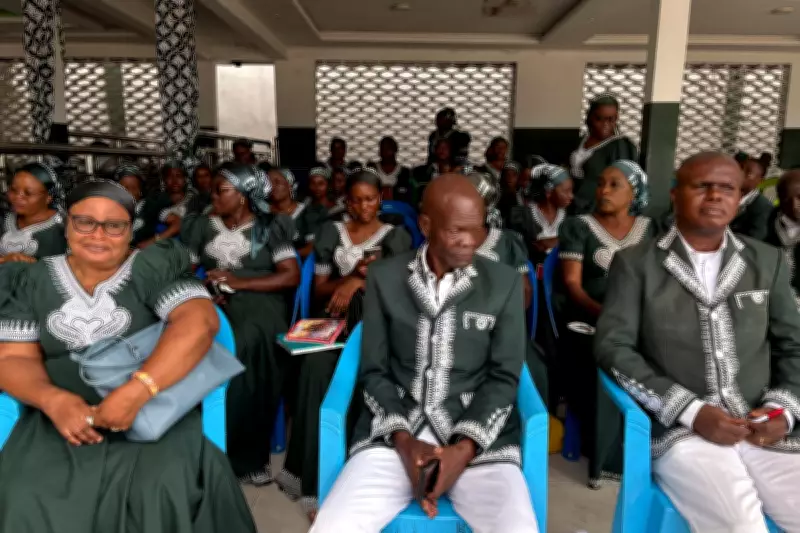
As Kimbanguists celebrated Easter Sunday in 2026, members at the Kinshasa branch chanted praises for their leader, boarding church-owned buses to Nkamba. The group composes its own sacred music, with lilting songs prompting women in green-and-white wraparounds to vigorously shake their bodies—a testament to a movement that continues to inspire amid Congo's ongoing struggles.