Ancient Controversy Reignites Over Jesus' Crucifixion Site
A heated historical and theological debate has been reignited concerning the precise location of Jesus Christ's crucifixion, with Christians, biblical scholars, and faith leaders deeply divided over the true site of Golgotha. This ancient controversy pits long-established tradition against alternative interpretations of scripture and landscape.
The Traditional Claim: Church of the Holy Sepulchre
Golgotha, meaning 'Place of the Skull' in Aramaic, is described in the New Testament as the location where Jesus was crucified outside Jerusalem's walls. The dominant traditional belief holds that the Church of the Holy Sepulchre in Jerusalem's Old City was constructed directly above this sacred site.
This theory originates from the 4th century AD when Roman Emperor Constantine the Great, after converting to Christianity, ordered an extensive search for the locations of Jesus' death and burial. Early Christian communities in Jerusalem identified a specific site they had venerated for generations. Convinced by their testimony, Constantine commissioned the construction of a church there, establishing what has become one of Christianity's oldest continuously recognized holy sites.

Modern archaeological research has provided substantial support for this traditional view. Scholars, including prominent Israeli archaeologist Dan Bahat, note that the area surrounding the church was historically a quarry situated outside Jerusalem's city walls during Jesus' lifetime, which aligns perfectly with biblical descriptions. Historian Joan E. Taylor, in a widely cited 1998 study reexamining the evidence, concluded that the Church of the Holy Sepulchre's general area remains the most plausible location for the crucifixion.
Significantly, a more recent discovery in 2025 uncovered remnants of an ancient garden beneath the church's foundation. This finding directly corresponds with the Gospel of John 19:41, which states, "Now in the place where he was crucified, there was a garden." A team from Sapienza University of Rome analyzed plant remains from this site, dating them to the pre-Christian era, approximately around the time of Jesus' crucifixion, which historians generally place around 33 AD.
The Alternative Theory: The Skull-Shaped Hill
Opposing the traditional view, a significant contingent argues that the crucifixion actually occurred on a distinct hill beyond Jerusalem's ancient city walls. Proponents believe this terrain better matches specific biblical descriptions. This alternative theory gained prominent recent attention when Pastor Josh Howerton of Lakepointe Church in Texas promoted it during an episode of his podcast, Live Free.
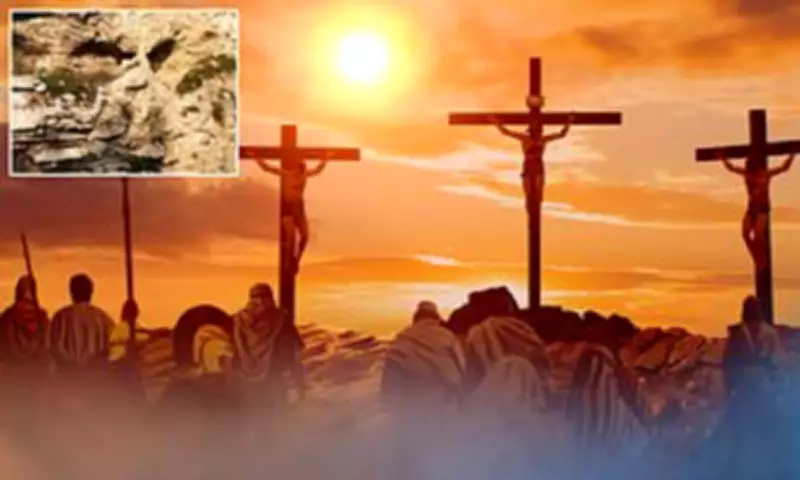
"The gospels tell us Jesus was taken outside the city walls to be crucified. This fits. It's within walking distance," Howerton stated, emphasizing the scriptural requirement for the site to be outside the city. He bolstered his argument by referencing older photographs that, according to him, showed the hill resembling a human skull formation, with rock features appearing to form distinct eye sockets and a nose cavity.
Howerton presented an image from the early 1990s that some viewers interpreted as skull-like, though he acknowledged that subsequent erosion or possible seismic activity may have altered the hill's appearance over recent decades. Supporters of this hill theory often cite the nearby Garden Tomb as corroborating evidence. This rock-cut burial site was discovered in the 19th century just outside Jerusalem's Damascus Gate, and they argue its proximity strengthens the case for this alternative location.
Historical Roots of the Hill Theory
Support for the skull-shaped hill as Golgotha is not a modern invention. It dates back to the mid-1800s when German theologian Otto Thenius first proposed that a specific skull-shaped ridge north of Jerusalem could be the biblical site. The idea gained substantial traction in the late nineteenth century after British officer Major General Charles Gordon visited the location. Gordon argued passionately that the rocky hill's contours resembled a human skull, leading many to refer to it colloquially as "Gordon's Calvary."

Other early researchers, including British surveyor Claude R. Conder and biblical scholar Henry Baker Tristram, supported this identification primarily because it lay convincingly outside the accepted boundaries of the ancient city walls, matching Gospel accounts that Jesus was crucified beyond Jerusalem.
However, this theory faces significant scholarly challenges. Most contemporary archaeologists and historians consider the Garden Tomb to be an Iron Age tomb, dating between the seventh and eighth centuries BC, which renders it centuries too old to be the actual burial place of Jesus of Nazareth. Furthermore, the hill near the Garden Tomb looks markedly different today than in historical photographs due to decades of erosion, quarrying activity, and urban development that have gradually softened and altered the rock face.
Online Debate and Scriptural Evidence
Pastor Howerton's claims quickly sparked a fervent and mixed reaction online. Many commenters vigorously defended the traditional belief. "Golgotha is at the Church of the Holy Sepulchre. Historical and archaeological evidence confirms it," one individual wrote in response to the video. Another countered, "You forgot that the city walls moved out from where they were at the time of Christ’s crucifixion. The most likely location for Golgotha is the Church of the Holy Sepulcher."
The debate hinges on nuanced interpretations of key biblical passages. The New Testament cites 'Golgotha' in several chapters, including the books of Matthew and Mark, both stating Jesus was brought there to die. Hebrews 13:12 reads, "And so Jesus also suffered outside the city gate to make the people holy through his own blood." Similarly, John 19:17 states, "Carrying his own cross, he went out to the place of the Skull (which in Aramaic is called Golgotha)."
Historic photographs from the late 19th and early 20th centuries do show the alternative hill with more defined features that some believers interpreted as resembling a skull. However, modern construction, roadwork, and natural weathering have significantly softened those formations over time, adding a layer of complexity to visual arguments.
This enduring debate underscores the profound intersection of faith, history, and archaeology. While the Church of the Holy Sepulchre remains the officially recognized site for most major Christian denominations and is supported by centuries of tradition and mounting archaeological evidence, the alternative hill theory persists, fueled by literal readings of scripture and historical testimonies. The search for Golgotha, the Place of the Skull, continues to captivate and divide, remaining one of Christianity's most poignant and unresolved historical mysteries.