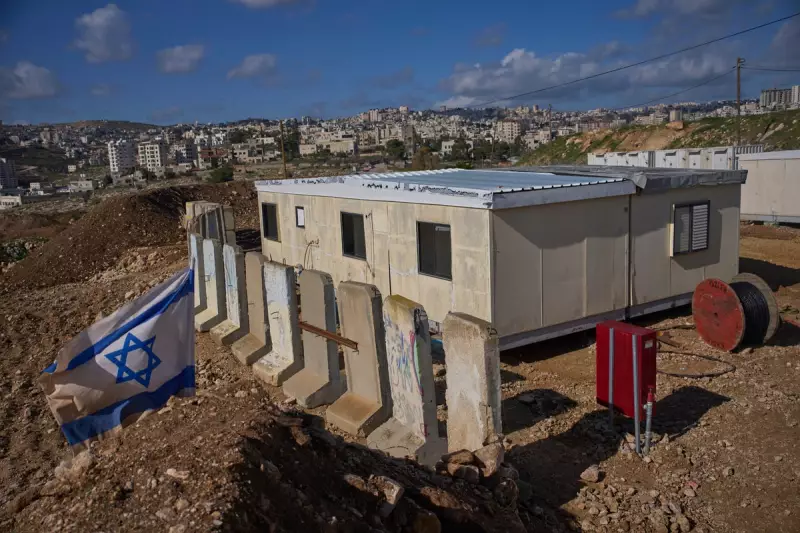
Celebratory music echoed across the West Bank valley on Monday, nearly drowning out the traditional calls to prayer from a nearby Palestinian mosque. The inauguration of the new Israeli settlement, named Yatsiv, marked a significant milestone for the settler movement after decades of campaigning for control of this strategic hilltop location.
From Outpost to Official Settlement in Record Time
What began as an unauthorised outpost with just a few mobile homes in November has transformed into a fully recognised settlement within a single month. The rapid approval process reflects the changing political landscape that settlers say has created ideal conditions for expansion.
Finance Minister and prominent settler leader Bezalel Smotrich addressed the ceremony with defiant rhetoric, declaring: "We are standing stable here in Israel. We're going to be here forever. We will never establish a Palestinian state here." The settlement's name, meaning "stable" in Hebrew, carries symbolic weight for the community establishing permanent roots in contested territory.

Strategic Location and Political Timing
The hilltop overlooking the Palestinian town of Beit Sahour has long been coveted by settlers for its position within a line of settlements surrounding Jerusalem and its claimed significance to Jewish history. However, the immediate catalyst for establishing the outpost came after Palestinian attackers stabbed an Israeli to death at a nearby junction in November.
Yaron Rosenthal, chair of the local settlement council, explained to journalists how multiple factors aligned to create what he called "the right political constellation" for rapid approval. The election of Israel's far-right government in late 2022, Donald Trump's return to office, and the security concerns following the November attack all contributed to creating favourable conditions.
Two Decades of Opposition to Palestinian Development
The land now occupied by Yatsiv settlement has been the subject of contention for twenty years. Back in 2006, settlers became incensed upon learning that Israel's government was discussing plans with the United States to build a hospital for Palestinian children on the site.
Hagit Ofran, a director at the anti-settlement watchdog group Peace Now, recalled how the U.S. Agency for International Development was simultaneously funding a "peace park" at the base of the hill while hospital discussions were underway. Settlers organised weekly demonstrations calling on Israel to abandon the hospital project, according to consulate documents obtained through WikiLeaks.
An email from U.S. consulate staffer Matt Fuller at the time noted the settlers appeared to have "no religious, legal, or security claim to that land" but simply opposed Palestinian development of the site, particularly for a hospital that might reduce the need for Palestinians to seek medical treatment in Jerusalem.
Military Base Paved Way for Settlement
The hospital project never materialised. Instead, after Benjamin Netanyahu's government came to power in 2009, the site was converted into a military base. Former Prime Minister Ehud Olmert, who was in office during the hospital discussions, identified this transformation as the critical turning point.
"Once it is a military installation, it is easier to change its status into a new outpost, a new settlement and so on," Olmert explained. He contrasted his administration's approach with Netanyahu's subsequent policies, noting the current leadership "didn't think about cooperation with the Palestinians."
Palestinian Concerns and International Perspectives
For Palestinians in Beit Sahour, the new settlement represents another chapter in what they describe as systematic land appropriation. Mayor Elias Isseid maintains that "these lands have been owned by families from Beit Sahour since ancient times" and worries about further territorial losses.
Yatsiv forms part of a growing network of Israeli settlements around Beit Sahour, all connected by a main highway that runs directly to Jerusalem without passing through Palestinian villages. The mayor expressed particular concern about the settlement's impact on local families and children.

The international community largely considers Israeli settlements in the West Bank illegal under international law, though their physical presence continues to expand. Settler violence increased by 27% in 2025 according to Israeli military statistics, contributing to what Palestinians describe as a fearful status quo in the occupied territories.
As the new settlement's yellow gate stands open and the abandoned peace park remains empty below, the transformation from potential hospital site to permanent Israeli community reflects the shifting power dynamics in one of the world's most contested regions.