Israeli Army Reservist Kills Two Palestinians in West Bank Shooting Incident
An Israeli army reservist has shot and killed two Palestinians, including a 14-year-old boy, near a school in the occupied West Bank, according to authorities. The incident occurred on Tuesday morning in the village of al-Mughayyir, located east of Ramallah, marking another violent episode in the region.
Details of the Fatal Attack
The Palestinian Ministry of Health identified the victims as 14-year-old Aws al-Naasan and 32-year-old Jihad Abu Naim. Three other individuals were wounded during the attack, which involved both Israeli settlers and soldiers. Witnesses reported a volley of gunfire after the arrival of settlers and the army, prompting school administrators to urge parents to collect their children, only to be met with additional gunfire and tear gas.
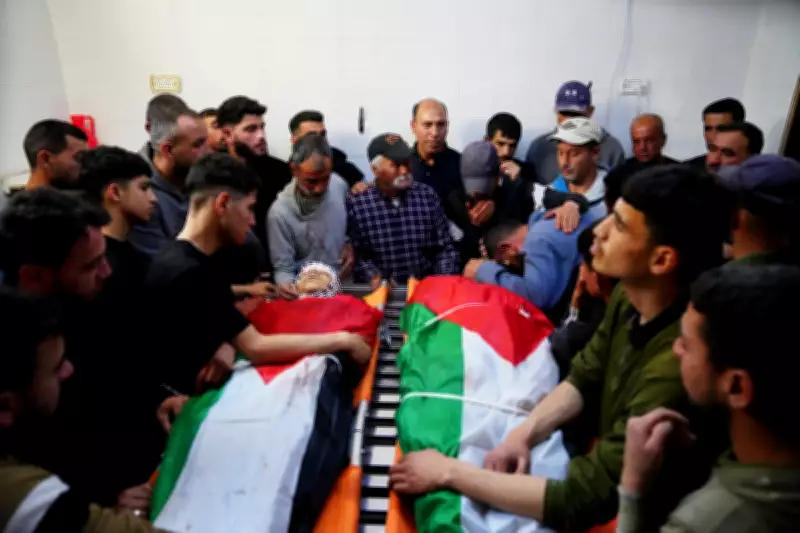
Kazem Al-Hajj Mohammad, who witnessed the shooting, described carrying the bodies, wrapped in Palestinian flags, from the Ramallah Medical Complex. He lamented, "This is our daily reality," highlighting the blurred lines between settler and military roles amid ongoing violence, displacement, and land seizures.

Military Response and Investigation
Israel's military stated that the gunman was a civilian reservist who was not mobilized at the time. While he has not been arrested, the incident is under investigation. The military claimed troops responded to reports of rock-throwing toward an Israeli civilian vehicle, but details remain contested.
Context of Escalating Violence in al-Mughayyir
Al-Mughayyir, situated 9 miles northeast of Ramallah, has become a hotspot for clashes between Palestinians and Israeli settlers and soldiers. In 2025, Palestinians reported dozens of attacks, including lethal shootings, arson, and vandalism. The village is now encircled by eight settler outposts, such as Adei Ad, which was legalized by Israel's government in December.
Access to agricultural lands and olive groves has been severely restricted, with many groves razed during an Israeli army raid last summer. This follows an incident where a Palestinian gunman allegedly opened fire on settlers grazing sheep nearby. Tragically, another 14-year-old, Mohammed Naasan, was killed in the village in January, and Aws al-Naasan's father, Hamdi al-Naasan, died in a 2019 clash with settlers that drew international condemnation.
Broader Trends in West Bank Violence
Al-Naasan and Abu Naim are among the latest Palestinians killed this year in the occupied West Bank, where 10 people have been killed by Israeli settlers, surpassing the total from 2025. According to the U.N. Office for the Coordination of Humanitarian Affairs, 240 Palestinians were killed in the territory last year, mostly by Israel's military, with nine deaths attributed to settlers.
Rights groups caution that the distinction between settler and military violence is often blurred. The Israeli advocacy group Yesh Din, in a February report titled "Settlers in Uniform," noted that lethal violence is increasingly carried out by "settler-soldiers" from reserve battalions, both on and off duty. The report emphasized that the availability of uniforms and firearms enables settlers, some with histories of ideologically motivated offenses, to engage in illegal acts against Palestinians.
Related Violence in Gaza Strip
Also on Tuesday, Israeli strikes killed at least five Palestinians in the Gaza Strip, including four suspected militants hit by a drone strike at a Hamas-controlled security point in Khan Younis. Nasser Hospital reported another man wounded in the strike, which occurred near the so-called Yellow Line separating Israeli-controlled areas from the rest of Gaza.
Relatives of the casualties claimed the checkpoint was used to protect people and properties, with Ahmed Musa Abu Helal calling it a "cold-blooded killing that didn't respect the truce." In Beit Lahiya, a 30-year-old woman was killed when Israel's navy opened fire toward tents sheltering displaced people, though Israel's military said it was unaware of attacks there.

These deaths add to the toll in Gaza since a fragile ceasefire in October attempted to halt the more than two-year-long war between Israel and Hamas. While heavy fighting has subsided, almost daily Israeli fire has continued, with Gaza health officials reporting over 780 Palestinian deaths from airstrikes and shootings near military-held zones. The health ministry, part of the Hamas-led government, maintains casualty records seen as reliable by U.N. agencies, though it does not distinguish between civilians and militants.
Militants have carried out shooting attacks on troops, and Israel asserts its strikes are responses to such violations. Since the ceasefire, four Israeli soldiers have been killed.