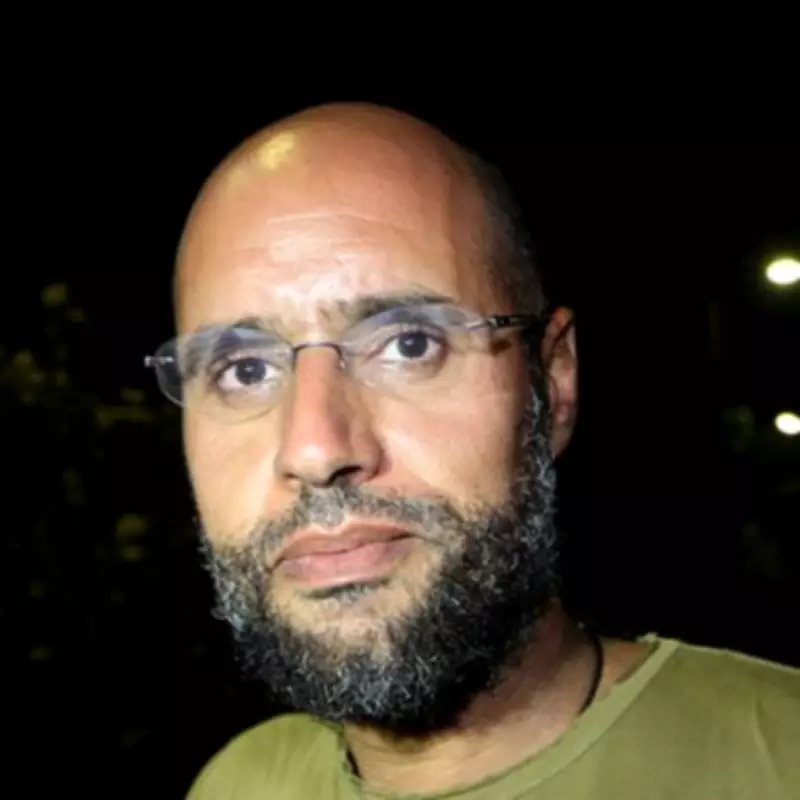
Saif al-Islam Gaddafi, the 53-year-old son and former heir apparent of the late Libyan dictator Colonel Moammar Gaddafi, has reportedly been killed in Libya, according to officials and family sources. The incident is said to have occurred in the remote town of Zintan, located approximately 85 miles southwest of the capital, Tripoli.
Details of the Reported Killing
Two Libyan security officials based in western Libya have confirmed the death, though the exact circumstances remain unclear. Unconfirmed reports circulating in Libyan media suggest that Saif al-Islam was assassinated by armed men who stormed his home. His adviser, Abdallah Othman Abdurrahim, confirmed the death in a social media post, while his cousin, Hamid Kadhafi, told the Libyan network al-Ahrar that Saif al-Islam had "fallen as a martyr," though the family lacked further details.
Abdurrahim provided more specific information to al-Ahrar TV, stating that four unidentified armed men disabled surveillance cameras before entering Saif al-Islam's residence and executing him. Libyan news outlet Fawasel Media has reported that prosecutors are now investigating the killing.

Background and Legacy of Saif al-Islam Gaddafi
Born in June 1972, Saif al-Islam was the second-born son of Colonel Gaddafi, who ruled Libya with an iron fist from 1969 until his ousting and execution during the 2011 uprising. Educated and holding a PhD from the London School of Economics, Saif al-Islam was often viewed as the reformist face of his father's regime. He played a pivotal role in Libya's rapprochement with the West from the early 2000s until the regime's collapse.
Following his father's death, Saif al-Islam emerged as one of the most influential and feared figures in Libya. During the 2011 uprising, he issued stark warnings in a televised broadcast, predicting "rivers of blood" and vowing that the government would fight "to the last man and woman and bullet." He was captured later that year by fighters in Zintan while attempting to flee to Niger.
Legal Troubles and Life in Hiding
In 2015, a court in Tripoli sentenced Saif al-Islam to death by firing squad for war crimes. He is also wanted by the International Criminal Court in The Hague on charges of murder and persecution. After being released by a militia in 2017 under an amnesty law, he spent years living underground in Zintan to avoid assassination.
Libyan analyst Mustafa Fetouri, who has contacts within Saif al-Islam's inner circle, noted that from 2016 onward, he was permitted to communicate with individuals both inside and outside Libya. Colonel Gaddafi's last spokesman, Moussa Ibrahim, mourned his death on social media, stating, "They killed him treacherously. He wanted a united, sovereign Libya, safe for all its people."
The Fall of the Gaddafi Regime
Colonel Gaddafi's brutal four-decade rule ended on October 20, 2011, when he was cornered by a revolutionary mob in Sirte. Found hiding in a storm drain, he was subjected to a frenzied execution by rebels, with chilling video footage capturing his final moments. Reports indicate he was beaten, tortured, and shot at close range, possibly with his own custom-made gold gun. His body was later placed on public display in a freezer to prove his death to the populace.
The reported killing of Saif al-Islam marks a significant chapter in Libya's turbulent post-Gaddafi era, occurring 15 years after his father's execution and underscoring the ongoing instability and violence that continue to plague the nation.