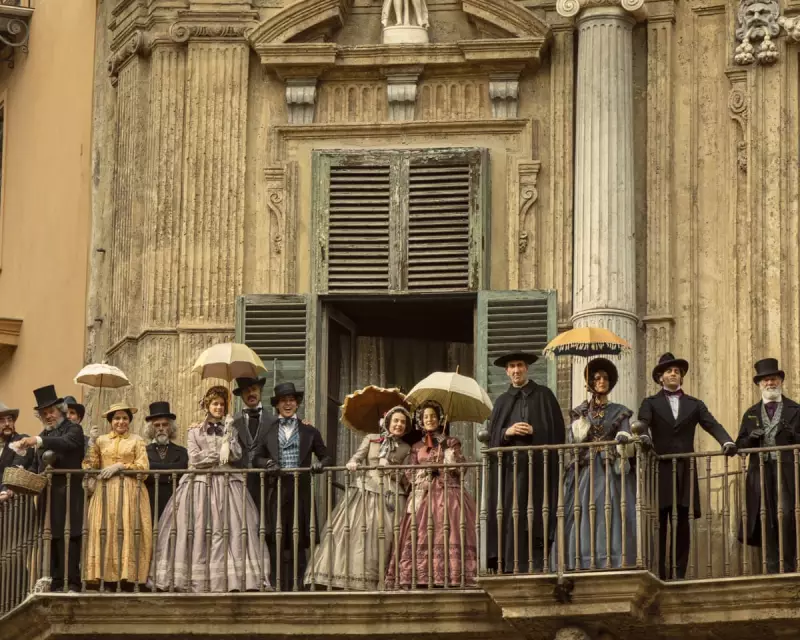
The year 2025 has brought a fresh adaptation of Giuseppe Tomasi di Lampedusa's classic novel, The Leopard, to Netflix, capturing the attention of audiences across Europe. This cinematic revival arrives at a pivotal moment for the continent, as it grapples with a profound sense of geopolitical and economic uncertainty. The parallels between the novel's depiction of a declining Sicilian aristocracy and Europe's current political elite are striking, prompting urgent reflections on the future direction of the European Union.
Europe's Precarious Position in a Shifting Global Order
At this quarter-mark of the 21st century, Europe finds itself at a critical juncture. For decades, its share of global GDP has been steadily diminishing, accompanied by a noticeable erosion of its geopolitical influence. This relative decline now threatens to transition into absolute decline, as external powers aggressively vie for dominance over the continent. The United States, Russia, and China are engaged in what can be described as a modern-day scramble for Europe, each with distinct ambitions: Moscow seeks to reassert hegemony in Eastern Europe, Beijing covets European industrial assets, and Washington demands compliance alongside strategic interests like Greenland.
Internally, key European nations are struggling with their own challenges. Germany is gripped by anxiety about its future trajectory, while France appears disoriented and unable to resolve its budgetary crises. In Brussels, desperation for economic growth has led to the dismantling of climate legislation enacted just years prior, alongside efforts to appease former US President Donald Trump. This series of concessions has fostered a palpable sense of déclassement, undermining European dignity on the world stage.

The Leopard's Timely Resonance with Contemporary Europe
It is within this context that Netflix's adaptation of The Leopard has found such profound resonance. Lampedusa's 1958 masterpiece chronicles the decline of a Sicilian aristocratic family during the period of Italian unification, but its enduring power lies in its exploration of elite mindsets. The narrative delves into how those in power, aware that their world is ending, resort to compromise and tactical manoeuvres to prolong their influence, even if only briefly.
Europe's political class, suspended between pain and complacency, increasingly mirrors this aristocratic reluctance. Many have adopted a strategy of managed decline, accepting gradual erosion as inevitable. However, Lampedusa's own words offer a glimmer of hope: "as long as there is death, there is hope." This suggests that Europe is not necessarily doomed, provided its leaders draw the correct lessons from the novel's cautionary tale.
Parallels Between Fiction and Reality: The Prince of Salina and European Elites
For those unfamiliar with the story, The Leopard is set against the backdrop of Italian unification and follows the Prince of Salina, an ageing Sicilian aristocrat whose vast estates provide a comfortable existence. Yet, the world around him is transforming rapidly: villagers aspire to more than mere labourers, and aristocratic dominance is yielding to an ambitious, sometimes ruthless, bourgeoisie.
The prince is clear-eyed about the demise of his way of life, witnessing the gradual ebbing of his wealth and privileges. His nephew Tancredi famously advises, "Everything needs to change for everything to remain the same," urging alignment with the new economic and political order. This aphorism raises a crucial question: if adaptation is pursued solely to preserve the status quo, what exactly is being safeguarded? For the prince, the answer is self-serving—an order that benefits only his class.

Today, many Europeans see themselves reflected in the melancholic Prince of Salina. Like him, they have enjoyed relative prosperity and believe in the superiority of their model—democratic governance, regulated capitalism, and refined culture—often overlooking how this wealth has historically relied on the exploitation of others. There is a growing sense that history is moving against them, with domestic politics devolving into a contest of nostalgias. The populist right dreams of an imagined nationalist past, while the mainstream political establishment engages in tactical adaptations: accumulating debt, implementing welfare cuts, pursuing deregulation, and yielding to external pressures, particularly from figures like Trump, who openly derides EU leaders as "weak".
An Alternative to Managed Decline: Embracing Purposeful Change
While the politics of muddling through has its merits, avoiding hubris and collapse, it is not the only path forward. Europe possesses the potential to choose an alternative to both denial and accommodation. The key lies in defining what truly matters and defending it vigorously.
Unlike the prince, Europeans have allies in principles worth preserving: democracy, the rule of law, a state apparatus that inspires confidence rather than fear, and territorial sovereignty. Recent events demonstrate that unity can yield results; standing up to Trump's tariff threats over Greenland proved successful, showcasing that a united Europe is far from weak.
To retain a sense of purpose, Europe must focus on building an economy that is both successful and conducive to meaningful lives. Advancing an order that prioritises human needs over capital interests is not a sign of decadence. Europe's way of life is not inherently doomed, especially since its citizens are determined to avoid the fate of Sicily in The Leopard—a periphery governed by external powers.
Signs of Resilience and the Path Forward
There are encouraging indicators of European resilience. Polls reveal that 76% of citizens rejected a humiliating trade deal with Trump last summer, while 81% support the development of a common EU defence and security policy. Approval of the EU has reached a record high of 74%, and public commitment to Ukraine remains steadfast as Russia's war enters its fifth year.
However, profound change is necessary to protect what truly matters. Preserving Europe's autonomy requires a stronger, more democratic EU. European Commission President Ursula von der Leyen has called for abandoning "nostalgia" in favour of building an independent Europe, a message that gains traction with each humiliation inflicted by Trump, Xi Jinping, or Vladimir Putin.
The ultimate question is whether Europe's leaders are prepared to drive this change actively, rather than passively enduring it. Will they step back from the fight, like the Prince of Salina, seeking comfort until their demise, or will they embrace the responsibility to shape a better future? The aristocratic adage "après moi, le déluge" epitomises irresponsibility; Europe must choose a different legacy. By heeding the lessons of The Leopard, the continent can navigate its turning point with dignity and determination, forging a path that avoids the fate of managed decline.