AP Reporter Chronicles Devastating Israeli Bombardment That Stunned Beirut
An Associated Press reporter has provided a harrowing firsthand account of the intense Israeli attacks that left Beirut reeling on Wednesday, April 8, 2026. The massive bombardment, which Israel stated targeted approximately 100 sites in Lebanon within just ten minutes, primarily focused on the Lebanese capital, resulting in over 300 fatalities, including more than 100 women, children, and elderly individuals.
A City Left Breathless by Unprecedented Strikes
The assault commenced at 2:14 PM local time, with the initial bomb impact resonating like a heavy truck overturning outside the AP office. Within moments, plumes of smoke ascended across Beirut's skyline, visible from the coastal corniche to the city's busiest intersections and encompassing both affluent and impoverished neighborhoods. The relentless barrage of explosions quickly became uncountable.
One staff member rushed into the office, her face pale and lips trembling with fear. Having resided in Beirut for a decade, the reporter noted that while the city has endured previous Israeli bombings, the detonation of Hezbollah pagers, and the catastrophic 2020 port explosion, Wednesday's events marked the first instance where Beirut appeared utterly breathless. Late-night television commentators compared the devastation to one of the most severe days during Israel's 1982 invasion of Beirut, when approximately 300 people perished over ten hours of bombardment in August of that year.

Chaos and Despair in the Aftermath
Prior to the bombardment, many Lebanese had harbored hopes that a recently announced ceasefire in the Iran war would halt the over month-long conflict between Israel and the Iran-backed militant group Hezbollah. Israel asserted that the strikes targeted Hezbollah command and control centers, though the only Hezbollah official reported killed was an aide to the group's secretary general.
As bombs rained down, panicked commuters found themselves trapped in traffic while attempting to rush home to relocate their families, uncertain where the next strike might occur. Others made frantic calls on an overwhelmed communication network, seeking loved ones or urging relatives to evacuate immediately. Confused drivers stared at acrid black and white smoke billowing over the city, desperately trying to determine safe routes.
In the most severely affected areas, the mayhem escalated to another level entirely. People's faces were smeared with black soot. At Corniche al-Mazraa, one of Beirut's busiest intersections, an Associated Press photographer witnessed charred cars piled atop each other, with a body crushed inside one vehicle. On Mar Elias, a primary commercial street, a blast raised dust and debris that obscured the entire block.
Personal Tragedies and Structural Collapse
Sahar Charara, huddled in her apartment, has attempted to shield herself from witnessing victims of violence since the 2020 port explosion, where her two children sustained minor injuries—a testament to how years of accumulated heartbreaks have scarred the Lebanese populace. However, when the dust settled, she observed an elderly woman frozen in place, screaming for minutes, her face reflecting the despair of an entire city. "There were so much horror and fear in her screaming," Charara recounted.
Upon leaving her apartment an hour later, Charara exchanged brief words with a neighbor whose shop was destroyed, noting a "blank look of horror" on her face. She later learned from her building's doorman that another neighbor had fallen from a balcony and died from the impact.
A few hundred meters west of Charara's building, motorists swerved and crossed paths while evacuating Tallet al-Khayyat, one of Beirut's highest points and home to some of its most elegant apartment buildings. One building crumbled to dust within seconds after an Israeli bomb strike, with a resident describing the sound of grinding stones before the collapse.

Families Torn Apart and Rescue Efforts
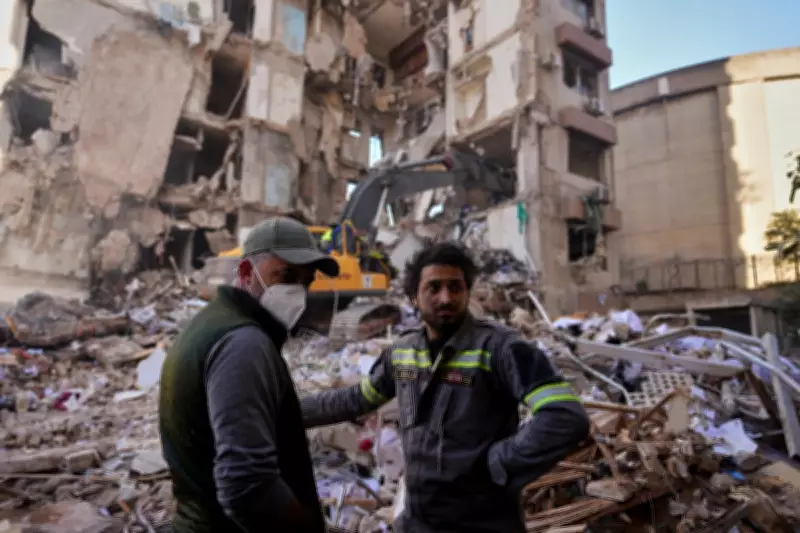
Nahida Khalil, residing near the corniche, witnessed a strike near her home, followed by smoke emanating from the direction of her brother's building further up the street. The ensuing fifteen minutes felt like an eternity as she attempted to call her brother without success. Finally, his wife responded, screaming that their building had been hit. They had navigated through black smoke filling their apartment to locate their three children. Upon reaching the street, they discovered half of their building leveled, with the remaining half slowly tumbling down as rescuers searched for missing individuals.
"I lived through all the wars since 1975. I never felt this fear," stated Khalil, a decades-long resident of the same building. "These strikes are meant to terrorize ... and to spoil the ceasefire and cause division between Lebanese."
By nightfall, people continued assessing losses and damages while attempting to identify safe locations. Some families spent the night sleeping in separate rooms, reasoning that if overnight strikes occurred, some might survive. Rescue efforts persisted throughout the night.
At Khalil's family building in the Ain Mreisseh neighborhood, rescue workers' hopes were momentarily lifted after finding a 92-year-old man alive. However, by daylight on Thursday, they were still searching for four or five additional bodies, as reported to the AP. A man whose 23-year-old daughter was among the missing stood on a mound of rubble, assisting in the search.
Hospitals Overwhelmed and Final Strikes
Hospitals struggled to identify dozens of bodies, while the last strike occurred shortly after midnight, targeting Beirut's southern suburbs, which have been regularly hit during the war. Mohammed Mehdi's barbershop, operational for thirty years, was destroyed. During the current conflict, Mehdi and his family fled their home in the Chiyah neighborhood, now sleeping in a dentist clinic near Khalil's family building. Nevertheless, he had made a point of keeping his barbershop open daily to meet friends, have coffee, and provide occasional haircuts, until shutting down on Wednesday as bombs began falling across the city.
"They carried out 100 strikes. Ours was the 101st," Mehdi remarked on Thursday, mourning Lebanon's dead from the day. "I am still in shock, and I don't know where things are going. I lost my job and this loss may last for a while."
AP correspondent Kareem Chehayeb in Beirut contributed to this report.