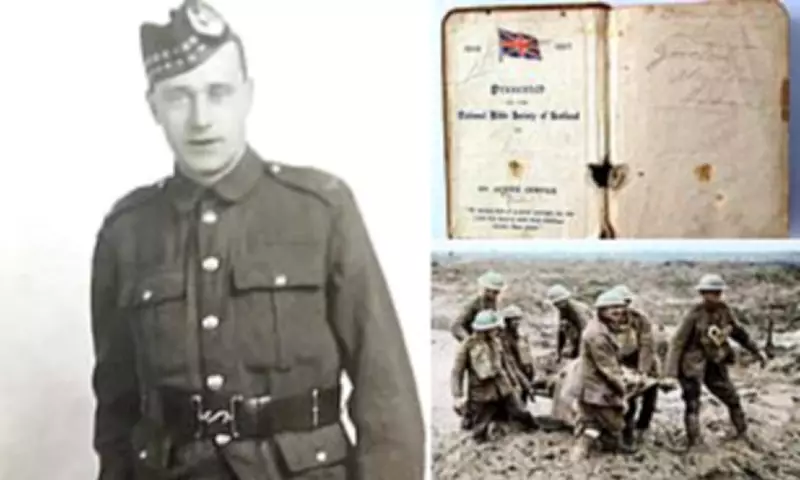
When Scottish soldier Duncan MacFarlane received a Bible during his military service, he likely had no idea of the profound role it would play in his survival. This holy book, kept securely in his breast pocket, performed a miraculous feat by shielding him from almost certain death when he was shot during one of the First World War's most brutal conflicts.
The Battle That Changed His Life
Private MacFarlane sustained serious wounds while serving in the trenches during the Third Battle of Ypres, commonly known as Passchendaele, on October 18, 1917. He was reported missing in action for six long months before his devoted wife, Agnes, managed to locate him in a military hospital in Edinburgh. Remarkably, the wounded postman still possessed the Bible that had absorbed the full impact of the bullet, sparing him from fatal injury.
A Century of Preservation
For more than one hundred years, his family has carefully safeguarded this historical artifact. Now, his granddaughter, Jo Abbott, aged 75, believes it is time for the Bible and other mementos from his military career to be "taken out of the drawer" so that his extraordinary story can be shared with a wider audience.

"The bullet lodged in the spine of his service Bible which was in his breast pocket," Ms Abbott explained. "Inside the Bible, it actually has his name, the Gordon Highlanders, and his service number – so that provenance is proved."
Exhibition and Legacy
These remarkable objects are scheduled to go on display at the Dunscore Heritage Centre in Dumfriess-shire, where they will be available for public viewing every Sunday afternoon throughout the season. Private MacFarlane, born in 1890, enlisted in 1915 and initially served with the 5th Argyll before transferring to the 4th Battalion, Gordon Highlanders.
The Horrors of Passchendaele
In October 1917, while engaged in shoring up trenches and repairing barbed wire on the Western Front, he was shot multiple times. The Battle of Passchendaele was infamous for its devastating casualties on both sides, lasting over 100 days and resulting in the Allies advancing merely five miles at the cost of more than 250,000 soldiers killed, wounded, or missing. Private MacFarlane was among those counted in this grim tally.
Ms Abbott recounted, "My grandmother only recognised him by his eyes. When she went to the hospital, he had bandages all around his head and face and all around his chest."
Life After the War
He was honourably discharged on February 28, 1919. Like many veterans of that era, he carried not only physical scars but deep psychological wounds for the remainder of his life. Ms Abbott noted, "He had all these terrible, terrible nightmares where he was shouting and screaming and crying. Nowadays, it would be diagnosed as PTSD, but in those days, these poor guys came home and that was it."
Private MacFarlane passed away in 1962 at the age of 72. To honour his memory, members of the Gordon Highlanders Regimental Association will join his family for a special ceremony at Dunscore Church on Sunday. At the conclusion of the exhibition season, the collection will be donated to the Gordon Highlanders Museum in Aberdeen, ensuring his legacy endures for future generations.