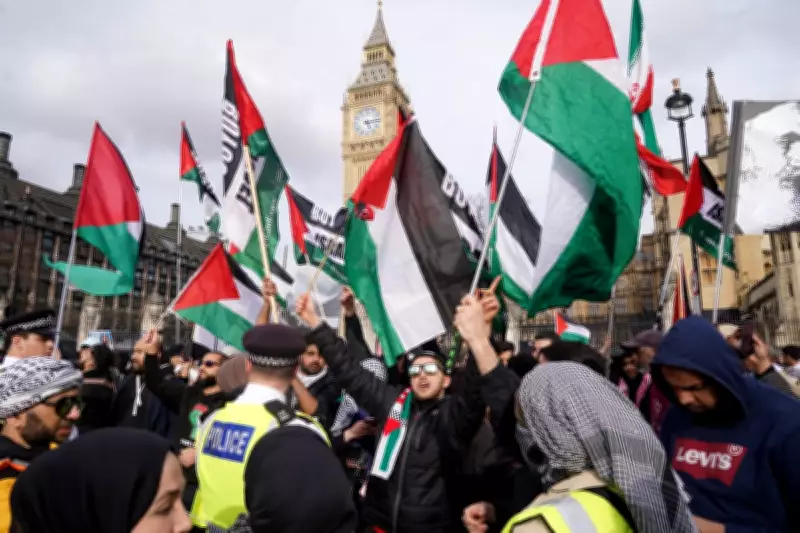
Metropolitan Police to Deploy Thames as Physical Barrier for Al Quds Day Demonstrations
In an unprecedented move, the Metropolitan Police will utilise the River Thames as a strategic barrier to keep Al Quds Day protesters and counter protesters apart this Sunday. This 'new, bespoke tactic' involves stationing marine units in the water to prevent clashes between rival groups, as authorities warn they cannot entirely eliminate the risk of disorder despite imposing a ban on marching.
Strict Conditions and Massive Police Presence
More than 1,000 officers, including reinforcements from other forces, will be deployed across central London to manage the static demonstrations, which are strictly confined to a two-hour window from 1pm to 3pm. Al Quds demonstrators will be limited to the south side of the Thames at Albert Embankment, while at least four planned counter protests will be restricted to designated zones on the north side near Millbank.
Deputy Assistant Commissioner Ade Adelekan explained that this approach provides a 'clear divide' between protest areas. 'One significant benefit of these conditions is that the groups will use different transport links to access and leave the protests. Our assessment indicates this will substantially reduce the risk of serious disorder,' he stated.

March Ban and Historical Context
The police successfully applied to ban the annual Al Quds Day march, marking the first such prohibition since 2012, with Home Secretary Shabana Mahmood approving the request this week. Mr Adelekan defended this decision as necessary to prevent 'serious public disorder,' emphasising it was based on a comprehensive risk assessment considering the event's history, community tensions, and ongoing Middle East conflicts.
'Our assessment wasn't based on a single piece of intelligence,' he clarified. 'It incorporated the event itself, its historical context, the complete intelligence picture including gaps, community impact, and our extensive experience policing thousands of protests annually.'
Controversy and Organiser Response
The annual Al Quds Day march in London has traditionally been viewed as pro-Iranian, drawing criticism after organisers expressed support for the late Ayatollah Ali Khamenei, though organisers describe it as primarily a pro-Palestine event. The Metropolitan Police noted that previous marches have resulted in arrests for supporting terrorist organisations and antisemitic hate crimes.
However, the Islamic Human Rights Commission (IHRC), which organises the event, strongly condemned the ban, calling it 'politically charged' and insisting their demonstrations are always 'good natured and peaceful.' In a statement, they accused police of abandoning their principle of policing without fear or favour and confirmed a static protest would proceed on Sunday.
Community Reactions and Security Concerns
The Community Security Trust (CST), a charity protecting the Jewish community from antisemitism and terrorism, welcomed the march ban, describing it as occurring during a period of 'unprecedented volatility.' This follows last week's arrest of four people by counter-terrorism police on suspicion of assisting Iran's intelligence service, heightening security apprehensions.
Mr Adelekan warned that anyone violating the restrictions faces arrest, with officers adopting a zero-tolerance stance towards hate crimes or displays of support for proscribed organisations. Despite these measures, he acknowledged that police cannot completely eliminate the risk of clashes, estimating roughly 6,000 protesters and 6,000 counter protesters might attend, though he cautioned that predicting numbers is not an 'exact science.'